
1. What is a NOC?
NOC (Network Operation Center) is a network operations center where a team of engineers monitors, manages, and maintains an organization's IT infrastructure around the clock, 24/7/365. The NOC serves as the coordination hub for all network and system-related activities.
A Network Operation Center consolidates all monitoring tools, incident response procedures, and technical personnel to keep network infrastructure performing at its best at all times. When an incident occurs, whether it is a circuit fault, an overloaded server, or a connectivity loss, the NOC is the first to detect it and begin remediation, before the problem ever reaches end users.
The NOC concept dates back to the 1970s, when telecommunications providers needed a centralized point of control for managing distributed networks. Today, NOCs extend well beyond the telco sector and have become a critical component in the IT operations strategy of mid-size to large enterprises, particularly in industries such as finance, e-commerce, healthcare, and logistics where system availability requirements are exceptionally high.

2. How does a NOC operate?
A NOC operates on a continuous 24/7/365 model, meaning engineers are always on duty at the operations center to monitor the status of the entire network infrastructure. NOC engineers use monitoring dashboards that aggregate data from routers, switches, servers, circuits, and applications to catch any anomaly the moment it appears.
The incident response workflow in a NOC typically follows these steps:
- Alert intake: The monitoring system automatically generates an alert when a threshold is breached (CPU overload, bandwidth spike, packet loss).
- Priority classification: NOC engineers assess severity and categorize the incident by priority level (P1, P2, P3) to determine the order of response.
- Escalation: Complex issues or those beyond current-tier authority are escalated to a higher tier or a specialized engineering team.
- Resolution and recovery: The NOC applies remediation measures ranging from restarting services to coordinating on-site field teams.
- Post-incident reporting and analysis: Root causes, resolution times, and lessons learned are documented to improve future processes.
Common NOC tooling includes infrastructure monitoring systems, ITSM (IT Service Management) platforms for ticket management, network configuration tools, and dashboards that consolidate logs from multiple sources.
3. What are the tiers in a NOC?
NOCs are typically structured around a tiered model to allocate responsibilities and ensure efficient incident resolution:
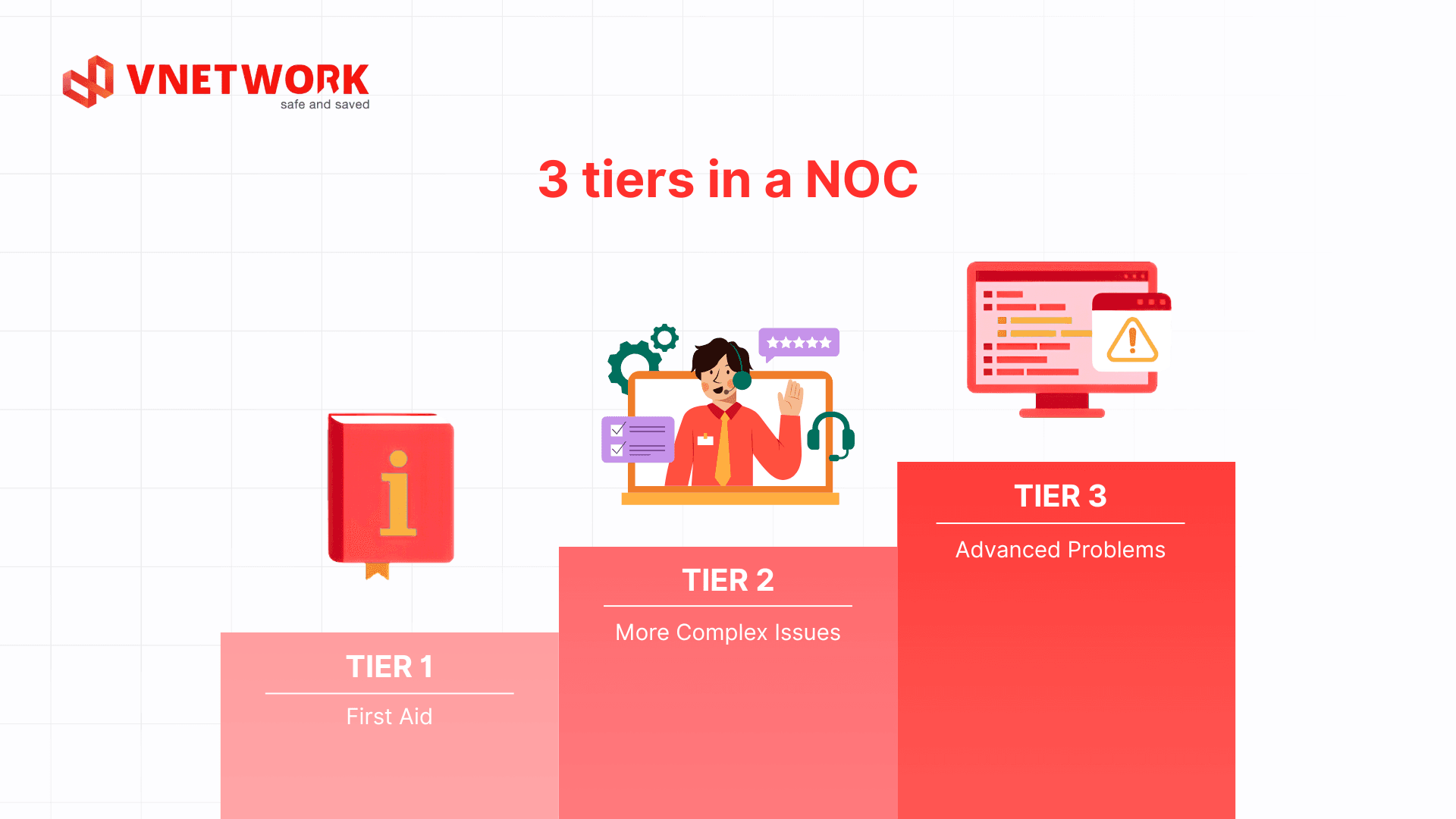
- Tier 1 is the front line for receiving alerts and executing basic remediation steps according to standard runbooks. Tier 1 engineers are responsible for filtering alerts, resolving straightforward issues, and escalating more complex incidents to higher tiers.
- Tier 2 handles incidents requiring deeper investigation, including root cause analysis, network device reconfiguration, and coordination with specialized engineering groups. Tier 2 engineers typically hold deep expertise in specific infrastructure domains.
- Tier 3 is the expert level, responsible for resolving the most severe incidents that require intervention at the core infrastructure layer or involve multiple systems simultaneously. Tier 3 also owns the development and ongoing maintenance of operational procedures for the entire NOC.
4. Core functions of a Network Operation Center
A NOC handles a wide range of operational functions, covering the full lifecycle of IT infrastructure management. Below are the four core function groups that an effective NOC must perform:
4.1. Continuous network infrastructure monitoring
The NOC continuously tracks operational metrics across the network infrastructure, including circuit bandwidth, latency, packet loss rate, and server resource utilization. When any metric exceeds an alert threshold, the system automatically creates an alert and NOC engineers immediately begin investigating. Continuous monitoring allows teams to catch early warning signs before they escalate into serious incidents that impact end users.
4.2. Incident detection and resolution
When an incident occurs, the NOC is responsible for coordinating the entire response workflow, from priority triage through resolution and recovery confirmation. The NOC's response speed directly determines the organization's MTTR (Mean Time to Restore). For businesses running e-commerce or online financial services, every minute of downtime translates into revenue loss and brand damage. The NOC keeps detection and resolution time to an absolute minimum.
4.3. System performance management
Beyond incident response, the NOC proactively manages system performance from a prevention standpoint. NOC teams regularly analyze historical data to identify traffic growth trends, forecast resource demand, and plan infrastructure expansion (capacity planning) before systems hit their limits. Periodic performance reports from the NOC give IT leadership and executive management the data-backed foundation they need to make better infrastructure investment decisions.
4.4. Backup and data recovery support
The NOC plays a monitoring and coordination role in backup and disaster recovery workflows. Engineers monitor automated backup jobs, verify backup integrity, and activate recovery plans when needed. This function is especially critical for businesses storing data on cloud computing or in hybrid environments, where data is distributed across multiple systems and geographic locations.
Summary of NOC functions by task group:
| Function group | Specific tasks | Outcomes delivered |
| Continuous monitoring | Tracking bandwidth, latency, and uptime 24/7 | Early anomaly detection, preventing incident escalation |
| Incident management | Receiving alerts, classifying, escalating, and resolving | Minimized downtime, faster recovery |
| Performance management | Trend analysis, periodic reporting, capacity planning | Optimized resources, bottlenecks prevented |
| Backup and recovery | Monitoring backup progress, coordinating disaster recovery | Data integrity preserved, fast recovery when incidents occur |
5. What benefits does a NOC bring to businesses?

Deploying a NOC provides clear operational advantages, particularly in environments where IT infrastructure is growing more complex and availability demands are high. Below are the core benefits a well-run NOC can deliver:
- Sustained uptime: The NOC monitors infrastructure without interruption, detecting and resolving issues before end users are affected. This is a survival factor for businesses in finance, healthcare, and e-commerce, where even an hour of disruption creates serious losses.
- Reduced incident recovery time: Rather than waiting for internal staff to notice a problem, the NOC detects and begins remediation immediately. MTTR (Mean Time to Restore) improves significantly thanks to a structured escalation process and a team standing by 24/7.
- Optimized IT operating costs: Early detection of minor issues prevents far more costly failures down the line. The NOC also supports capacity planning, helping businesses procure exactly the resources they need instead of over-investing or falling short.
- Enhanced decision-making: Periodic performance reports from the NOC give CTOs and IT managers structured data to base infrastructure investment and IT strategy decisions on operational reality rather than intuition.
- Reduced load on internal IT teams: When the NOC handles day-to-day monitoring and incident response, the internal IT team can focus on product development and digital transformation initiatives instead of constantly firefighting.
- SLA and regulatory compliance: Monitoring data and incident logs from the NOC serve as critical evidence for demonstrating SLA adherence to customers, as well as satisfying audit and compliance requirements in finance, healthcare, and government sectors.
6. A comparison of NOC and SOC
NOC (Network Operation Center) and SOC (Security Operation Center) are two distinct operations centers with different goals and scopes. While the NOC focuses on network infrastructure continuity and performance, the SOC specializes in handling cybersecurity threats. The two functions can and often do coexist and collaborate, but neither replaces the other.
| Criteria | NOC | SOC |
| Primary goal | Ensure continuous, stable network operation | Detect and respond to cybersecurity threats |
| Scope | Network performance, uptime, technical incidents | Cyberattacks, data breaches, malware |
| Primary tools | Monitoring system, ITSM, ticketing, alerting | SIEM, IDS/IPS, threat intelligence |
| Incidents handled | Network outages, server overloads, bandwidth exhaustion | DDoS attacks, phishing, unauthorized access |
| Key metrics | Uptime, latency, bandwidth, MTTR | MTTD, security MTTR, security incident count |
In practice, the NOC and SOC frequently need to collaborate on incidents. For example, when the NOC detects an unusual bandwidth spike, it may be a sign of a DDoS attack, and the NOC will need to work with the SOC to determine whether the situation is a technical fault or a security event, so the appropriate response can be launched.
Large enterprises typically operate both centers in parallel, while SMEs may prioritize one over the other based on risk exposure and budget, or opt for an integrated NOC/SOC model to optimize staffing costs.
7. Build your own NOC or outsource to a managed NOC provider?
Businesses have two main options when deploying a NOC: build an in-house NOC or engage a managed NOC service from a specialized external provider. Each model has its own trade-offs depending on the organization's size, budget, and desired level of control.
| Criteria | In-house NOC | Managed NOC (outsourced) |
| Initial investment | High (infrastructure, hiring, training) | Low (pay-per-service model) |
| Deployment timeline | Long (6 months to over a year) | Fast (a few weeks to one month) |
| Level of control | High, fully customizable to internal needs | Moderate, bound by provider SLA terms |
| Staffing requirements | Requires dedicated 24/7 engineering team | No dedicated NOC team needed |
| Scalability | Dependent on internal capacity | Flexible, scales quickly as needs grow |
| Best suited for | Large enterprises with complex IT infrastructure | SMEs and organizations with limited specialist IT staff |
Conclusion
A NOC is the essential network operations hub that helps businesses maintain uptime, shorten incident resolution time, and optimize IT infrastructure performance. Unlike a SOC, which focuses on security, the NOC ensures the network runs continuously and stably around the clock. Depending on scale and available resources, organizations can choose to build an in-house NOC or engage a professional Managed NOC provider.
FAQ - Frequently asked questions about NOC
1. How is a NOC different from a SOC?
A NOC (Network Operation Center) focuses on ensuring continuous, stable network infrastructure operation, handling technical incidents such as circuit outages, server overloads, and link failures. A SOC (Security Operation Center) specializes in detecting and responding to cybersecurity threats including DDoS attacks, malware, and unauthorized access. The two functions complement each other and can work together when incidents have both operational and security dimensions.
2. How many staff does a NOC need to operate?
NOC headcount depends on infrastructure scale and system complexity. A small NOC running 24/7 needs a minimum of 6 to 8 engineers to cover three shifts across four rotations. A mid-sized NOC typically requires 12 to 20 people, encompassing Tier 1, Tier 2, Tier 3 engineers, and NOC management. Beyond operations engineers, the NOC also needs staff responsible for process governance, reporting, and cross-departmental coordination.
3. Do SMEs need a NOC?
The need for a NOC at an SME depends on how heavily the business relies on IT infrastructure to operate. If the organization runs an e-commerce website, customer-facing applications, or business-critical internal systems, implementing at least a basic network monitoring model is worth considering. Rather than building a costly in-house NOC, SMEs typically opt for a Managed NOC or cloud computing services with built-in monitoring features to balance cost and effectiveness.
4. What does a NOC monitor in network infrastructure?
A NOC provides comprehensive coverage across the entire network infrastructure, including routers and switches (connection status, traffic, protocol errors), application and web servers (CPU, RAM, disk capacity, service state), WAN/Internet circuits (bandwidth, latency, packet loss rate), firewalls and network security devices (logs, configuration, operational status), and critical applications and APIs (response time, error rate, uptime).
5. What does it cost to build a self-operated NOC?
Building an in-house NOC involves several cost categories: physical infrastructure investment (NOC room, display monitors, cooling systems, backup power), monitoring and ITSM tooling, recruiting and training a technical team, and ongoing operational expenses. Total initial deployment costs can range from hundreds of millions to billions of Vietnamese dong depending on scale, not including recurring personnel costs. This is why many organizations choose Managed NOC to access professional monitoring capabilities at a more predictable and controlled cost.