
1. What is database security?
Database security is the set of measures, processes, and technologies applied to protect stored data from unauthorized access, leakage, modification, or destruction. More specifically, database security covers three primary protection scopes: data at rest, data in transit between systems, and access to that data. Database security is not simply about erecting a firewall; it also encompasses controlling who can read, write, and delete data, and how all of those activities are recorded.
Effective database security requires coordination across multiple layers: user authentication, data encryption, periodic vulnerability assessments, and real-time anomaly monitoring. Enterprises in highly regulated industries such as finance and healthcare must pay particular attention to this protection layer.
2. Distinguishing database security from general infrastructure security
Many enterprises mistakenly believe that deploying a network firewall is sufficient to protect their databases. In reality, database security and infrastructure security are two entirely different layers of protection that complement, rather than replace, each other.
Infrastructure security focuses on blocking attacks at the network and operating system layer, such as DDoS mitigation, port scanning prevention, and external intrusion detection. Database security, by contrast, operates at the application and data layer: it prevents attackers who have already accessed the system from exploiting malicious queries, escalating privileges, or extracting data.
The table below compares both security layers to clarify the distinction:
| Criterion | Database security | Infrastructure security (Network/OS) |
| Protection scope | Stored data, queries, data access permissions | Servers, networks, operating systems, network firewalls |
| Protection layer | Application and data layer (Layer 7) | Network and physical layer (Layer 3/4) |
| Attack types prevented | SQL Injection, privilege escalation, data leakage | DDoS, port scan, man-in-the-middle |
| Primary tools | DAM, encryption, access control, WAF/WAAP | Firewall, IDS/IPS, VPN, NAC |
3. Which standards must database security comply with?
Adhering to security standards is not only a legal obligation but also a reference framework for building systematic database security policies.
- ISO 27001: The international standard for information security management systems, requiring enterprises to establish access controls, encryption, and database monitoring through fully documented procedures.
- Cybersecurity Law and Decree 53/2022: Regulations governing data protection requirements for organizations operating in Vietnam, particularly in finance, telecommunications, and healthcare.
- Personal Data Protection Law (Law No. 91/2025): Directly regulates enterprises’ obligations to protect personal data, including requirements for encryption, access control, and data breach notification.
- OWASP Top 10: The list of the ten most common web application security vulnerabilities, of which SQL Injection and Broken Access Control are the two direct threats to databases.
- PCI-DSS: The payment card data security standard, mandatory for all organizations that store or process credit and debit card information. PCI-DSS requires card data encryption, strict access controls, and periodic vulnerability assessments across all payment databases.
- 5 Information Security Levels under Decree 85/2016/ND-CP: Classifies information systems into five tiers from lowest to highest. Databases in finance, healthcare, and government typically fall under Level 3 or above, requiring periodic security audits and mandatory incident response plans.

4. Common threats targeting databases
Enterprises need a clear understanding of common attack types in order to select appropriate protective solutions:
- SQL Injection: Attackers inject malicious SQL code into application input fields to manipulate the database, reading or deleting data without authorization.
- Brute force authentication attacks: Automated mass password attempts to hijack database administrator accounts.
- Ransomware data encryption: Malware that encrypts the entire database and demands a ransom, causing complete operational disruption.
- Data breach and insider leakage: Employees with legitimate access who intentionally or inadvertently expose data externally; one of the most difficult risk sources to detect.
- Zero-day vulnerability exploitation: Attacks exploiting unpatched security vulnerabilities in database management systems, particularly dangerous when enterprises do not update software regularly.
- Privilege escalation: Attackers use low-privilege accounts to elevate access rights to administrator level, bypassing all standard security controls.
- XSS targeting administration interfaces: Malicious scripts injected into the database management interface to hijack administrator login sessions.
- Layer 7 DDoS targeting applications: Application-layer DDoS attacks that exhaust the query-processing server resources, rendering the database unable to respond.
5. Why is database security critical for each industry?

Each industry has its own data structure and risk profile. Understanding these specifics helps enterprises allocate security resources where they matter most.
5.1. E-commerce
E-commerce platforms store large volumes of personal customer data, including names, addresses, phone numbers, and transaction histories. An attack on an e-commerce database can expose millions of customer records, resulting in violations of the Personal Data Protection Law and serious brand damage. Database security in e-commerce must focus especially on protecting payment data and enforcing access controls per transaction session.
5.2. Finance, banking, and securities
Financial databases contain account information, transaction histories, credit limits, and customer identification records; they are the highest-value target for cybercriminals. A successful attack not only causes direct financial losses but also violates standards such as PCI-DSS and Basel III, triggering severe legal consequences. For securities platforms, recovery time after an incident is extremely short because any disruption during trading hours directly affects investors.
5.3. Healthcare
Electronic medical records, test results, and health insurance information are among the most sensitive data types, protected by the strictest regulations. Healthcare data breaches not only violate individual privacy but can also influence treatment decisions and create risks of discrimination. Healthcare facilities are frequent ransomware targets because of the pressure to restore systems quickly in order to continue patient care.
5.4. Technology
Technology enterprises store source code, AI models, product user data, and intellectual property in internal databases. Attacks on technology databases typically aim to steal intellectual property or undermine market competitiveness. Managing internal employee access rights is a security challenge unique to this sector.
The table below summarizes the characteristic risks by industry:
| Industry | Typical sensitive data | Primary risks if attacked |
| E-commerce | Personal information, order histories, payment data | Loss of customer trust, fines for Personal Data Protection Law violations |
| Finance, banking, securities | Account numbers, transaction histories, loan records | Financial fraud, customer asset loss, Basel/PCI-DSS violations |
| Healthcare | Medical records, test results, health insurance data | Privacy violations, impact on treatment decisions and facility reputation |
| Technology | Source code, user data, intellectual property | IP theft, user data leakage, competitive damage |
6. What solutions are available for database security?
Effective database security requires the coordinated deployment of multiple protection layers; no single solution can address all risks. The following represents a condensed model of the Defense in Depth strategy.
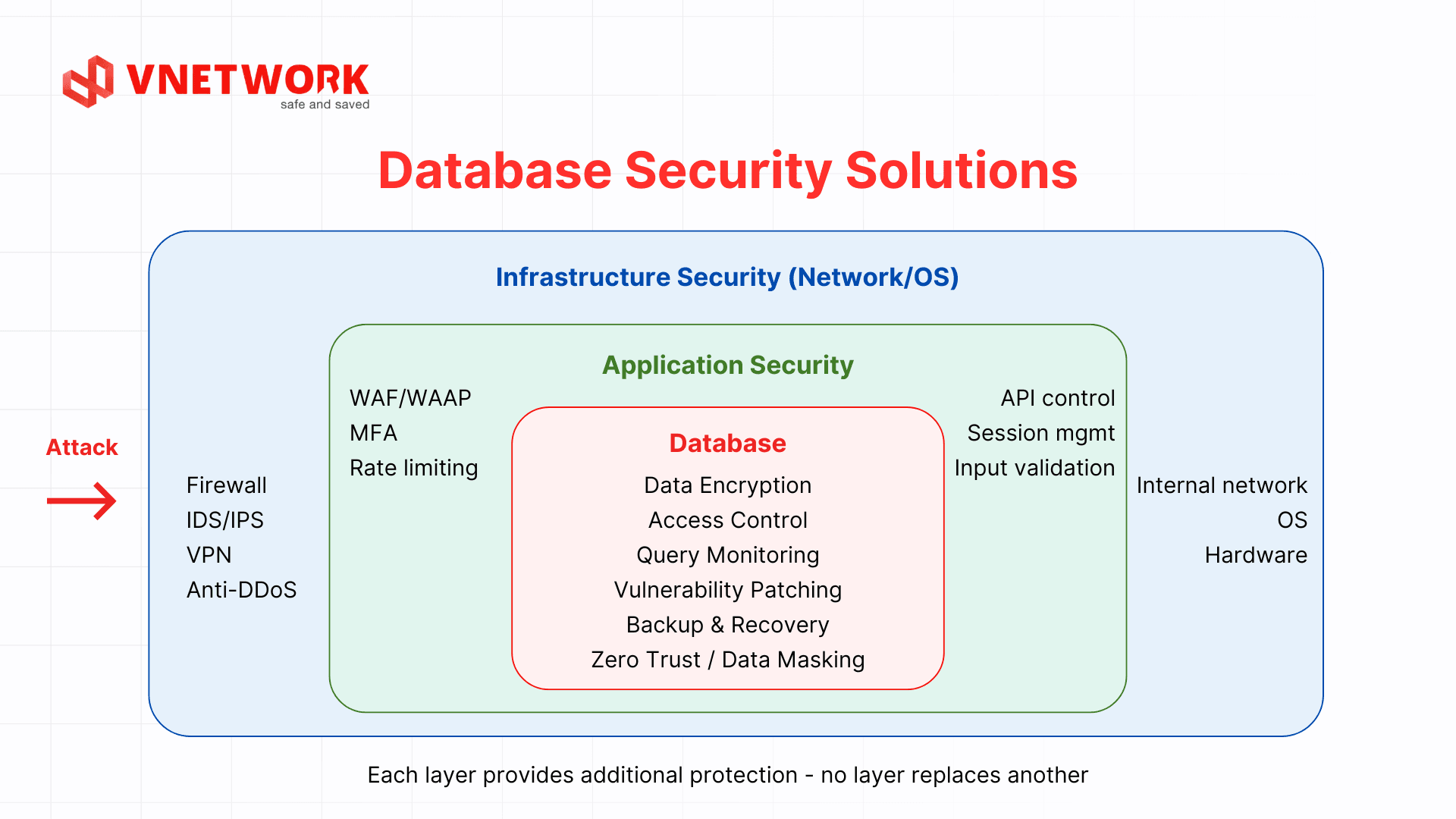
This model demonstrates a clear separation between technical barriers, enabling attack prevention at multiple stages, from the infrastructure layer to the application layer and the database layer.
6.1. Firewalls and WAF for application-layer protection
While a traditional firewall protects at the network layer, a WAF (Web Application Firewall) protects databases by inspecting and filtering HTTP/HTTPS requests reaching the web application. A WAF analyzes each request and blocks attack patterns such as SQL Injection, XSS, and vulnerabilities listed in the OWASP Top 10.
The next generation of WAF is WAAP (Web Application and API Protection), which adds API protection and malicious bot mitigation capabilities. WAAP applies AI to detect anomalous behavior in database queries that traditional static rules cannot identify.
The sections below provide an in-depth analysis of the core components of the database security tier.
6.2. Encryption of stored and in-transit data
Encryption at Rest ensures that even if an attacker gains access to the database’s physical files, the data remains unreadable without the decryption key. The AES-256 algorithm is the recommended standard for this type of encryption.
Encryption in Transit via TLS/SSL prevents data interception on the communication channel between the application and the database. This is a mandatory requirement for systems processing sensitive information under PCI-DSS and ISO 27001 standards.
6.3. Access control and strong authentication
The Principle of Least Privilege requires that each account be granted only the permissions strictly necessary for its function. Combined with multi-factor authentication (MFA) and role-based access control (RBAC), enterprises can prevent the majority of attacks that exploit compromised credentials.
All service accounts connecting to the database must be strictly controlled. Administrator (DBA) accounts should not be used for routine tasks and must be authenticated separately with comprehensive logging.
6.4. Database activity monitoring and audit logging
Database Activity Monitoring (DAM) records all queries, modifications, and access events in real time. A DAM system can detect anomalous behavior such as accounts accessing data outside business hours, bulk extraction queries, or unauthorized schema changes.
Log data from DAM is critical forensic evidence when a security incident occurs, and is also a mandatory requirement in ISO 27001 compliance audits and financial industry regulations.
6.5. Regular vulnerability patching and security updates
The majority of database exploitation attacks target publicly disclosed vulnerabilities that have not yet been patched. Enterprises need to establish a Patch Management process with a minimum monthly review schedule for database management systems and their dependent libraries.
6.6. Periodic data backup and recovery
A backup strategy following the 3-2-1 rule (3 copies, on 2 different media types, 1 copy offsite) enables enterprises to recover quickly after a ransomware attack or hardware failure. Equally important is regularly testing the recovery process to ensure that backup data can actually be restored when needed.
The table below summarizes database security solutions by implementation priority:
| Solution | Priority | Implementation complexity | Best suited for |
| WAF/WAAP application-layer protection | High | Medium | Web apps, public APIs |
| Encryption at rest and in transit | Very high | Medium | Fintech, healthcare, e-commerce |
| Access control (RBAC/MFA) | Very high | Low | All scales |
| Activity monitoring and logging (DAM) | High | Medium | Enterprise, banking |
| Vulnerability patching and updates | High | Low | All scales |
| Periodic backup and recovery | High | Low | All scales |
7. Latest database security technology trends in 2026
An increasingly complex threat landscape is driving the development of next-generation database security technologies. Staying ahead of these trends enables enterprises to proactively build a future-oriented security strategy.
7.1. AI-driven threat detection
AI-powered threat detection systems analyze database query behavior and establish a baseline for normal activity. When any deviation is detected, the system automatically alerts or blocks access without requiring manual intervention. This approach is particularly effective at detecting attacks from compromised internal accounts and zero-day exploits that static rules cannot address.
7.2. Zero Trust database access
The Zero Trust model applied to databases requires continuous authentication for every access session, including from previously trusted devices and accounts. The core principle is "Never Trust, Always Verify," minimizing damage when an administrator account is compromised.
7.3. Dynamic data masking
Rather than blocking access to sensitive databases entirely, dynamic data masking conceals specific data fields according to the user’s role in real time. For example, a customer service representative sees only the last four digits of an account number instead of the full number, while the transaction processing team still sees the complete information per their authorized access level.
7.4. Confidential computing
Confidential Computing technology protects data even while it is being processed in RAM, using an encrypted Trusted Execution Environment. This represents a significant advance in cloud database security, where data must be processed by third parties while maintaining absolute confidentiality.
8. How does VNIS support database security?
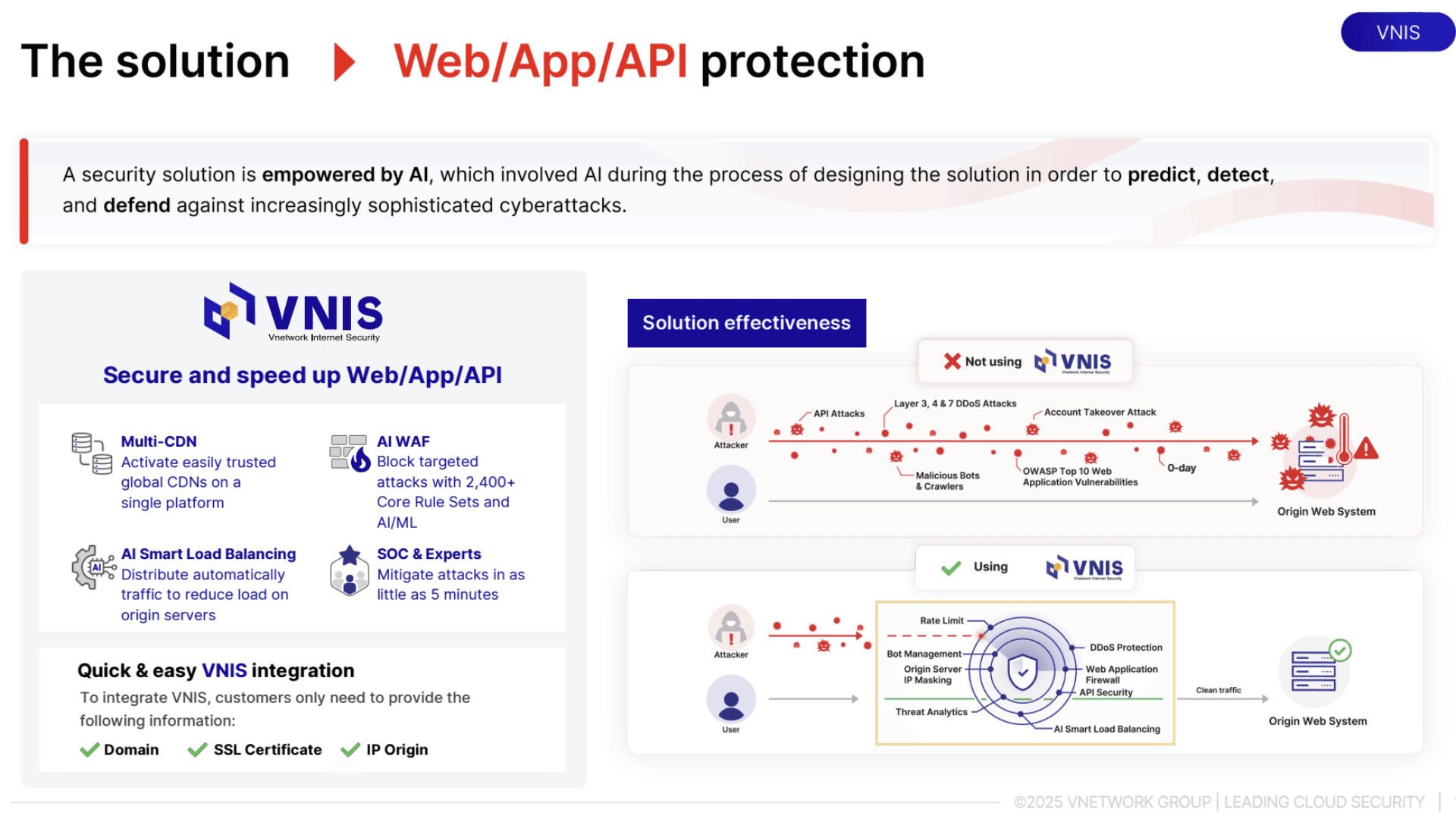
With extensive experience protecting thousands of websites, applications, and APIs globally, VNETWORK has developed VNIS (VNETWORK Internet Security), a Web/App/API security and acceleration platform.
VNIS operates on a two-layer protection model:
- Layer 1: Combines AI Smart Load Balancing and a global Multi-CDN infrastructure to handle network-layer DDoS attacks, blocking malicious traffic before it reaches the database server.
- Layer 2: Deploys AI-powered WAAP to analyze and block attack queries based on the OWASP Top 10 list, including SQL Injection, XSS, and zero-day vulnerability exploitation.
To see specifically how VNIS helped a securities company recover its systems overnight after a large-scale DDoS attack, refer to: Case study - FireAnt
9. Conclusion
Database security is no longer optional but a mandatory requirement for any enterprise handling sensitive data in e-commerce, finance, banking, securities, healthcare, and technology. An effective security strategy must integrate access control, data encryption, WAF/WAAP application-layer protection, continuous monitoring, and compliance with applicable legal standards.
FAQ - Database security
1. How does database security differ from standard network security?
Network security protects at the infrastructure layer (servers, network connections, network firewalls), while database security focuses on the application and data layer: controlling who can access which data, encrypting stored content, and blocking malicious queries such as SQL Injection. These two security layers complement each other and must be deployed simultaneously for comprehensive protection.
2. Do small businesses need database security?
Yes. Company size does not determine how attractive its data is to cybercriminals. Smaller businesses are often targeted more frequently because their security systems are weaker. In particular, the Personal Data Protection Law applies to all organizations processing personal data regardless of scale, meaning that failing to implement database security represents a legal risk that cannot be overlooked.
3. Can SQL Injection steal an entire database?
Yes, if the system is not properly protected. A successful SQL Injection attack can allow an attacker to read entire data tables, delete data, and even execute system commands on the database server. Deploying a WAF, using parameterized queries, and validating user input are the three core measures for preventing SQL Injection.
4. How often should database vulnerabilities be assessed and patched?
Monthly vulnerability assessments are recommended for database management systems. For financial and healthcare systems, comprehensive penetration testing should be conducted at least quarterly. Beyond fixed schedules, enterprises must monitor published CVEs (Common Vulnerabilities and Exposures) and apply patches immediately when updates become available for the database software in use.
5. Can VNIS protect databases in real time?
Yes. VNIS analyzes and blocks attack queries targeting databases in real time at the application layer, before malicious requests reach the database server. The WAAP system within VNIS applies AI to continuously update and expand detection capabilities, addressing new attack variants that static rules cannot identify. VNETWORK’s SOC team monitors and responds to incidents 24/7, ensuring rapid response times even during large-scale attacks.