
1. Why the Logistics industry is a prime target for email attacks
Global shipping brands such as DHL, FedEx, and USPS consistently rank among the most impersonated names in phishing emails. Cyberattacks targeting the logistics sector increased by 61% in 2025, placing it among the top three most targeted sectors globally (Everstream Analytics, 2025). Among these, ransomware accounts for 38% of all attacks on transportation companies. It is no coincidence that hackers favor Logistics so heavily. So why do logistics emails remain in the crosshairs of attackers?
1.1. Large cash flows and continuous financial transactions
Every day, a logistics company processes hundreds of payment invoices covering port fees, warehousing charges, customs duties, and international freight costs. The sums involved in these transactions can easily reach tens or hundreds of thousands of US dollars. A single successful bank account swap via email is all it takes for a hacker to pocket an enormous sum.
1.2. Complex and interdependent partner networks
A typical Logistics business communicates daily with shipping lines, airlines, customs brokers, warehouses, insurance providers, and customers from multiple countries. This vast partner network creates countless points of exploitation, as cybercriminals can impersonate any partner that employees are accustomed to communicating with.
1.3. Time pressure breeds a rush mentality
The logistics industry demands instant responses: vessel schedules, flight schedules, and customs clearance windows all have hard deadlines that cannot be delayed. This pressure forces employees to process emails quickly, leaving little time to verify the authenticity of senders or attachments. Cybercriminals understand this well and often send attack emails with fabricated urgent deadlines such as "confirmation required before vessel departure" or "urgent transfer needed to clear shipment." Under time pressure, employees frequently click on malicious links or follow hacker instructions without completing standard security verification steps.
1.4. Many small and medium-sized businesses have limited security budgets
90% of Logistics businesses in Vietnam are small and medium-sized enterprises, and these companies typically prioritize capital for terminals, transport vehicles, and personnel over investing in security systems. Hackers know this well and select SMEs as stepping stones for attacks, using them to send phishing emails targeting larger logistics corporations further up the supply chain.
2. Common email attack methods in the Logistics industry
2.1. Business Email Compromise (BEC)
Over the past year, BEC attacks targeting Logistics organizations have increased by 133.5%. Rather than exploiting technical vulnerabilities, this attack type relies purely on text. The attacker impersonates a colleague's or executive's email address (for example, substituting "m" with "rn"), then sends an email in a normal conversational tone requesting a change to payment account details or an urgent fund transfer.
2.2. Account takeover via email phishing
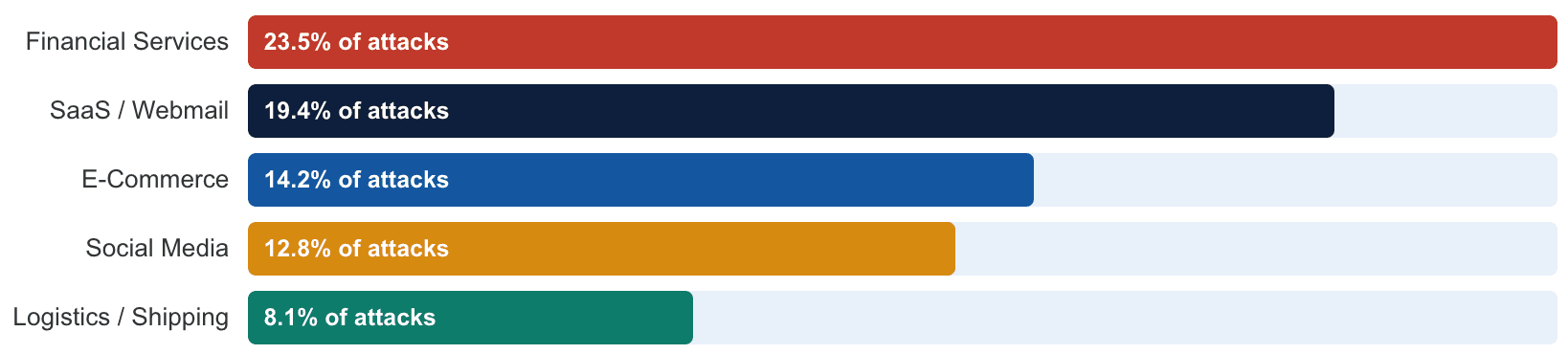
According to the APWG 2025 report, the Logistics sector accounts for 8.1% of all global phishing email attacks, ranking fifth among the most targeted industries.
Phishing emails typically appear as fake system notifications requesting login confirmation for shipment management accounts. When an employee clicks the link in the email and enters their credentials, the attacker gains control of the account and can alter delivery information, impersonate legitimate shipping companies, or redirect shipments to locations under their control.
2.3. Email thread hijacking and man-in-the-middle (MitM) attacks
This is a sophisticated attack method in which the attacker infiltrates an ongoing email thread between a Logistics business and a partner, complete with full conversation history. They intercept the mail flow, hide the legitimate emails, and insert a fraudulent bank account number directly into the existing email thread to trick accounting staff into transferring freight payments to their account without raising any suspicion.
2.4. Ransomware distribution via email attachments
The Logistics industry regularly exchanges attachments such as commercial invoices, bills of lading, certificates of origin, and inspection reports. Cybercriminals exploit this habit to embed Ransomware or Malware into attachments disguised as common Logistics documents. When an employee opens a malicious file, all data on the computer and internal servers is encrypted, bringing the business's operations to a complete standstill.
3. Why traditional security measures are no longer effective
Many Logistics businesses feel confident because their systems already have a Firewall or a built-in spam filter from Microsoft or Google. However, these traditional security measures are completely powerless against the wave of AI-driven cyberattacks.
- The rise of Generative AI: 82.6% of phishing emails today contain some AI-generated content, and users are 4.5 times more likely to click on AI-written phishing emails than conventionally written ones. Attackers now use AI to craft phishing emails that are fluent, grammatically correct, and full of industry-appropriate logistics terminology, without containing any traditional spam keywords.
- Polymorphic malware: AI enables hackers to automatically alter the structure of malware every few seconds. Traditional signature-based filters are completely bypassed because the attachment always appears as a clean file, one that has never appeared on any blacklist.
- Attack speed measured in minutes: The time from a successful breach to full system compromise has been reduced from several days to an average of just 29 minutes, thanks to AI-driven automation. Manual inspection or reactive patching by enterprise IT teams can never keep pace with this speed.
4. Consequences when a Logistics business suffers an email attack
4.1. Financial losses
A Logistics business suffers severe financial damage when it falls victim to a fraudulent email, transferring funds to a hacker's account in a transaction that is nearly impossible to recover once completed. Attackers who alter or encrypt critical shipping documents (bills of lading, packing lists) can cause cargo to be held up at customs, forcing the business to absorb rapidly escalating detention and demurrage (DEM/DET) charges for each day of delay. On top of that, the business must spend a significant budget to hire specialists to restore systems and data.
4.2. Supply chain operational disruption
Hackers who attack email systems and alter recipient details, shipment timelines, or delivery routes can cause misdirected or lost high-value cargo. This information blockage creates a negative domino effect: delivery schedules are delayed, supply chain partners are left scrambling, and most critically, it causes significant disruption to customers' own production and business operations.
4.3. Loss of reputation with customers and international partners
Reputation and security are critical factors for Logistics businesses in retaining global customers. When an email system is compromised, partner trust collapses immediately, leading to the risk of mass contract cancellations. Worse still, if the business account is hijacked to distribute spam or malware to partner systems, the company's domain will be added to a blacklist, causing all future transactional emails to land directly in partners' spam folders.
4.4. Legal risks related to data protection compliance
Emails in the Logistics industry contain large volumes of sensitive information belonging to partners and customers. When this data is leaked, the business faces serious legal risks for violating applicable regulations, including Law No. 91/2025/QH15 in Vietnam and the international GDPR standard in Europe.
5. Benefits of deploying email security for Logistics businesses
- Complete focus on business operations: Instead of having employees spend time inspecting, filtering, and deleting spam or junk mail every day, an automated security system handles this comprehensively at the gateway. This allows your team to dedicate their full time and energy to processing orders, coordinating shipments, and serving customers to optimize revenue.
- Time savings: The security system optimizes mail flow, ensuring critical documents are sent and received instantly and delivered directly to partners' primary inboxes without falling into spam folders and causing work delays.
- Protecting trust with partners and customers: Thoroughly preventing hackers from hijacking or impersonating business emails to send false information or distribute malware. Ensuring that all outgoing emails are consistently clean, secure, and credible so they do not negatively impact customers' business operations.
- Comprehensive support: All monitoring activities, detection of anomalous behavior, and identification of cyberattack indicators are carried out by a team of professional security experts, ensuring the system operates stably without draining internal personnel.
- Email traffic control: Email traffic is monitored and distributed appropriately, preventing any single account from consuming excessive storage capacity and maintaining overall system stability.
6. EG-Platform: VNETWORK's specialized email security solution for the Logistics industry
With over 13 years of experience in the cybersecurity field, VNETWORK has protected the digital infrastructure of more than 2,000 businesses in Vietnam and the region, including major names in the logistics sector such as Nhat Tin Logistics and Asean Lines. This track record has given VNETWORK a deep understanding of the specific risks that logistics business email must face on a daily basis.
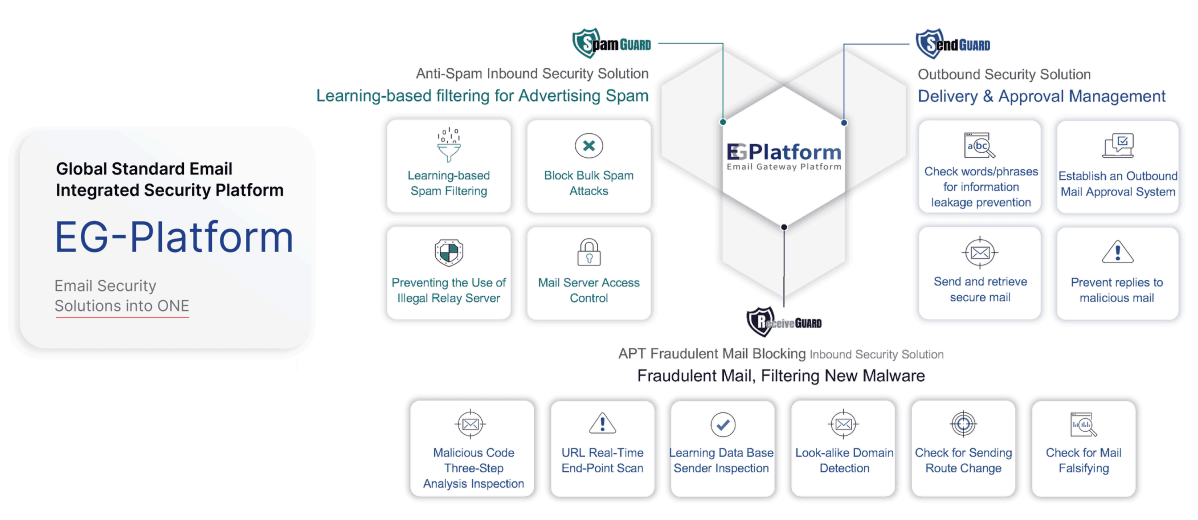
From the moment an email is sent to the moment it is received, every stage of the transmission process can be targeted. EG-Platform from VNETWORK is a comprehensive email security solution for both inbound and outbound mail, fully satisfying 100% of the email security standards recognized by the ITU (International Telecommunication Union). It protects businesses from targeted email attacks by integrating AI and Machine Learning models along with per-user email behavior analysis, enabling accurate detection of potential threats and providing detailed diagnostic reports.
6.1. Key features of EG-Platform
- All-in-one: Complete and absolute protection for both outbound and inbound email flows. Logistics businesses can operate smoothly in a multi-channel, multi-partner environment without the cost of integrating multiple separate solutions.
- Attack prevention and data loss prevention: Proactively blocks and responds comprehensively to all forms of malicious email attacks, providing absolute protection for sensitive internal data such as competitive freight rates, vessel schedules, and customer information, preventing resource and reputational loss for transport businesses.
- Advanced technology: AI and Machine Learning technology enhances the ability to identify and block sophisticated attacks. The system monitors the communication behavior of shipping lines and international agents to immediately detect lookalike domain spoofing emails, protecting the business's financial transaction flows.
- Intelligent virtual sandbox: Automatically isolates and analyzes email attachments in a virtual environment. This feature identifies and neutralizes viruses and ransomware before they can enter the system, proactively protecting employees who open data files from unknown partners without risking a shutdown of the entire operation chain.
6.2. The EG-Platform model with 3 email filters
EG-Platform from VNETWORK provides comprehensive protection for the business email system through 3 layers:
- SpamGUARD: Using Machine Learning and Bayesian technology, SpamGUARD filters and blocks up to 99.9% of junk email, protecting the business from threats such as phishing, viruses, and ransomware.
- ReceiveGUARD: All incoming emails pass through a Virtual Area to have attachments and URLs inspected before reaching the user's inbox. Sender addresses and domains are automatically verified, detecting and blocking all types of email attacks before they reach employees.
- SendGUARD: Protects outbound email, ensuring information security and preventing internal data leaks. Integration of DMARC and SPF authentication standards ensures the business's domain is recognized as a trusted sending source. The system inspects email content to detect malware and supports secure sending and email recall.
6.3. Case study: VNETWORK protects the entire email system of Nhat Tin Logistics
Nhat Tin Logistics is an express delivery company with a network of over 350 post offices, serving 36,000 partners with 24/7 operations. However, its rapid growth had led the business to face challenges from its legacy email system: invoices and order confirmation emails were continuously landing in customers' spam folders due to insufficient domain authentication. More than 2,500 employees were constantly targeted by phishing emails and ransomware. A single mistaken click could freeze the entire system.
Nhat Tin Logistics chose to partner with VNETWORK to deploy the comprehensive EG-Platform email security solution. VNETWORK's experts identified and thoroughly cleaned all existing malware from Nhat Tin's legacy systems, then migrated the entire dataset to a new email infrastructure with a completely rebuilt security architecture. The entire transition was completed in just 2 weeks, with absolutely no disruption to the company's 24/7 business operations.
Thanks to VNETWORK's timely intervention, Nhat Tin Logistics achieved:
- 80% reduction in time spent handling junk mail across all staff.
- 100% email flow continuity, with invoices delivered directly to the Inbox, shortening work processing cycles with partners.
- Zero serious security incidents recorded since deployment, even as the postal office network continues to expand.
7. Conclusion
In the digital era, email is no longer simply a communication tool; it is the key that operates the entire Logistics supply chain. To ensure commerce flows smoothly and securely, proactively upgrading your email security system is a strategic move that cannot be delayed.
Let VNETWORK partner with your Logistics business in integrating an email security solution. Contact the VNETWORK team for a free consultation and to experience the right EG-Platform for your needs. Hotline: (028) 7306 8789 or email: contact@vnetwork.vn.
FAQ: Frequently asked questions about EG-Platform
1. Can I receive periodic reports on blocked emails?
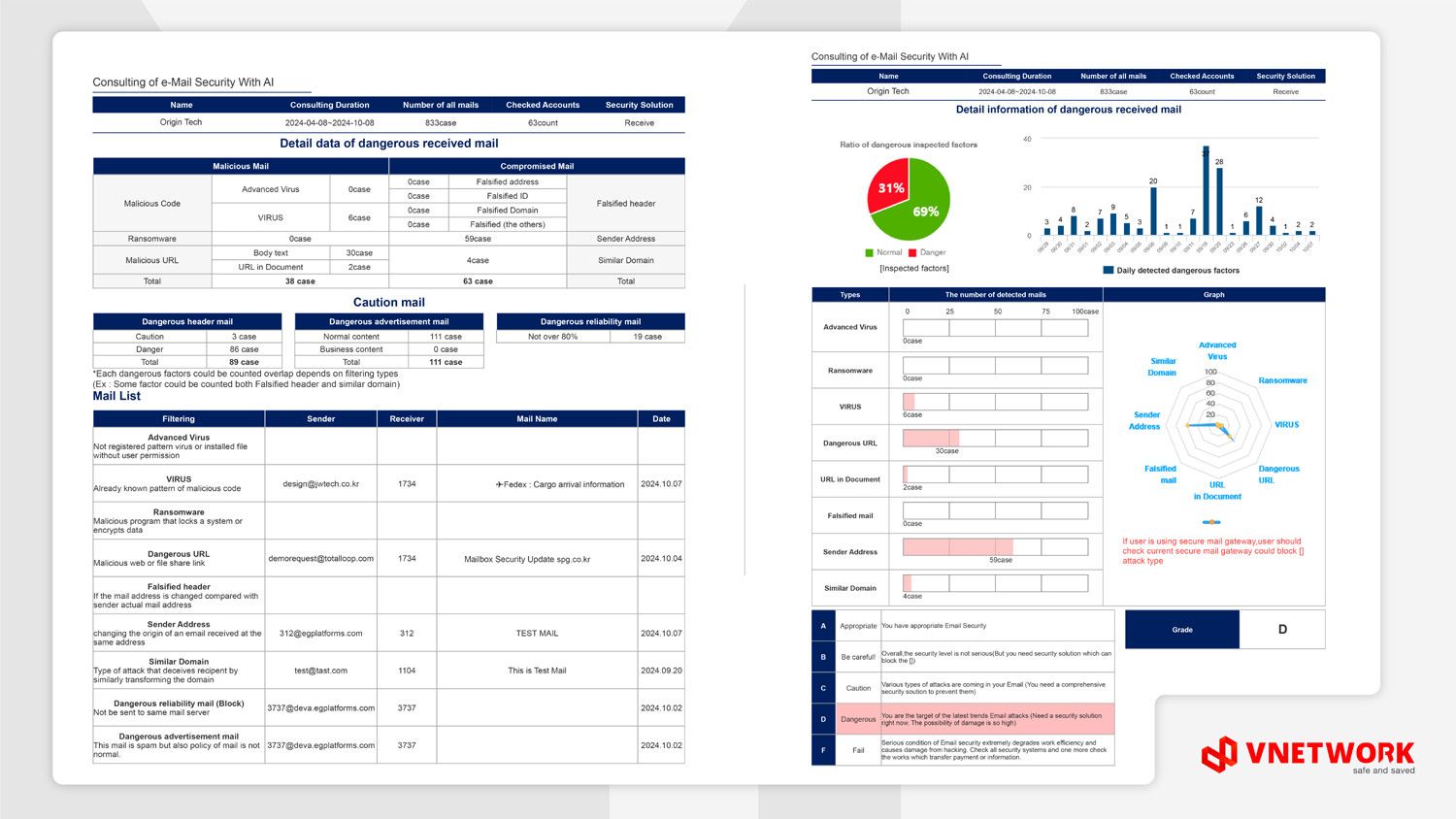
VNETWORK provides reports through the ReceiveGUARD admin account. These reports include statistics on the reasons emails were blocked, the frequency of blocking, and other relevant information for more effective email management.
2. There is information that ReceiveGUARD directly opens malicious files on the device. Does this risk infecting the device itself?
The Virtual Area (VA) within ReceiveGUARD directly inspects malicious files, and its configuration environment is completely different from a regular computer. Therefore, opening malicious files within the VA does not pose any risk of infecting the device with a virus.
3. What is the difference between SpamGUARD and ReceiveGUARD, and why are both necessary?
Both SpamGUARD and ReceiveGUARD function as inbound email security devices. SpamGUARD is designed to block advertising emails, while ReceiveGUARD is specifically used to block phishing emails and cyberattack emails. Although many email systems rely solely on SpamGUARD, integrating ReceiveGUARD creates a two-step filtering process. This involves blocking advertising emails first, followed by blocking phishing and cyberattack emails, ultimately ensuring that only safe emails are received.
4. What filtering and inspection features does ReceiveGUARD have that other products lack?
ReceiveGUARD detects lookalike domain names that are difficult to distinguish with the naked eye and issues warnings to both administrators and users. Furthermore, it retains recipient information when receiving mail from the same account, and if there is any change in the sender, it alerts both administrators and users.
5. Malicious viruses such as ransomware are becoming increasingly common. Can these be prevented?
ReceiveGUARD directly inspects executable files and email attachments through the Virtual Area to assess their safety. This approach ensures high accuracy when examining email attachments. Moreover, the device can detect malicious viruses such as ransomware using regularly updated antivirus tools.