1. The role of email security in manufacturing
Email security is the set of techniques and technologies designed to protect email accounts, communications, and attachments from unauthorized access, impersonation, or data theft. Its scope covers sender authentication, malicious content filtering, data encryption, and outbound behavior control. Because email was not originally designed with built-in security or authentication mechanisms, businesses must proactively add layers of protection to keep this communication channel safe.
For manufacturing businesses, email is the primary communication channel linking the factory floor, suppliers, distribution partners, and international customers. Exchanges typically involve sensitive content such as technical drawings, production specifications, contracts, and payment data. Manufacturing supply chains involve multiple parties and tiers of sub-suppliers, creating a broad attack surface for phishing emails and domain spoofing. A single gap in email security can cascade across the entire operational chain.
2. Why manufacturing is a top target for email attacks
According to an Arctic Wolf report based on Q1 2023 investigation data, manufacturing is the sector most frequently targeted by Business Email Compromise attacks. The core reasons lie in how the industry operates:
- Complex, unsynchronized supply chains: Manufacturing companies manage sprawling networks of suppliers, logistics partners, and global distributors. Uneven security maturity across supply chain participants creates multiple weak points that attackers exploit by impersonating smaller entities to infiltrate systems or commit financial fraud.
- High-value intellectual property: Manufacturers hold invaluable assets such as engineering blueprints, proprietary product formulas, and operational processes. These make them prime targets for industrial espionage groups and cybercriminal organizations seeking to steal strategic data.
- Time pressure and downtime risk: In manufacturing, unplanned machine downtime inflicts massive financial losses. Attackers exploit this psychology by crafting urgent fake emails that pressure employees to act quickly without going through standard verification steps.
- Recurring high-volume financial transactions: Manufacturers maintain frequent, large-scale payment flows with suppliers. Attackers insert fraudulent emails requesting bank account changes or order confirmations, making them indistinguishable from routine business activity.
- Convergence of IT and OT systems: Connecting operational technology (OT) systems on the factory floor to corporate IT networks has expanded the attack surface. A successful phishing attempt does not stop at financial theft — it can serve as a gateway into industrial control systems, causing serious physical consequences.
3. Common email threats targeting manufacturing companies
3.1 Business Email Compromise (BEC) and financial fraud
Business Email Compromise, or BEC, is an attack in which criminals impersonate company executives, accounting staff, or partners to trick victims into transferring funds or disclosing financial information. In manufacturing, BEC typically appears as emails requesting payment of fake invoices, changes to supplier bank account details, or urgent order confirmations. These requests almost always carry a sense of urgency designed to push employees into acting before completing verification.
3.2 Phishing and spear phishing targeting technical staff
Phishing is an email fraud technique aimed at stealing login credentials or sensitive data by impersonating a trusted source. Spear phishing is a targeted variant that focuses on engineers, production managers, or technical personnel who have access to design and operational systems. Fraudulent emails may contain links to fake login pages or requests for technical information under the guise of system checks.
3.3 Malware via attachments and ransomware risk on the factory floor
Email attachments remain one of the most common vectors for delivering malware into corporate environments. Attackers embed malicious code in files that look like ordinary PDFs or Word documents, activating the payload when the user opens them. In manufacturing environments, ransomware delivered via email can encrypt operational data and halt production lines, causing far greater damage than in industries that do not depend on continuous automated machinery.
3.4 Account takeover and email interception
Account takeover occurs when an attacker gains access to a real employee or partner email account, usually through credentials stolen in a prior phishing attack. Once in control, they can read the entire correspondence history, intervene in ongoing conversations, and send fraudulent payment requests from a legitimate email address. This form of attack is particularly dangerous because outgoing emails carry valid authentication headers, making anomalies very difficult for recipients to detect.
3.5 Email domain spoofing in the supply chain
Domain spoofing is a technique for faking the sender address so an email appears to originate from a legitimate organization. Attackers register domains that closely resemble a supplier's real domain — differing by just one or two characters — and then send payment requests under the guise of a familiar partner. In manufacturing supply chains involving many participants, carefully verifying the sender domain before processing any financial request is a critical safeguard.
4. Consequences when a manufacturing company suffers an email attack
A successful email attack can trigger a cascade of consequences across a manufacturing business, extending well beyond direct financial loss.
- Disruption to production lines when operational systems are encrypted by ransomware or technical staff lose access to work email.
- Loss of intellectual property when engineering drawings, product formulas, or technical specifications are stolen through a compromised email account.
- Reputational damage with overseas partners when a security incident exposes customer data or causes delivery delays.
- Incident recovery costs and downtime, including root-cause investigation, system restoration, and crisis communications with partners.
5. Technical email security solutions for manufacturing
5.1 Strong email authentication with SPF, DKIM, and DMARC
SPF, DKIM, and DMARC are three DNS records that verify an email genuinely originates from the domain it claims to represent. SPF declares which mail servers are authorized to send email on behalf of a domain. DKIM attaches a digital signature to email messages to confirm the content has not been tampered with in transit. DMARC specifies how to handle emails that fail SPF or DKIM checks, and sends monitoring reports to administrators. Manufacturing businesses should configure all three records to reduce domain spoofing risk across supply chain communications.
5.2 Email encryption and sensitive data protection
Email encryption converts message content into an unreadable form that can only be deciphered with a valid decryption key — like sealing a letter in an envelope before sending it. Ordinary email passes through multiple intermediate servers before reaching the recipient, and without encryption, the content can be read at any point along the route. For manufacturing companies that regularly send technical drawings, contracts, and product specifications by email, encryption ensures that only the intended recipient can access the content, even if the email is intercepted in transit.
5.3 Protection against malicious attachments and malware
Email security solutions must be able to scan attachments in a sandbox environment — opening and analyzing files in an isolated space before granting user access. This mechanism detects malicious code hidden in document or PDF files that signature-based filters often miss. For factories running networked machinery on an internal network, blocking malware at the email gateway before it reaches operational systems is a critical layer of defense against production disruption.
5.4 Multi-factor authentication and single sign-on
Multi-Factor Authentication (MFA) requires users to verify their identity through multiple steps rather than a password alone, blocking account takeover even when credentials have been stolen. Single Sign-On (SSO) lets companies centrally manage email access through a single authentication system, reducing the number of attack points adversaries can exploit. Combining MFA and SSO gives manufacturing companies tight control over who can access corporate email, especially personnel with access to sensitive design and operational data.
5.5 Advanced spam and phishing filtering and data loss prevention
Advanced spam and phishing filters use behavioral analysis, sender IP reputation checks, and known attack pattern matching to block malicious emails before they reach user inboxes. Data Loss Prevention (DLP) solutions monitor outbound email content to detect and prevent the leakage of sensitive information such as engineering drawings or customer data. For manufacturing companies, DLP serves as a final control layer to ensure internal data is not accidentally sent or stolen via email.
6. Benefits of deploying a comprehensive email security solution
Email has evolved from a simple communication tool into the backbone of manufacturing supply chain operations. Yet this dependency has simultaneously made it a prime attack target that directly threatens business continuity and industrial confidentiality. The following are the core benefits manufacturing companies gain by deploying a comprehensive email security system.
6.1 Minimizing the risk of production disruption
Ransomware attacks delivered via email typically aim to encrypt machinery data or take over network infrastructure, forcing production lines to halt entirely. By scanning attachments and blocking malicious links at the entry point, email security systems stop malware from reaching industrial control devices (OT). This keeps production running continuously and eliminates the enormous costs that arise from unplanned downtime.
6.2 Protecting industrial secrets and competitive advantage
Product data such as CAD drawings, proprietary formulas, and supply plans are invaluable assets that are also among the most easily stolen via email. Security solutions with Data Loss Prevention (DLP) functionality automatically detect and block the transmission of sensitive information to unrecognized addresses. This enables companies to safeguard their core business secrets and maintain their market leadership position against competitors and industrial espionage actors.
6.3 Long-term cost savings
The cost of recovering systems after a ransomware attack or managing a crisis when customer data is breached is far greater than the cost of ongoing security investment. By proactively identifying and blocking BEC fraud or phishing attempts early, companies avoid direct financial losses from misdirected payments to attackers. Investment in email security therefore functions as effective insurance, optimizing financial resources and sustaining long-term business stability.
6.4 Compliance with the Personal Data Protection Law
Under Personal Data Protection Law No. 91/2025/QH15 (effective 01/01/2026), manufacturing companies that process personal data via email — including employee, partner, customer, and supplier information — must implement appropriate protective measures, report violations within 72 hours, and bear liability for resulting damages. Administrative fines can reach VND 3 billion for general violations, with higher penalties for unlawful data transfers or data trading. Deploying a comprehensive email security solution with DLP, encryption, and logging makes regulatory compliance straightforward, reduces the risk of heavy fines, and enhances credibility with international partners who demand high data protection standards.
7. EG-Platform: the optimal email security solution for Vietnamese manufacturing
Founded in 2013, VNETWORK is proud to be Vietnam's leading cybersecurity and digital infrastructure provider, with more than 13 years of hands-on experience. Holding the international ISO/IEC 27001 certification, VNETWORK is a trusted strategic partner for major corporations, financial institutions, and large-scale fintech companies across the domestic market.
VNETWORK's reputation has been validated through security and infrastructure optimization across many industries — including industry-leading partners in manufacturing, construction, and logistics such as LG, Hyundai, Newtecons, Gilimex, and Nhat Tin Logistics. With a deep understanding of the operational mindset and unique security pressures facing manufacturers, VNETWORK delivers EG-Platform to help manufacturing companies optimize their defense posture, ensure production line continuity, and give absolute protection to high-value intellectual assets.
For manufacturing companies seeking a certified email protection solution, VNETWORK's EG-Platform is an email gateway platform powered by AI and Machine Learning that provides comprehensive two-way email protection against sophisticated fraud targeting supply chains.
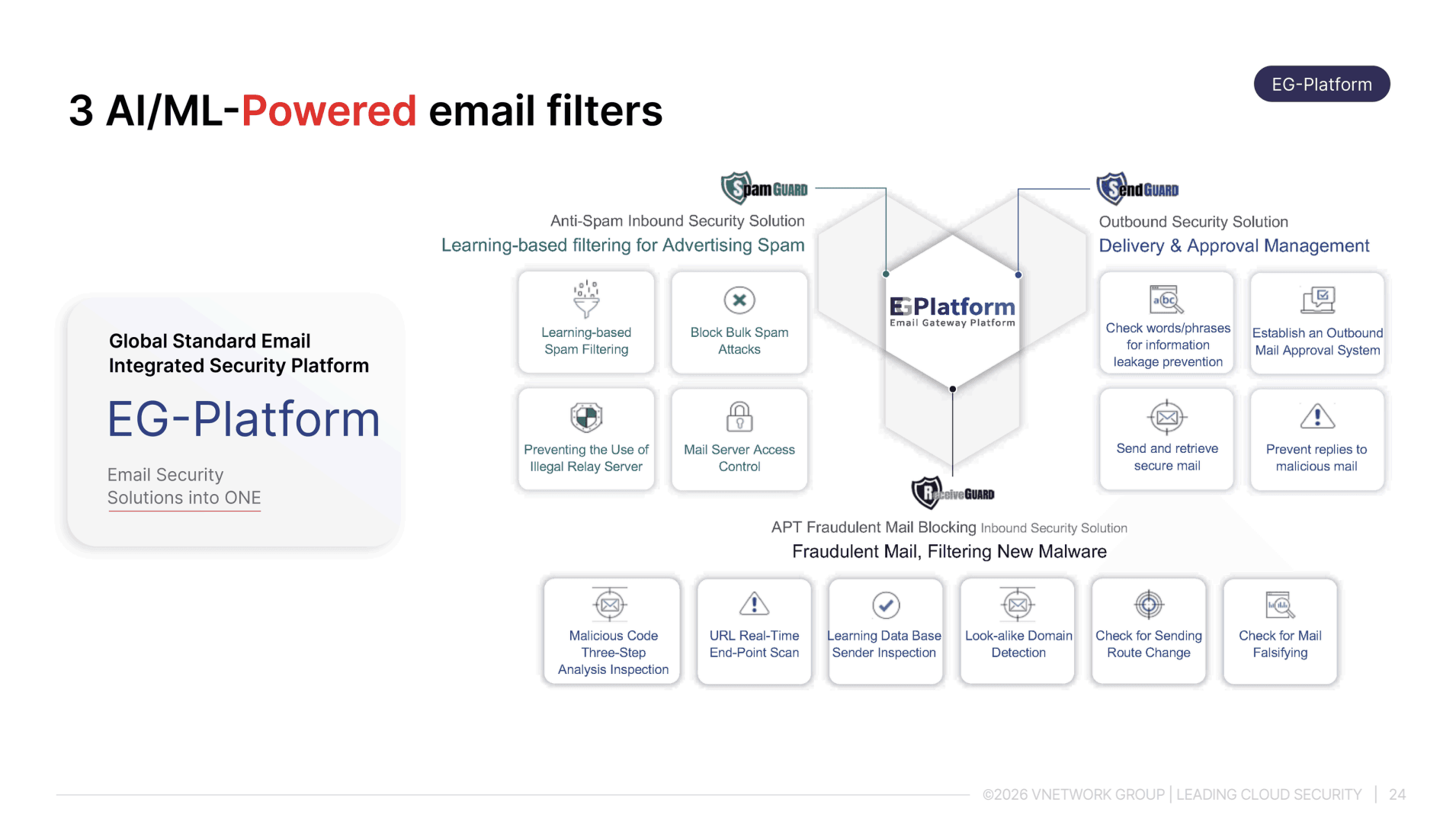
EG-Platform operates on a coordinated three-layer protection model designed to address threats that directly impact the factory floor:
- Spam Guard: Uses Machine Learning and Bayesian filters to score risk for every email. The system rigorously validates SPF, DKIM, and DMARC authentication standards to completely eliminate supplier domain impersonation — a common BEC attack scenario in manufacturing.
- Receive Guard: Protects inbound email by inspecting content, attachments, and URLs within an isolated sandbox environment. When malicious code is detected in technical drawings or attached documents, the system neutralizes it immediately, blocking ransomware from infiltrating and disrupting the production line.
- Send Guard: Exercises strict control over outbound email, preventing compromised internal accounts from distributing sensitive technical information or sending fraudulent payment requests to partners, thereby protecting the company's reputation against data leak accusations.
EG-Platform from VNETWORK is currently the only solution that meets 100% of the ITU-T X.1236 email security standards from the International Telecommunication Union — making it especially well-suited to manufacturing companies with high information security requirements and international export compliance obligations. The solution integrates directly with existing SMTP infrastructure without requiring a full system replacement, letting factories maintain operational stability while gaining the strongest possible security shield.
8. Conclusion
Email security for the manufacturing industry has moved well beyond conventional defense into a prerequisite for safe supply chain operations and uninterrupted production. In the face of increasingly sophisticated attacks such as BEC and ransomware, basic security measures are no longer sufficient to protect intellectual assets and corporate reputation. To build an optimized defense posture, manufacturers need to integrate modern email gateway solutions such as EG-Platform — harnessing the power of AI and Machine Learning to intercept risks at the gateway, while rigorously meeting international data protection standards in the digital era.
FAQ
1. Why is manufacturing more vulnerable to email attacks than other industries?
Manufacturing companies hold high-value intellectual property and operate complex supply chains with many sub-suppliers at varying levels of security maturity. This creates numerous weak points that attackers can exploit for financial fraud or technical data theft.
2. Do small-scale manufacturing companies need to invest in email security?
Yes. Smaller companies are often easier targets because they tend to have less rigorous payment verification processes and fewer cybersecurity monitoring resources, while still participating in supply chains that handle high transaction volumes.
3. How do SPF, DKIM, and DMARC differ?
SPF defines which servers are authorized to send email for a domain. DKIM attaches a digital signature to verify that email content has not been altered. DMARC specifies how to handle emails that fail authentication and sends monitoring reports. The three mechanisms work in combination to effectively counter domain spoofing.
4. Is EG-Platform suitable for factories without a dedicated IT team?
Yes. EG-Platform is designed to integrate seamlessly with existing corporate email systems and includes real-time monitoring and automated reporting, reducing the operational workload for technical staff who are not dedicated security specialists.
5. Will deploying email security disrupt existing email systems?
No. Solutions such as EG-Platform are deployed in parallel with the company's existing email infrastructure. They do not require changes to current systems and do not interrupt email communication flows during integration.