
1. Infrastructure challenges unique to modern online news
Online news outlets operate on a rhythm entirely different from conventional websites. Content is updated continuously around the clock, traffic fluctuates sharply with every news cycle, and the competitive pressure to break stories first grows ever more intense. These characteristics create a distinct set of infrastructure challenges that standard technology solutions struggle to meet.

1.1. Traffic spikes tied to breaking news cycles
The defining characteristic of online news is highly uneven traffic. During quiet periods, readership holds steady, but when a major event breaks, such as a natural disaster, a national sporting event, or a significant political development, visitor numbers can multiply several times over within minutes. If the origin server is not designed to handle such sudden load, the site will respond slowly or become entirely unreachable. This creates a double loss: readers are lost at the very moment traffic peaks, and advertising revenue evaporates during the most valuable time slots.
1.2. Multi-format content demands flexible infrastructure
Modern online news is no longer just text and static images. A comprehensive investigative piece may include a high-resolution photo gallery, video reporting clips, interactive graphics, and even a live stream from the scene. Each content format requires its own distribution strategy. Video demands high bandwidth and device-specific transcoding. News photography needs intelligent compression without sacrificing quality. Static assets such as CSS and JavaScript require effective caching for fast delivery. Infrastructure that lacks this flexibility produces an inconsistent experience, negatively affecting Core Web Vitals scores and SEO rankings.
1.3. Readers dispersed across multiple ISPs and devices
Vietnamese readers access online news through a variety of ISPs: Viettel, VNPT, Mobifone, FPT, and mobile 4G/5G networks. Load times for the same website can differ considerably depending on the ISP if a newsroom hosts its servers in a single location. Additionally, the proportion of readers accessing news via smartphone continues to rise, requiring infrastructure optimized for both low-bandwidth connections and small screens.
1.4. Downtime equals lost credibility and advertising revenue
For online news outlets, every minute of downtime is not just a technical incident but a brand liability. Readers who cannot access a site during an urgent news moment will switch to a competitor and may never return. The pageview-driven advertising revenue model makes uptime even more critical: a page that fails to load is an ad slot lost entirely.
1.5. Origin server costs escalating with growth
As readership grows, the traditional approach is to continuously upgrade the origin server. This strategy causes infrastructure costs to rise in direct proportion to traffic growth, while actual efficiency remains suboptimal because most resources sit idle during off-peak hours. This cost-optimization problem is one that the majority of small and medium-sized newsrooms currently face.
2. The role of CDN in the online news ecosystem
CDN (Content Delivery Network) is a geographically distributed network of servers whose purpose is to deliver content to users from the nearest server rather than from a single origin. When a reader opens an article, the CDN serves the content from the Point of Presence (PoP) closest to their location, significantly reducing response time.
For online news outlets, a CDN is far more than a speed-boosting tool; it serves as the backbone of the entire content distribution strategy. Its specific roles include:
- Distributing content from the PoP nearest to the reader, reducing latency and improving page load times across all ISPs
- Offloading the origin server and preventing site congestion during breaking news through intelligent caching
- Accelerating all static assets including news photos, video clips, CSS, and JavaScript to improve Core Web Vitals
- Load balancing automatically, distributing traffic evenly across servers to eliminate bottlenecks
- Supporting stable livestream delivery of events to multiple devices and ISPs simultaneously
- Integrating security including DDoS protection, Rate Limiting, and SSL/TLS directly at the content delivery layer
- Improving DNS resolution and initial connection time through optimized global network routing

3. What criteria matter most when choosing a CDN for a newsroom?
Not every CDN solution suits the specific operational needs of an online news outlet. Newsrooms should carefully evaluate the following criteria to ensure a genuine return on investment.
3.1. Multi-ISP coverage across Vietnam
The most important criterion for a news outlet serving the domestic market is that the CDN must have PoPs on all major Vietnamese ISPs: Viettel, VNPT, Mobifone, and FPT. A CDN optimized for only one or two ISPs creates an uneven experience, leaving a portion of readers receiving content noticeably slower than the rest.
3.2. HTTP/3 and QUIC support
The HTTP/3 and QUIC protocols significantly reduce connection time and improve performance on unstable mobile networks. The CDN also needs to support HLS video streaming and the ability to transcode content into formats suited to each end device. This criterion is especially important as the proportion of readers accessing news via smartphone continues to grow.
3.3. Intelligent caching for constantly changing content
Online news content is updated continuously around the clock, posing a major challenge for conventional caching. The CDN must classify content intelligently: applying long-duration cache to rarely changing static assets such as logos, CSS, and core JavaScript, while setting short TTLs for new articles. The ability to proactively purge cache by URL or by content group is also essential for ensuring readers always receive the latest version of a story.
3.4. Integrated security on the CDN infrastructure
Online news outlets are frequent targets of DDoS attacks, particularly during sensitive periods such as elections, natural disasters, or major public events. The CDN must have built-in Layer 3/4 DDoS mitigation, Rate Limiting to control abnormal request volumes, and SSL/TLS to secure connections. Integrating security directly at the CDN layer means newsrooms do not need to invest in separate, standalone security appliances.
3.5. Real-time dashboard and API integration capabilities
The newsroom technical team needs to monitor content delivery performance in real time, especially during major news events. An intuitive dashboard displaying traffic, cache hit rates, reader geolocation data, and anomaly alerts enables the operations team to respond quickly. API integration with the CMS allows automatic cache purging whenever an article is updated, eliminating the need for manual intervention.
3.6. A broad ecosystem of complementary solutions
An ideal CDN provider goes beyond delivering a basic distribution service; it offers a comprehensive ecosystem of complementary solutions. A newsroom can start with a basic CDN and gradually expand into cloud storage, video processing and delivery, or Multi-CDN deployment as its scale grows, all from a single provider. This approach minimizes integration costs, simplifies operations, and ensures compatibility across services.
4. When should an online news outlet adopt Multi-CDN?
Multi-CDN is a model that combines multiple CDN providers simultaneously to optimize both speed and reliability. Unlike Single CDN, which depends on a single network, Multi-CDN allows the system to automatically switch to another provider when one CDN experiences an outage or performance degradation. That said, not every newsroom needs to adopt it from the outset.

Multi-CDN is appropriate when a newsroom meets one or more of the following conditions:
- A significant international readership or a strategy to expand into markets outside Vietnam
- Extremely high uptime requirements with zero tolerance for any disruption, even when a single CDN provider experiences an incident
- A high proportion of video and livestream traffic that demands geographic optimization
- The newsroom already operates stably on Single CDN and wants to further elevate distribution performance
The table below summarizes the key differences between the two models:
| Criteria | Single CDN | Multi-CDN |
| Coverage scope | One PoP network from a single provider | Combined PoP networks from multiple providers |
| Redundancy | Fully dependent on a single provider | Automatically switches to another CDN when an incident occurs |
| International performance | Depends on the reach of one provider | Optimized for readers across multiple countries |
| Cost | Simple, easy to budget | Higher; suited to large-scale newsrooms |
| Operational complexity | Low; a single point of support | Higher; requires coordination across multiple providers |
| Best suited for | News outlets focused on the domestic market | Large newsrooms with international audiences and high video traffic |
5. CDN costs versus the benefits delivered to newsrooms
CDN investment is often weighed carefully by small and medium newsrooms due to cost concerns. However, when the cost of CDN is placed alongside the real losses caused by weak infrastructure, the calculation tends to favor clear, measurable benefits.

5.1. What makes up the cost of CDN
CDN costs are typically calculated based on actual bandwidth consumption, number of requests, and optional add-ons such as video streaming or advanced security. This pay-for-what-you-use model is more advantageous than investing in fixed server infrastructure: newsrooms pay only for what they actually consume, and costs automatically adjust with operational scale.
5.2. Directly measurable benefits
The most immediate benefit of deploying a CDN is a significant reduction in origin server load. When the majority of content is served from the CDN cache, the number of direct requests reaching the origin server drops sharply, reducing bandwidth consumption and extending the lifespan of existing infrastructure. Improved page load speed directly lowers bounce rates. Flexible storage through cloud storage also helps newsrooms manage their photo and video archives more efficiently, without needing to expand physical servers.
5.3. Indirect benefits with high strategic value
Beyond infrastructure savings, CDN delivers important indirect benefits. Faster page load times improve Core Web Vitals scores, which in turn support rankings in Google News and organic search. Higher uptime protects advertising revenue during peak breaking-news windows. Additionally, digital transformation is pushing newsrooms to expand across multiple platforms, and CDN is the infrastructure foundation that allows this expansion to proceed smoothly without service disruption.
The summary table below illustrates the relationship between each challenge, the consequence if left unaddressed, and the value CDN delivers:
| Challenge | Consequence | CDN solution |
| Slow page load speed | Readers leave, conversion rates drop, competitive disadvantage | Content delivered from the PoP nearest to the user, significantly reducing latency |
| Unable to handle traffic spikes during breaking news | Poor user experience, lost advertising revenue, damaged newsroom reputation | CDN and high-capacity bandwidth ensure stability under any load condition |
| High origin server operating costs | Reduced profitability, difficulty optimizing technology budgets | CDN caching offloads the origin server, saving bandwidth and costs |
| Security risks and cyberattacks | Service disruptions, data loss, eroded reader trust | TLS/SSL, Rate Limiting, and DDoS protection integrated at the CDN layer |
| Difficulty optimizing video and livestream across multiple devices | Long video load times, poor stream quality, viewers abandoning content | Real-time video transcoding and livestream delivery compatible with all devices |
6. VNCDN - The content delivery acceleration ecosystem for online news
VNCDN is VNETWORK's content delivery acceleration ecosystem, built and optimized specifically for the Vietnamese market and the broader Asia-Pacific region. The system is deployed across all major ISPs in Vietnam, including Viettel, VNPT, Mobifone, and FPT, ensuring fast and stable content delivery to every reader regardless of their mobile network operator.
What sets VNCDN apart from standalone CDN solutions is that it is built as a complete content delivery ecosystem, comprising multiple complementary services that eliminate the need for newsrooms to integrate from several separate providers:
- CDN: Distributes static content from the server nearest to the user, with HTTP/3 and QUIC support for optimized performance on mobile networks
- Multi-CDN: Combines multiple CDN networks to maximize speed and ensure high availability, automatically switching when one CDN encounters an issue
- Cloud Storage: Flexible, scalable online storage that connects directly to the CDN for fast delivery without routing through the origin server
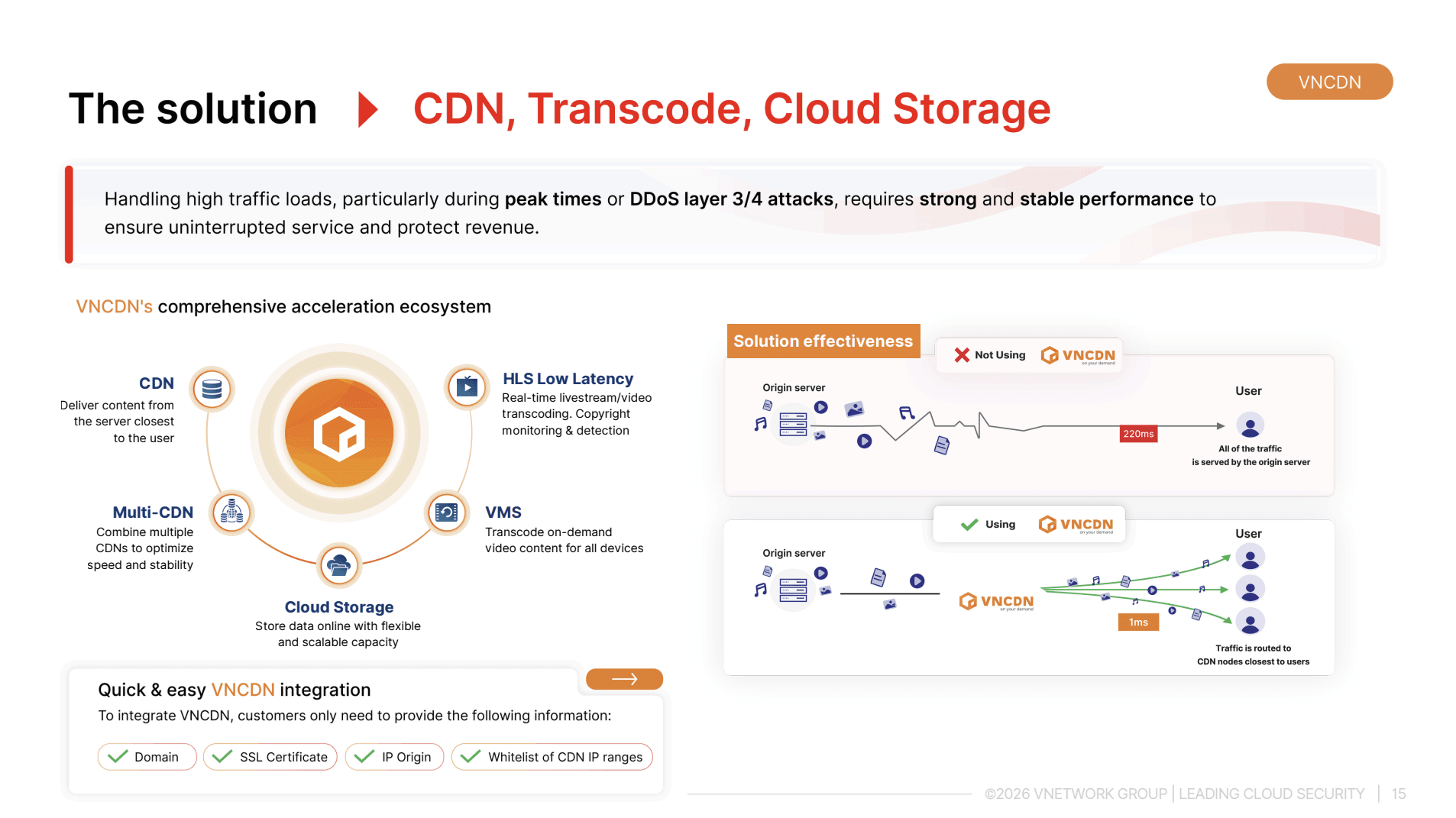
VNCDN features an intuitive management interface, real-time traffic monitoring dashboards, and flexible API integration with popular CMS platforms. The newsroom technical team can proactively track performance, configure caching rules, and handle content purges without requiring intervention from the provider.
7. Case study: Quan Doi Nhan Dan (People's Army Newspaper)
Quan Doi Nhan Dan (People's Army Newspaper) operates under the General Department of Politics of the Ministry of National Defence. It is the official mouthpiece of the Central Military Commission of the Communist Party of Vietnam and the voice of the Vietnamese People's Armed Forces. As the publication responsible for delivering political and military news to citizens both in Vietnam and abroad, its technical infrastructure must meet far stricter standards than any ordinary online news outlet.
With a readership spanning from domestic audiences to the Vietnamese diaspora in numerous countries, the foremost challenge was access speed. Readers located far from the origin server faced significantly longer waits for content to fully render, creating an inconsistent experience and consuming considerable bandwidth as the server processed each request individually.
After deploying VNCDN, the entire website's content was cached and distributed from the server nearest to each reader, ensuring consistent access speeds whether the reader is in Laos, Cambodia, or as far away as the United Kingdom or the United States. The origin IP masking feature also prevents hackers from identifying the actual server address for direct attacks.
As a result, Quan Doi Nhan Dan resolved DDoS attacks entirely. The website loads quickly and reliably, with content reaching every reader anywhere in the world in a timely manner. Even when a network outage occurs in a specific region, the website continues operating around the clock thanks to the distributed CDN infrastructure.
Read the full case study: Quan Doi Nhan Dan
8. Conclusion
CDN has become essential infrastructure for any online news outlet that wants to compete in the digital news landscape. No longer reserved for large media conglomerates, CDN solutions today can be deployed flexibly to match the scale and budget of any newsroom, from a local publication to a national newspaper. Newsrooms that invest early in the right CDN infrastructure will have a clear advantage in news distribution speed, reader experience, and long-term operational efficiency.
FAQ: Frequently asked questions about CDN for online news
1. Does CDN help improve rankings on Google News?
Yes. CDN improves page load speed and Core Web Vitals metrics such as LCP (Largest Contentful Paint) and CLS (Cumulative Layout Shift). These are the factors Google uses to assess page quality and determine rankings in both organic search and Google News. A news site that loads quickly and reliably has a clear ranking advantage over competitors with slower infrastructure.
2. Do small newsrooms need to deploy CDN?
Yes. CDN is not only for large newsrooms. With a pay-as-you-go billing model, CDN costs scale proportionally with operational size. Smaller newsrooms may actually benefit more, since CDN offloads the origin server, extends the lifespan of existing infrastructure, and eliminates the need for continuous hardware upgrades.
3. How does CDN handle news livestreams?
CDN distributes livestreams by segmenting the original video stream into small chunks, then caching and delivering those segments from the PoP closest to each viewer. Low-latency HLS technology reduces delay to under three seconds, ensuring viewers receive content almost instantaneously relative to the live broadcast. The video stream is also automatically transcoded to a resolution suited to each viewer's bandwidth and device.
4. How long does it take to integrate CDN into a newsroom CMS?
Integration time depends on the existing CMS and the level of customization required. For popular platforms such as WordPress or dedicated news publishing systems, a basic configuration can typically be completed within a few hours to one business day. Advanced integrations such as automatic cache purging via API or video streaming configuration may take several additional days depending on complexity.
5. Is Single CDN or Multi-CDN better suited to Vietnamese online news outlets?
For the majority of online news outlets focused on serving the domestic market, a Single CDN optimized for multiple Vietnamese ISPs is the most cost-effective and operationally efficient choice. Multi-CDN is better suited when a newsroom has a significant international readership, regularly operates large-scale livestream services, or has strict requirements for redundancy and absolute uptime.