
1. Overview of the online education industry in Vietnam
In recent years, the online education sector in Vietnam has entered a period of strong growth. According to Statista forecasts, the revenue of Vietnam's education technology (EdTech) market is expected to reach nearly 423.69 million USD in 2026. With a compound annual growth rate (CAGR) of approximately 12.08% during the 2025 to 2029 period, the market is projected to reach 627.33 million USD by 2029.
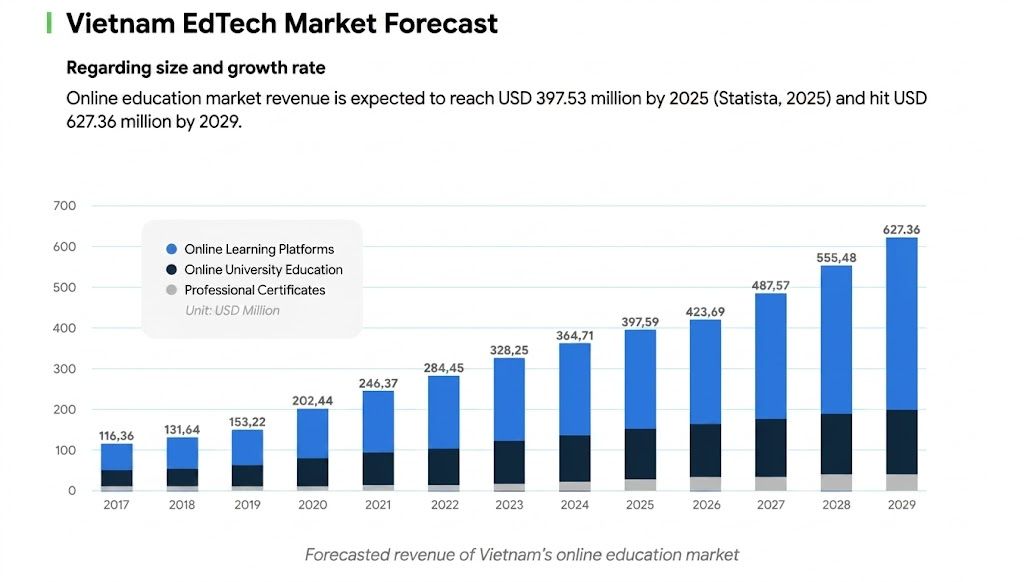
The Vietnam EdTech White Paper 2025 ranked Vietnam among the top 10 countries with the fastest EdTech growth globally, and among the top 3 most promising markets in Southeast Asia, alongside Singapore and Indonesia. The Vietnamese government has also identified education as one of the 8 priority sectors in the National Digital Transformation Program for the 2025 to 2030 period. With this strong growth momentum, the Vietnamese EdTech sector is expected to continue its rapid expansion, not only meeting domestic demand but also asserting its position in the international market. This trajectory places growing demands on the underlying cloud computing and network infrastructure that powers online platforms.
2. Challenges facing online education platforms
The rapid growth of the online education market comes with increasing pressure on technical infrastructure.
2.1. Server overload during peak periods
When thousands of students simultaneously log in, watch videos, complete quizzes, submit assignments, and download documents within a short time window, the origin server can easily become overloaded as all requests are funneled to a single point. Online exams and periodic assessments are the moments when system interruptions are absolutely unacceptable. Even a few minutes of downtime during an exam can affect the results of thousands of candidates, causing reputational and legal damage to the organizing institution.
2.2. Unexpected bandwidth costs
Online educational resources such as video lectures, PDF documents, and slide decks tend to have large file sizes. When student access volume increases, every request to stream or download is directed to the origin server. The continuous processing and transmission of this massive data volume causes bandwidth consumption to spike, resulting in significant cost burdens for operators.
2.3. Users distributed across a wide geographic area
Users of an eLearning platform may come from provinces and cities across the country, or even from multiple countries. When the origin server is located at a single geographic point, students who are far away experience higher latency as data must travel longer distances, resulting in slow loading speeds, video buffering, and a direct impact on learning effectiveness.
2.4. DDoS attacks and security risks
DDoS attacks often target moments of peak system load, making it difficult for the platform to distinguish real traffic from fake traffic. A DDoS incident occurring during exam hours or course registration periods can bring the website down for hours, causing serious damage to the institution's reputation. Beyond that, the leakage of sensitive data such as student information, internal course materials, or payment data constitutes a data breach that carries severe legal consequences.
3. How CDN works on educational websites
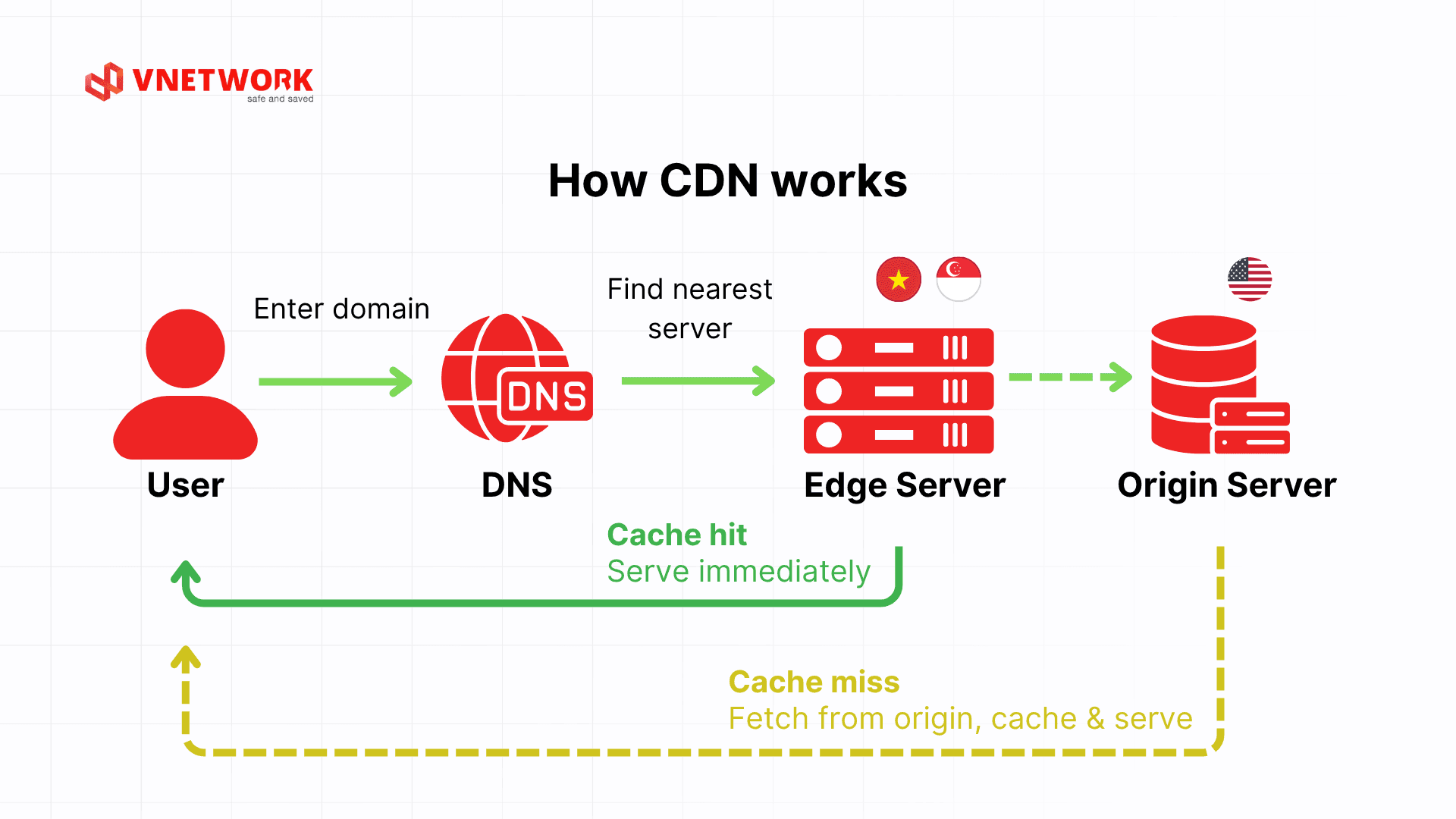
An educational website integrated with CDN operates through a closed-loop process that optimizes the data path from the origin server to the user in 3 steps:
Step 1: The user accesses the website
When a user enters the domain name of an online learning website into their browser, the access request is sent to the DNS system to locate the server address.
Step 2: Locating the nearest Edge Server
The DNS system identifies that the website has CDN enabled. It immediately redirects and locates the Edge Server closest to the student's geographic location.
For example: if a student in Ho Chi Minh City is accessing a course, the system will connect directly to an Edge Server located in Ho Chi Minh City or Hanoi, rather than routing to the origin server in the United States or Singapore to retrieve data.
Step 3: The Edge Server checks the cache
At this point, the system checks whether the requested lesson content is already available in the cache. Response speed is determined by two scenarios:
- Cache hit: If the content is already stored at a PoP near the user, the CDN responds immediately without needing to retrieve data from the origin server.
- Cache miss: If the content is not yet available at the PoP, the request is forwarded to the origin server to retrieve the data.
In a cache miss scenario, after retrieving data from the origin server, the Edge Server automatically stores a copy in its cache. From the second student onwards who accesses the same lesson, the system will trigger a cache hit in Step 3 at optimal speed.
4. Benefits of integrating CDN for educational websites
To address the infrastructure challenges described above, educational websites are integrating CDN as a core technical solution. Below are 5 real-world benefits that CDN delivers:
4.1. Faster content delivery
CDN shortens the distance between users and servers by distributing content to servers closest to the user, allowing users to connect to the nearest data center rather than the website's origin server, significantly reducing latency.
4.2. Reduced load on the origin server
The school's origin server not only serves content but also handles thousands of student logins, teacher permission management, automated grading, learning progress tracking, and many other tasks. When CDN takes over the distribution of static content to PoPs, the origin server is freed to focus on core operations. Efficient load balancing across PoPs keeps the system stable even during peak periods such as the start of the school year or exam season.
4.3. Lower bandwidth costs
CDN distributes content across multiple servers, reducing the number of times students access the origin server directly. Data is cached at edge servers, enabling students to load content from the nearest location without connecting to the main server. As a result, bandwidth consumption at the origin server is significantly reduced, while infrastructure costs are optimized.
4.4. Enhanced security and DDoS protection
Learning management systems (LMS) contain personal information of students and teachers, making them a target for cyberattacks. Placing CDN in front of the system acts as a protective shield, defending the origin server against network-layer DDoS attacks (Layer 3/4). When integrated with a web application firewall (WAF), CDN can also block application-layer attacks (Layer 7), ensuring the safety of student data and the entire educational system.
4.5. Continuous availability
For educational websites, downtime during peak periods such as exam sessions or course registration can affect thousands of students and teachers. CDN distributes content across multiple edge servers at different data centers. When one node encounters an issue such as hardware failure or network congestion, the system automatically redirects traffic to other active PoPs without manual intervention, ensuring online classes remain uninterrupted.
5. Criteria for selecting the right CDN for an educational website
Not every CDN is suited for educational websites. CDN providers should be evaluated based on the following criteria:
| Criteria | Description |
| PoP network | Strong PoP coverage across Vietnam |
| DDoS protection and security | DDoS Layer 3/4 protection, SSL/TLS, Rate Limit, Token Access, Access Control Policy |
| Features | Livestreaming, VOD, DASH |
| Cost | Flexible Pay-as-you-go model, billed by actual bandwidth or fixed rate |
| Technical support | 24/7 expert support team, immediate incident response even during peak periods |
| Ease of integration | Customization and deep integration via API |
| SLA/Uptime | Minimum 99.9% uptime commitment |
| Real-time reporting and analytics | Intuitive dashboard, traffic and bandwidth charts, cache hit ratio in real time |
6. VNCDN: Accelerating content delivery for Vietnam's online education platforms
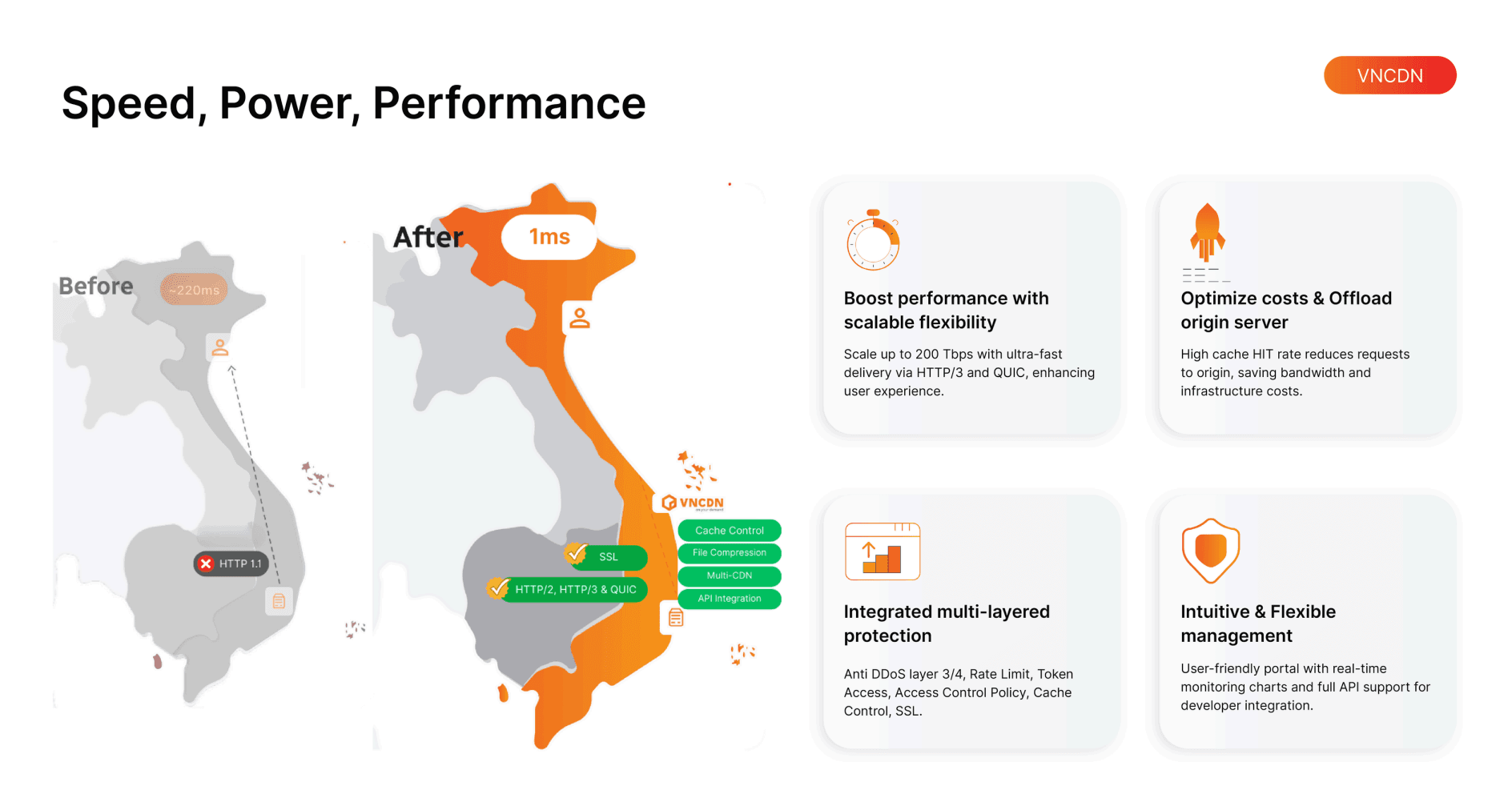
VNCDN is VNETWORK's CDN solution, purpose-built and optimized for the Vietnamese market. With infrastructure deployed directly at major domestic ISPs, VNCDN offers superior speed and low latency compared to international providers when serving students across the country. For platforms that combine CDN with cloud infrastructure, the performance gains are especially significant.
6.1. Key features of VNCDN
- Robust infrastructure: Over 2,300 PoPs spanning 146 countries. International uplink bandwidth reaching 2,600 Tbps. In Vietnam, VNCDN infrastructure is deployed at leading data centers including Viettel, FPT, VNPT, and Mobifone. With domestic uplink bandwidth of up to 15 Tbps, the infrastructure can handle 10 million or more concurrent users and process over 20 billion requests per day.
- Powerful security integration: DDoS Layer 3/4 protection, Rate Limit, Token Access, SSL, and comprehensive access control policies.
- Automatic PoP failover: When any PoP encounters an issue, the system automatically redirects requests to another PoP to continue serving user needs.
- Performance optimization: Accelerates HTML, CSS, video, images, JSON, XML, and many other content types.
- Access control: Prevents content theft and hotlinking on other websites using Token, CORS, or DRM.
- Continuous monitoring: 24/7 technical team and SOC system, intuitive portal interface with real-time charts for anomaly detection.
- GEO Blocking: Controls and restricts content access based on the user's geographic location.
- Cache Depth: Stores cache data on both RAM and NVMe SSD drives.
- SNI support: Supports easy and fast SSL upload and configuration for individual domains.
- Access Logs: Enables proactive download of system log records for analysis and review.
- Advanced analytics: Provides statistics and analysis on browser, device, and operating system ratios to help easily monitor and evaluate the user experience.
6.2. Case study: Esuhai enhances its eLearning system with VNCDN
Esuhai is Vietnam's leading organization for Japanese language training and employment placement in Japan, with over 15 branches nationwide. As student numbers grew rapidly, the system experienced repeated overloads, service disruptions, and increasingly sophisticated cyberattacks.
VNETWORK deployed VNCDN to distribute content from servers closest to students, reducing page load times and keeping the system stable even during peak traffic surges.
As a result, Esuhai's eLearning platform operates more smoothly, student data is comprehensively protected, and the team can focus on developing training content rather than managing infrastructure incidents.
7. Conclusion
CDN is no longer optional — it has become an essential infrastructure component for any online education platform that wants to optimize the learning experience: fast, stable, and secure. In the context of Vietnam's rapidly growing eLearning market, investing in content delivery infrastructure is a strategic move that cannot be delayed for organizations looking to strengthen their competitive position. Platforms that have already adopted hosting and server infrastructure can integrate VNCDN to immediately elevate their delivery performance.
Let VNETWORK accompany your organization in integrating a comprehensive CDN solution for your educational website. Contact VNETWORK's team for a free consultation and to experience VNCDN tailored to your infrastructure. Hotline: (028) 7306 8789 or email: contact@vnetwork.vn.
FAQ: Common questions about CDN for educational websites
1. Is CDN suitable for small-scale online education platforms?
Yes. CDN is suitable for education platforms of all sizes, including small training centers and local schools. Even with a modest student base, content still needs to be delivered quickly and reliably to users across multiple provinces and cities, ensuring a smooth learning experience regardless of where students are located.
2. Can CDN replace hosting or a server?
No. CDN and hosting complement each other and cannot replace one another. CDN handles the distribution of static content to edge servers nearest to the user. Website source code, databases, and dynamic processing still require hosting or the origin server.
3. Is deploying CDN for an educational website expensive?
No. Compared to investing in upgrading physical server infrastructure, professional CDN services are far more cost-effective thanks to the Pay-as-you-go model, where fees are based on actual bandwidth consumption.
4. Does integrating CDN affect SEO for an educational website?
No, CDN actually helps improve SEO. Page load speed is one of the factors Google evaluates in Core Web Vitals. A faster loading website means better scores, which in turn improves search rankings and attracts more prospective students.
5. Does VNCDN support copyright protection for lecture videos?
VNCDN integrates a Token tracing feature that assigns a unique Watermark ID to each streaming session to track individual users. When a video is detected as being shared without authorization, the system automatically extracts the watermark to trace the source of the leak and sends violation information to the backend for handling. In addition, VNCDN supports GEO-Blocking to restrict content distribution based on the user's geographic location.