
What is HTTP Live Streaming (HLS)?
HTTP Live Streaming (HLS) is a media streaming protocol developed by Apple that supports both live streaming and video on demand (VOD) delivery to viewers across a wide range of devices, including smartphones, laptops, and smart TVs.
What sets HLS apart is its ability to automatically adjust video quality based on the viewer's internet connection speed, ensuring a consistently smooth and stable playback experience.
A standout feature is that HLS operates entirely over the standard HTTP protocol, making it straightforward to deploy on virtually any web server without requiring additional plugins or specialized software. This simplicity has made HLS a widely adopted solution for OTT businesses aiming to deliver video content efficiently and consistently across all devices.

Benefits of HTTP Live Streaming (HLS)
HTTP Live Streaming (HLS) delivers significant advantages for OTT businesses and online video platforms. Its broad compatibility, adaptive streaming capabilities, robust security, and cost efficiency have established it as the industry standard for both live and on-demand video.
- Broad platform compatibility: Supports nearly all popular devices and browsers, including iOS, Android, Windows, macOS, smartphones, desktops, and smart TVs, thanks to its use of the standard HTTP protocol.
- Adaptive bitrate streaming (ABR): Automatically adjusts video quality from HD to lower resolutions based on the viewer's network speed, minimizing stuttering, lag, and buffering.
- Seamless playback experience: Video content is segmented into small chunks (typically MPEG-TS segments) accompanied by a manifest file (M3U8 playlist), allowing players to switch quality rapidly and begin playback almost instantly, even on unstable connections.
- High scalability: Easily distributes content to massive global audiences through CDNs and standard web servers.
- Content protection: Supports digital rights management (DRM) to safeguard copyrighted material against unauthorized access.
- Effective ad integration: Enables seamless insertion of advertisements (VAST/VPAID), helping content providers maximize revenue.
How does HTTP Live Streaming (HLS) work?
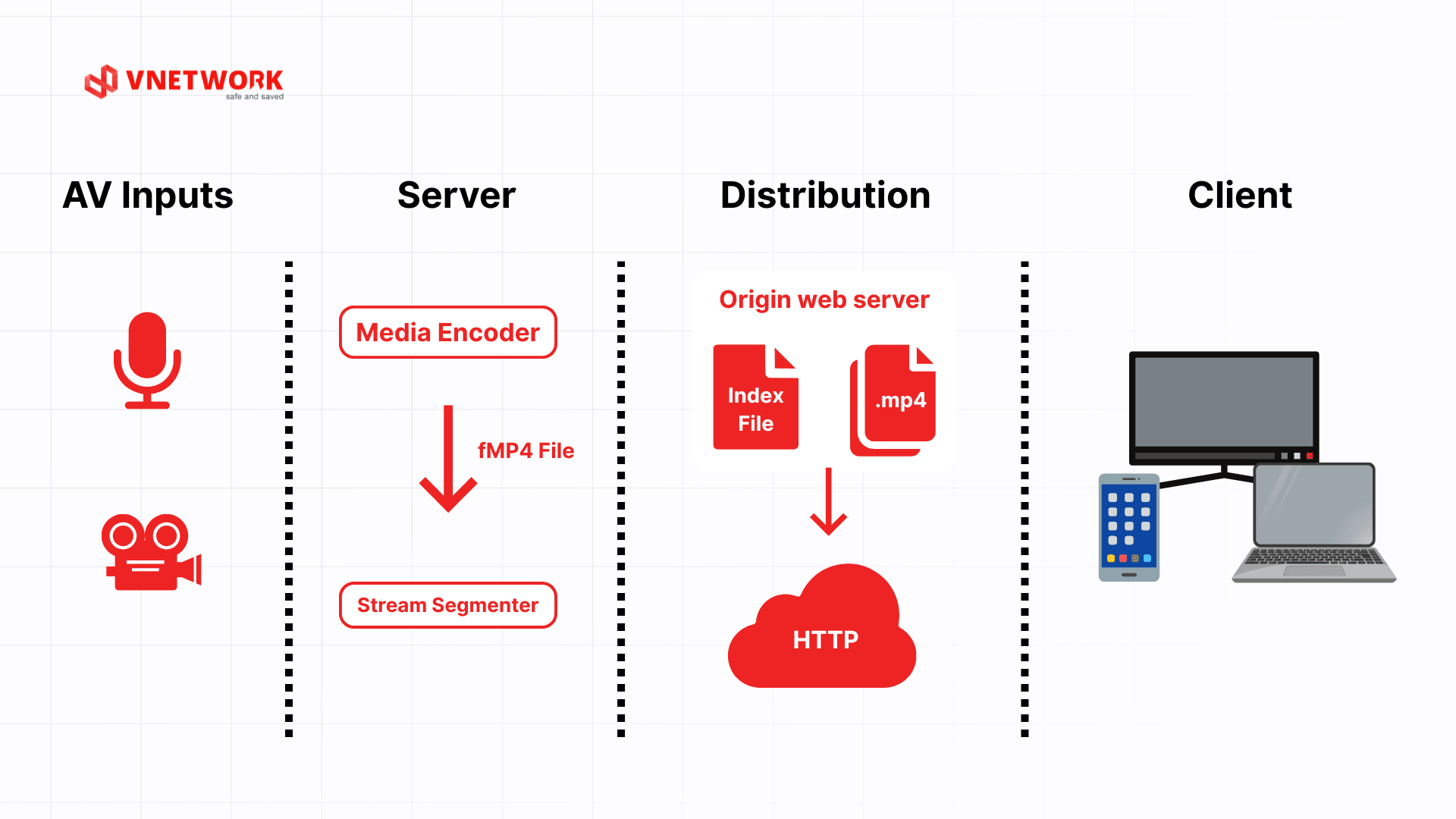
HLS delivers streaming video by breaking content into small segments and transmitting them over HTTP, resulting in a smooth experience that adapts to varying network conditions. The core workflow consists of four main steps:
1. AV Inputs
Audio and video signals are captured directly from microphones and cameras. These raw data sources serve as the starting point for the streaming process. Raw video and audio must be processed before transmission over the internet.
2. Server (Encoding and Segmentation)
Once received, the server processes the raw video for streaming. A media encoder compresses the content into efficient formats (such as fMP4), making it suitable for internet delivery. A stream segmenter then divides the video into thousands of small segments. This segmentation enables instant playback without downloading the entire file and supports automatic quality adjustment based on available bandwidth.
3. Distribution
Processed segments are stored on an origin web server, while an index file (.m3u8) is generated. This manifest file does not contain video data; instead, it lists the locations of the segments, guiding the client device on playback order. To enhance speed and reduce latency, segments are typically distributed via a Content Delivery Network (CDN), which caches content closer to viewers across different geographic regions. The entire delivery process relies on standard HTTP, ensuring compatibility with most web servers and easy traversal through network firewalls.
4. Client (Viewer Device)
The viewer's device (such as a laptop, tablet, or smartphone) first downloads the .m3u8 manifest file. Using the listed segments, it progressively downloads and assembles them for continuous playback. This mechanism ensures smooth video delivery even when network conditions fluctuate, with minimal interruptions.
Which devices support HLS?
One of the primary reasons for HLS's widespread adoption is its extensive compatibility across devices and browsers. HLS performs reliably on iOS, macOS, Android, and most major browsers. Key support includes:
- Web: Modern browsers support HLS natively via HTML5 video players (such as Video.js or hls.js) or built-in playback in Safari. It works seamlessly with Safari, Chrome, Firefox, and others.
- iOS/macOS: Native support without requiring plugins or additional software.
- Android: Supported through Google ExoPlayer for smooth playback on smartphones and tablets.
- Smart TVs and gaming consoles: Compatible with platforms such as Roku, Apple TV, Xbox, Amazon Fire TV, PlayStation, Samsung, LG, and more.
Which businesses should use HLS Streaming?
HLS is an ideal streaming solution for organizations seeking high-quality, smooth, and reliable video delivery across all devices. It suits a variety of use cases, including:
- OTT and digital media companies Providers of video-on-demand (VOD) services or live event streaming can leverage HLS to reach thousands or millions of viewers while maintaining excellent quality with reduced stuttering, lag, and buffering.
- E-commerce and video marketing Online retailers, e-commerce platforms, and marketing agencies can use HLS to showcase products or host live sales, reaching global customers with consistent playback across browsers and devices.
- Online education and webinars Educational institutions, online training providers, and webinar organizers can deliver lectures and live sessions to large audiences with reliable audio-visual quality and scalability.
- Gaming and esports Gaming streaming platforms, esports events, and online sports broadcasts benefit from high-resolution delivery and adaptive bitrate to prevent lag, even on variable connections.
Low-Latency HLS from VNETWORK - Reducing latency to just 3–5 seconds
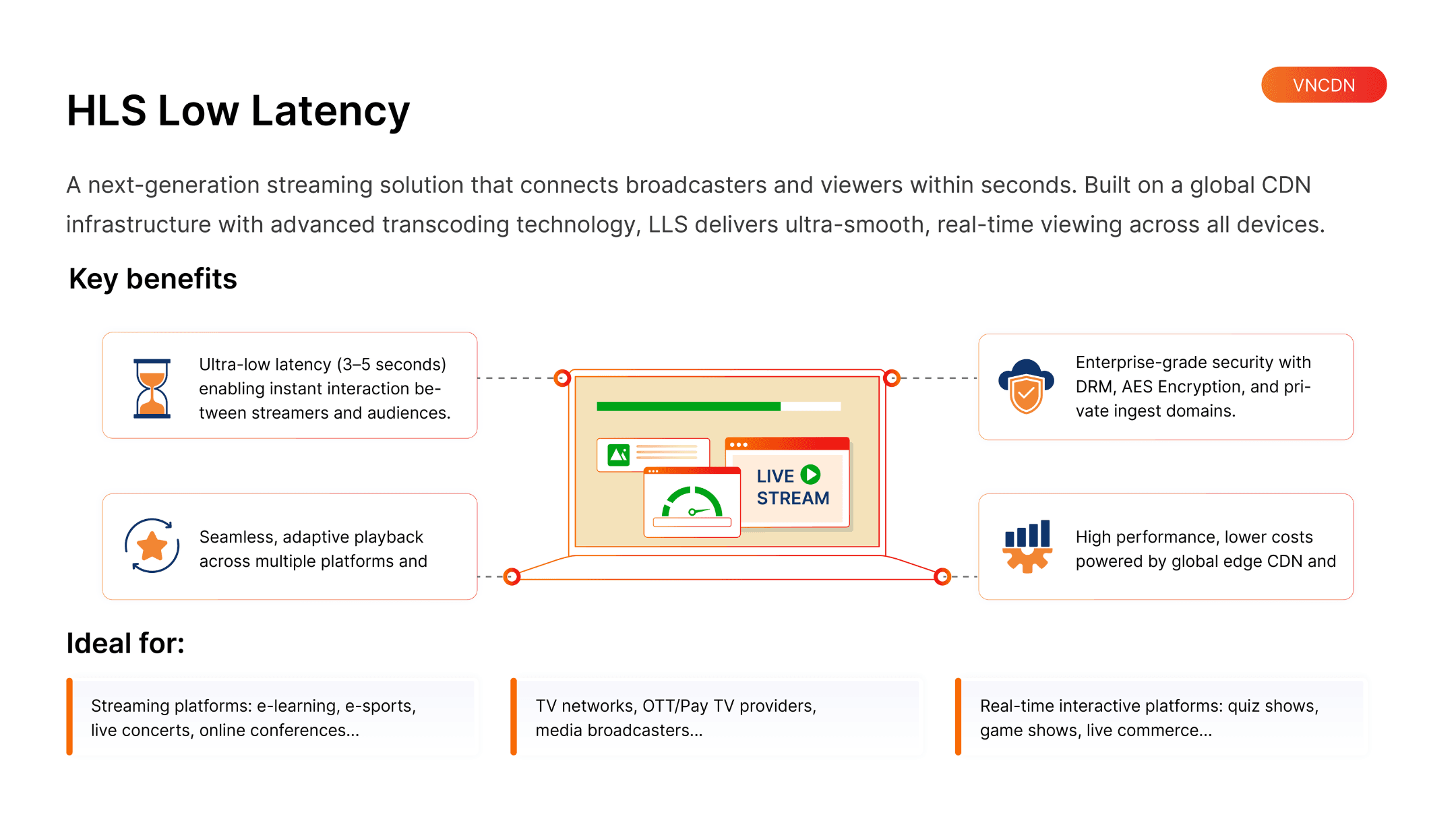
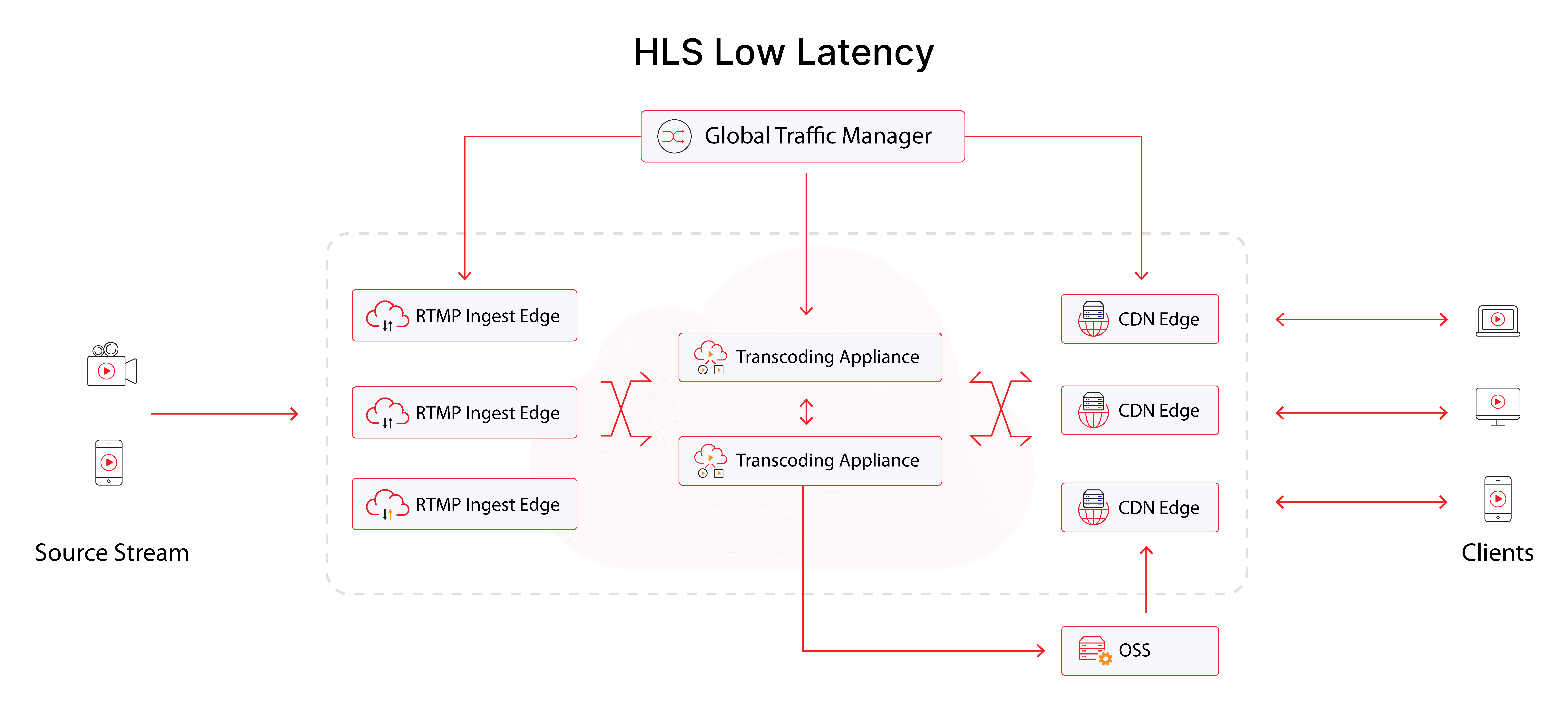
VNETWORK's Low-Latency HLS is a next-generation live streaming solution that achieves near-instant delivery with only 3–5 seconds of latency. Built on a robust CDN infrastructure with over 2,300 points of presence (PoPs) across 146 countries, it includes advanced features such as recording, rewind (time-shift), and content protection. This solution meets diverse needs, from live e-commerce and training to major events and broadcasting.
Video streams are ingested rapidly and processed in real time at GPU-accelerated data centers using optimized algorithms for instant transcoding and packaging. During distribution, viewers receive content from the nearest CDN edge node, ensuring sharp, high-speed, and smooth playback worldwide. Optimized GOP caching further reduces latency from the very first frame, delivering a near-real-time and seamless live experience.
Key features of Low-Latency HLS from VNETWORK
This solution provides enterprises with powerful capabilities:
- Ultra-low latency: Compliant with LL-HLS standards, reducing delay to 3–5 seconds for near-real-time interaction.
- Custom domains: Supports branded ingest domains for flexibility and optimized routing.
- Simultaneous multi-stream output: A single job can generate multiple streams without limits.
- Customizable video quality: Creates multiple manifests from one input stream, tailored to different devices and network conditions.
- Audio and podcast support: Separates audio tracks or converts to MP3 files easily.
- Storage optimization: Selective recording at desired quality levels to minimize costs.
- Security and utilities: Integrates time-shift, AES encryption, and DRM for content protection.
- Failover redundancy: Supports high-availability ingest from multiple sources for uninterrupted streaming.
- Channel-based management: Intuitive channel interface for easy monitoring and control.
- Scheduled broadcasting: Automated EPG-style scheduling for recurring events or linear TV.
- Modern interface: User-friendly and straightforward operations.
Vietnam National Day – Delivering smooth live broadcast to millions
With over 12 years of experience, VNETWORK has partnered with more than 2,000 enterprise clients. During Vietnam's National Day military parade on September 2, VNETWORK proudly collaborated with VTV to ensure stable, high-quality video distribution to millions of viewers across smartphones, laptops, and smart TVs. Leveraging optimized solutions and extensive large-scale project expertise, the event ran flawlessly, demonstrating VNETWORK's capability to handle massive video workloads and commitment to delivering the best possible viewer experience.

Conclusion
HTTP Live Streaming (HLS) remains the industry-standard protocol for online video, offering smooth, reliable playback across all devices while simplifying scalability and content protection for businesses.
Partner with VNETWORK to implement HLS using powerful infrastructure and a global CDN network, ensuring your videos reach viewers quickly, sharply, and seamlessly. Ready for any event, program, or marketing campaign.
FAQ – Common questions about HLS Streaming
1. What is HLS?
HLS (HTTP Live Streaming) is an HTTP-based video streaming protocol that segments content into small chunks and uses a manifest file (.m3u8) for smooth playback across devices.
2. Does HLS work on all devices?
Yes, HLS offers broad compatibility with iOS, Android, Windows, macOS, smart TVs, and most modern browsers.
3. Does HLS support adaptive video quality?
Yes, HLS employs adaptive bitrate streaming (ABR) to automatically adjust quality based on the viewer's network speed, reducing lag and buffering.
4. How does HLS scale for large audiences?
By leveraging CDNs, HLS can efficiently distribute video to millions of global viewers with consistent stability.
5. How does HLS compare to other streaming protocols?
Compared to RTMP or DASH, HLS excels in broad compatibility, easy HTTP-based deployment, strong adaptive bitrate support, and seamless CDN integration, making it suitable for both VOD and live streaming.