What is a CDN?
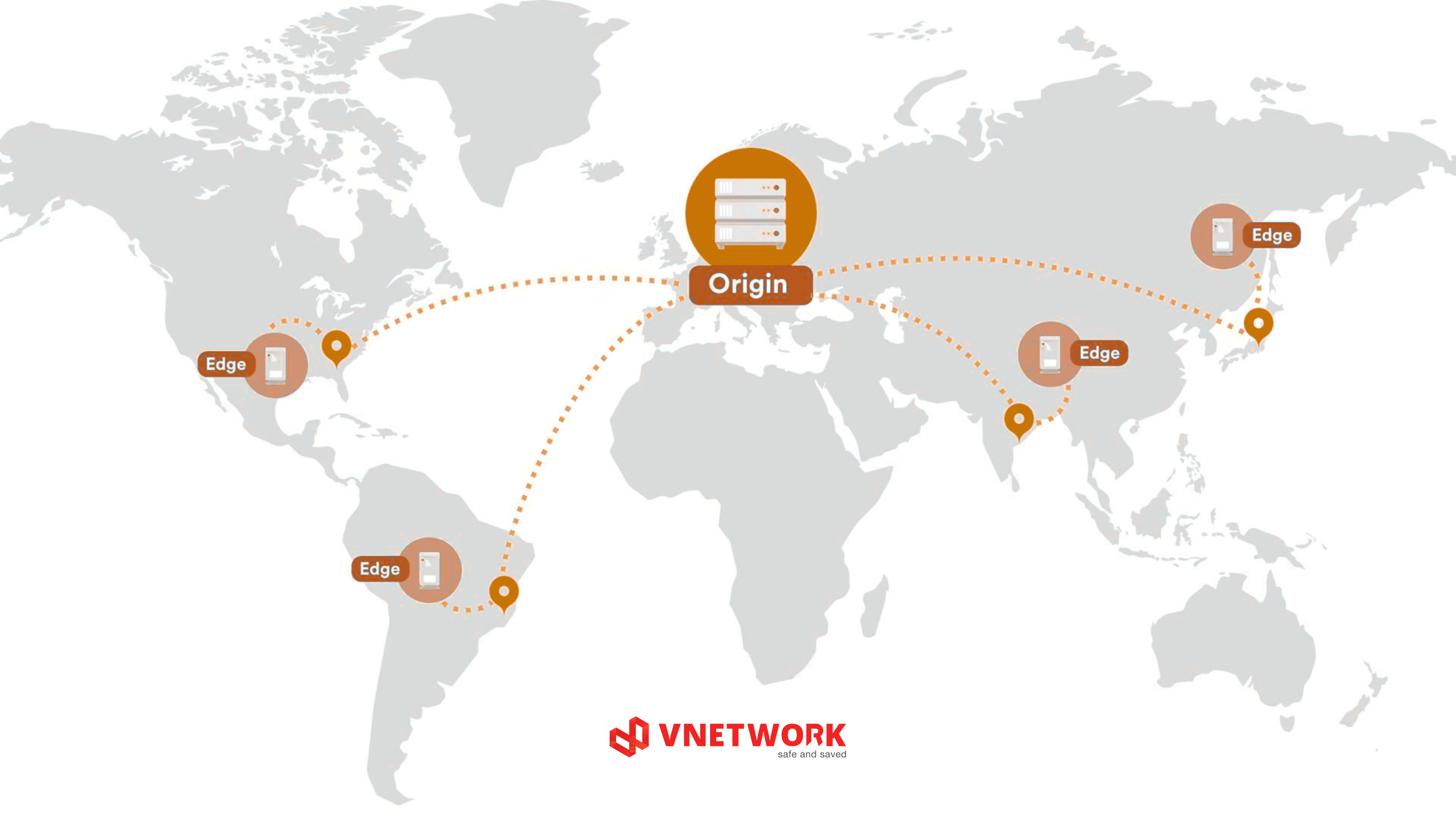
A Content Delivery Network (CDN) consists of a distributed system of servers strategically located across multiple global regions. These servers collaborate to deliver website content, such as images, videos, CSS files, and JavaScript, to end users with maximum speed and reliability.
Rather than routing every request directly to the origin server, which is typically hosted in a single fixed location, a CDN automatically directs users to the nearest edge server. This approach minimizes page load times, alleviates pressure on the origin server, and significantly improves overall user experience.
Beyond acceleration, CDNs provide robust protection against cyber threats like DDoS attacks, optimize bandwidth usage, and ensure consistent availability during traffic surges. In essence, a CDN functions as an intelligent network of relay stations, guaranteeing that your content reaches users worldwide as swiftly as possible.
The evolution of CDN technology
CDN technology emerged in the late 1990s to address challenges in internet content distribution. Since then, it has progressed through three distinct generations, each introducing advanced capabilities, technologies, and architectural concepts.
- The first generation focused primarily on interconnecting data centers with intelligent traffic management systems.
- The second generation arose to support the rise of audio and video streaming services, particularly on-demand video. It tackled mobile content delivery hurdles by leveraging cloud computing and peer-to-peer networks to enhance distribution speeds.
- The third generation is envisioned as community-driven, autonomous, and self-managed, with a strong emphasis on elevating end-user experience quality. Throughout this evolution, CDN service pricing has trended downward, transforming it into a mainstream technology.
What are the benefits of a CDN?
A Content Delivery Network delivers tangible advantages to both businesses and end users. Below are the six most prominent benefits:
Accelerate page load times and enhance user experience
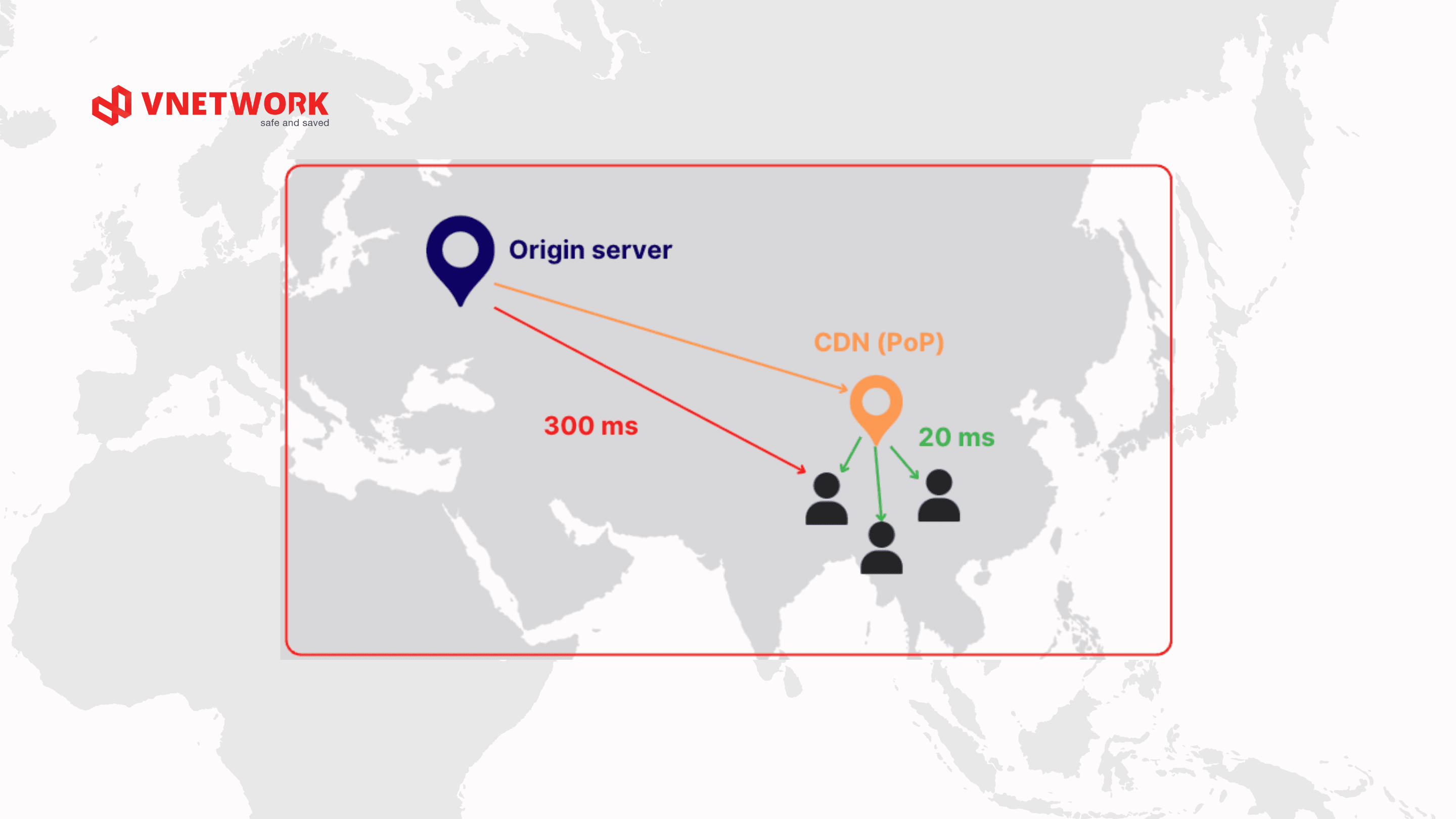
By minimizing the data transmission distance between users and servers, CDNs enable faster website loading, lower latency, and fewer interruptions during access.
Reduce load on the origin server
Static files are cached on edge servers, sparing the origin server from handling every request. This promotes system stability and conserves resources.
Optimize bandwidth and infrastructure costs
With most content served from edge locations, organizations substantially cut international bandwidth expenses and avoid excessive investments in central server infrastructure.
Strengthen security posture
CDNs mitigate DDoS attacks at the network layer (OSI Layers 3 and 4). When integrated with a Web Application Firewall (WAF), they also block application-layer threats (Layer 7), including SQL injection, XSS, and unauthorized access, thereby safeguarding the origin server and user data.
Ensure high availability and scalability
In the event of a server failure, CDNs automatically reroute traffic to other nodes in the network, maintaining uninterrupted operation even during peak loads.
Enable efficient global content distribution
Leveraging Points of Presence (PoPs) deployed worldwide, CDNs deliver content swiftly and consistently to users regardless of location. Whether accessing from Vietnam, the United States, or Europe, users enjoy a seamless and uniform experience.
Key CDN terminology
| No. | Term | Explanation |
| 1 | Anycast | Anycast routes traffic to the nearest CDN node for efficient request handling. |
| 2 | Origin server | The origin server runs one or more programs designed to listen for and process incoming internet requests. |
| 3 | Edge server | Edge servers bridge distinct networks. Their primary role in a CDN is to store content as close as possible to requesting clients, reducing latency and improving page load times. |
| 4 | Internet exchange point (IXP) | An IXP is a facility where Internet Service Providers (ISPs) and CDNs interconnect. It shortens transit paths between ISPs, lowering latency and round-trip times. |
| 5 | Reverse proxy | A reverse proxy sits in front of web servers, forwarding client requests (e.g., from browsers) to those servers. It is commonly deployed to boost security, performance, and reliability. |
| 6 | Global server load balancing (GSLB) | GSLB distributes internet traffic across numerous geographically dispersed servers. It enhances CDN reliability and reduces latency for SSL/TLS connections. |
| 7 | CDN security | Like any internet-exposed network, CDNs must defend against in-transit attacks, data breaches, or DDoS. Strategies include proper SSL/TLS encryption and dedicated hardware accelerators. Anycast routing further ensures efficient request processing at the nearest node. |
| 8 | Data center | A data center is a facility housing multiple networked servers for processing, storing, and sharing data. |
Components of CDN infrastructure
Edge servers and points of presence (PoPs)
Each edge server or PoP is often situated at internet exchange points (IXPs), which are data centers where various ISPs interconnect to exchange traffic originating from their networks. By connecting to these high-speed, well-interlinked locations, PoPs communicate efficiently with nearby end users, minimizing round-trip times for data delivery and transmission costs. Typically, each PoP houses multiple caching servers.
Caching servers
Every PoP includes several caching servers. Their core function is to store and serve cached static content to proximate users. Caching web content reduces origin server bandwidth consumption while accelerating page loads. These servers feature robust storage and memory capabilities to handle high-speed, secure caching operations.
DNS configuration
Beyond physical infrastructure, activating a CDN requires modifying DNS records for the root domain (and subdomains) targeted for CDN integration. The goal is to position the CDN as the default gateway for all incoming requests, routing visitors to the CDN rather than the origin server. Activation generally involves two steps:
- Step 1: Update the root domain's A record to point to one of the CDN's IP ranges.
- Step 2: Modify subdomain CNAME records to reference the CDN-assigned edge address.
CDN and DNS providers may vary in configuration details, so consult each provider's step-by-step guides for precise instructions.
One of the most significant factors impacting website performance is the geographic distance between users and the web server. Shorter distances yield faster content delivery. CDNs address this effectively by deploying edge servers globally, bridging the gap between the origin server and users.
Common CDN types in web administration
For web administrators, selecting the right CDN type is crucial. Here are several prevalent options commonly utilized.
Peer-to-peer (P2P) CDN
Many non-governmental organizations and large corporations employ P2P methods for web content distribution. P2P CDNs eliminate the need for traditional caching; end users become part of the CDN network. This approach demands fewer resources and hardware, leading to the emergence of free P2P CDN services.
Push CDN
In a push CDN, the origin server manually or automatically sends web content directly to CDN nodes. Content remains cached on CDN servers until explicitly purged. The core principle is that web administrators are responsible for pushing content to the CDN.
Pull CDN
Opposite to push CDNs, pull CDNs have the network retrieve web content for end users upon request. Administrators keep content on the origin server but rewrite URLs to point to CDN nodes. When a user requests content, the CDN pulls it from the origin and distributes it.
Cloud CDN
To advance scalability, security, performance, and reliability beyond traditional CDNs, leading cloud providers have integrated CDN capabilities into their computing platforms. This enhances management simplicity and efficiency. Industry reports position cloud CDNs as the latest trend in digital-era content delivery.
How does a CDN work?
To illustrate CDN operations, consider this step-by-step process when a user accesses web content:
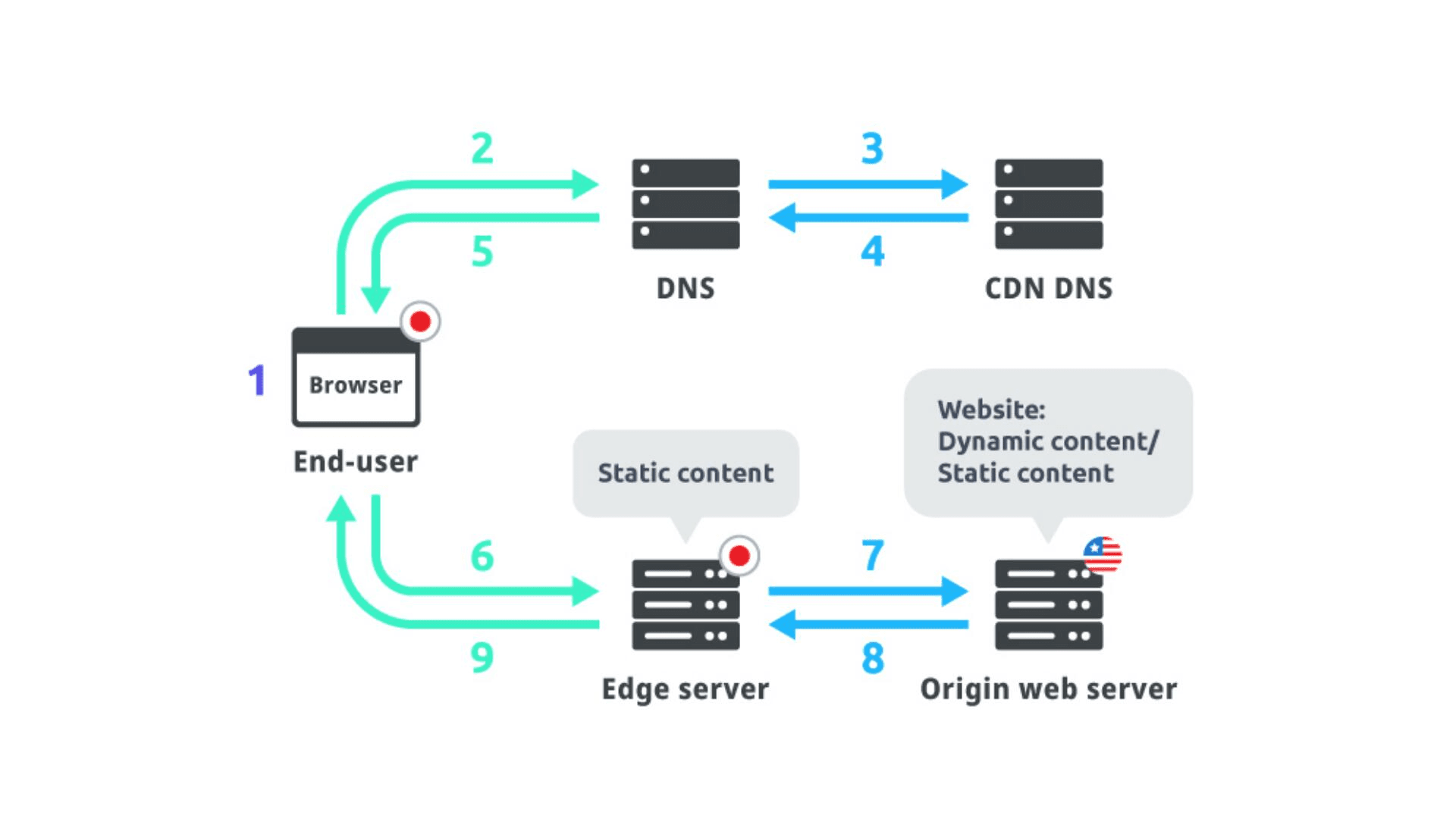
In the diagram above, an end user in Asia requests a website hosted in North America, where the site owner employs a CDN. The sequence unfolds as follows:
- Step 1: The Asian user enters the domain www.vnetwork.vn in their browser.
- Step 2: The browser routes the query for www.vnetwork.vn to the Domain Name System (DNS).
- Step 3: DNS performs a lookup and returns a CNAME record aliasing to the CDN's DNS system.
- Step 4: The CDN DNS identifies the closest edge server (in this case, an Asian edge) and returns its IP address to DNS.
- Step 5: DNS forwards the edge server IP to the browser.
- Step 6: With the IP, the browser sends an HTTP GET request to the edge server. From this point, it interacts with the edge rather than the origin. Processing differs based on content type (static or dynamic):
| Static content | Dynamic content |
| Step 9: The Asian edge server delivers cached static content directly to the browser (skipping steps 7 and 8). This is how CDNs accelerate performance. If unavailable locally, the edge queries other CDN nodes. If still absent, it acts as a reverse proxy, fetches from the origin (step 7), caches it (step 8) for future requests, and serves the browser. |
|
Caching on edge servers occurs only once initially. Edge nodes start without static content and must fetch everything from the origin. Both static and dynamic content follow steps 7 through 9 for the first request, making initial loads slower than subsequent ones.
Static content caching follows predefined rules on edge servers; not all static assets are necessarily cached. Although dynamic content is not cached on edges, CDNs can accelerate its delivery via compression. This feature significantly reduces file sizes (e.g., JS, HTML, CSS, XML, JSON, SHTML) from the origin, enabling faster user access.
CDN caching involves storing multiple copies of the same data for rapid retrieval. In computing, caching principles apply across memory types and storage management. In CDN contexts, it specifically refers to storing website static content across network nodes.
CDN caching data storage process
CDN caching operates as follows:
- Step 1: First request: A distant user requests static content (HTML, CSS, JS, images, videos).
- Step 2: The request routes to the origin, which serves the user and sends a copy to the nearest PoP/edge.
- Step 3: The PoP/edge caches the copy.
- Step 4: Subsequent requests in the same region are served directly from cache, bypassing the origin for faster loads and reduced origin burden.
Which businesses need a CDN?
Industries with high traffic volumes or stringent speed requirements view CDNs as essential. The following sectors typically benefit from CDN deployment to optimize performance, costs, and user experience:
- E-commerce: Online stores, marketplaces, and flash sale sites experience traffic spikes with abundant images and product videos. CDNs cache static assets, easing origin load and sustaining speed during peak seasons.
- Omnichannel retail (websites, apps): Multi-channel models require synchronized promotions and inventory across platforms. CDNs distribute content via regional PoPs/edges, paired with GSLB and failover for seamless online-to-offline experiences.

- News and online publishing: Breaking news or live events can multiply traffic hundredsfold. CDNs deliver articles, images, and videos through edge servers, mitigating origin pressure and preventing outages.
- Finance, banking, and insurance: Online transaction systems demand top-tier security and minimal latency. CDNs distribute load while countering network-layer DDoS (Layers 3/4), ensuring secure, stable operations.
- Education, EdTech, and online learning: Platforms with large videos and documents face concurrent access peaks. CDNs serve learning materials from the nearest server, reducing latency and lag in live sessions or exams.
- Online gaming and mobile apps: Game updates or patches benefit from PoP-stored files near players, shortening downloads. Anycast routing lowers ping for superior gameplay.
Criteria for selecting a CDN
Not all CDN providers are equivalent. Key factors guide the choice of a suitable vendor. Geographic coverage need not be global; focus on regions relevant to your business. Consider these selection criteria:
Mitigate malicious requests
Beyond diluting distributed denial-of-service (DDoS) attacks, preventing unauthorized origin access is vital. Opt for providers integrating Web Application Firewalls (WAF) and SSL encryption to counter website vulnerabilities.
Feature diversity
CDNs vary in capabilities, so evaluate offerings upfront. Essential features include image management, advanced caching, and dynamic content acceleration.
Cost structure
Clearly define all incurred costs to align with your budget. Enterprises often favor leading providers with flexible pricing and usage-based plans.
Additional services may include cloud storage, continuous monitoring via a Security Operations Center (SOC), and video-related features like transcoding and streaming (live or Video on Demand).
Support quality
Superior customer service requires 24/7 availability, including holidays.
VNCDN - A leading CDN provider in Asia
For businesses seeking a robust, adaptable CDN optimized for the Vietnamese market, VNCDN stands out as a compelling option. With over 2,300 PoPs across more than 146 countries, VNCDN delivers exceptional transmission speeds, flexible scaling, and comprehensive security for enterprises of all sizes, from e-commerce and media to finance and online education.
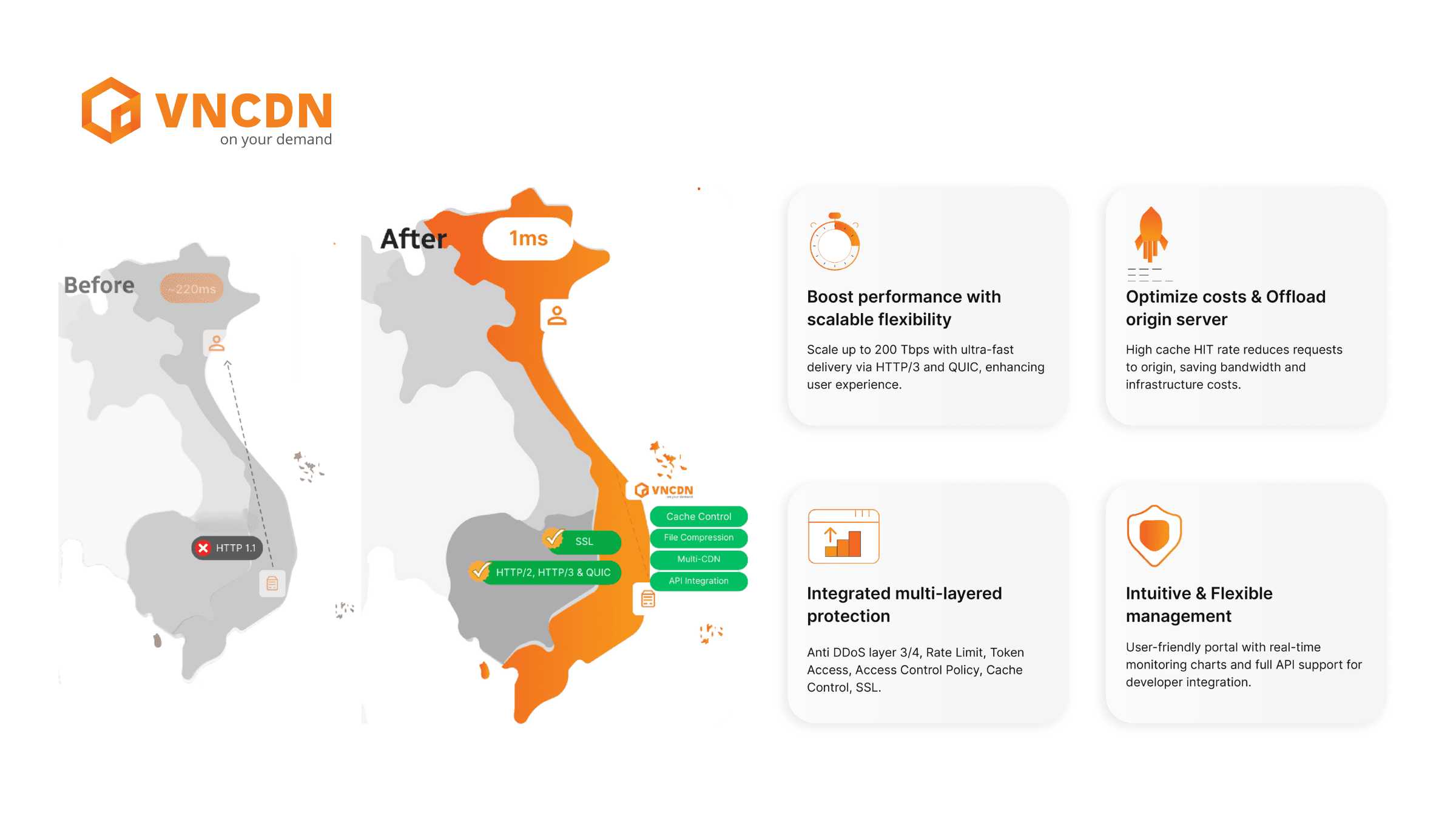
Deployed across Vietnam's top ISPs (Viettel, Mobifone, VNPT, FPT), it handles over 10 million concurrent users and 20 billion daily requests. Domestic uplink bandwidth exceeds 15 Tbps, with international reaching 200 Tbps.
VNCDN highlights include:
- Performance boost and flexible scaling: Supports the latest HTTP/3 and QUIC protocols, with bandwidth expandable to 200 Tbps.
- Cost optimization and origin offloading: Intelligent caching reduces requests and saves significant bandwidth.
- Robust security integration: DDoS protection at Layers 3/4, rate limiting, token access, SSL, and comprehensive access controls.
- Intuitive management: User-friendly portal, real-time dashboards, and API support for rapid developer monitoring and optimization.
Backed by powerful processing, multi-layered security, and 24/7 support, VNCDN is the ideal CDN solution to accelerate websites, streamline infrastructure costs, and deliver consistently smooth user experiences.
FAQ - Frequently Asked Questions About CDNs
1. What is a CDN ?
A Content Delivery Network (CDN) is a distributed system of servers positioned across various geographic locations. It accelerates, stabilizes, and secures data delivery from the origin server to end users. CDNs are particularly effective for static assets such as images, videos, CSS, JavaScript, and streaming media.
2. How does a CDN work ?
A CDN caches copies of static data on multiple edge servers. When a user requests content, it is served from the nearest edge server rather than the origin, resulting in faster page loads and reduced latency.
3. Does a CDN completely replace the origin server ?
No. A CDN only handles content distribution. The origin server remains responsible for storing source data, processing dynamic requests (APIs, databases, backend logic), and managing content updates.
4. Is a CDN necessary for small websites ?
Yes. Even with modest traffic, a CDN improves access speeds, especially for users in diverse regions. Fast and reliable performance is a critical factor for websites of any scale.
5. Does a CDN improve SEO rankings ?
A CDN enhances page load times and Core Web Vitals, indirectly supporting SEO. However, search rankings depend on multiple factors, including content quality, backlinks, site structure, and domain authority. A CDN cannot substitute for a comprehensive SEO strategy.
6. Does a CDN enhance security ?
Yes. CDNs mitigate and block network-layer DDoS attacks (Layers 3 and 4) through their distributed edge infrastructure. Many modern CDNs also integrate Web Application Firewalls (WAF) for application-layer protection (Layer 7), provide SSL/TLS encryption, and conceal the origin server IP, strengthening overall security.
7. How does a CDN differ from a load balancer ?
A load balancer distributes traffic across multiple servers within the same system, whereas a CDN delivers static content to users across global regions. The two are frequently combined to optimize performance and availability.
8. How do I choose the right CDN provider ?
Evaluate the following criteria:
- Coverage areas (PoP locations), prioritizing proximity to your target markets
- Response speed and reliability
- Integrated security features (WAF, DDoS protection, SSL)
- Pricing and depth of technical support
9. What makes VNETWORK’s VNCDN stand out?
VNETWORK operates a large-scale infrastructure with over 2,300 Points of Presence (PoPs) across 146 countries, deployed on leading ISP networks, powered by modern technology, and backed by 24/7 Network Operations Center (NOC) support. For businesses targeting users in Vietnam and Asia, VNCDN is a top-tier choice.