1. What is a CDN?
CDN (Content Delivery Network) is a system of multiple servers distributed across different geographic locations around the world, working in coordination to deliver website content to users as quickly and reliably as possible.
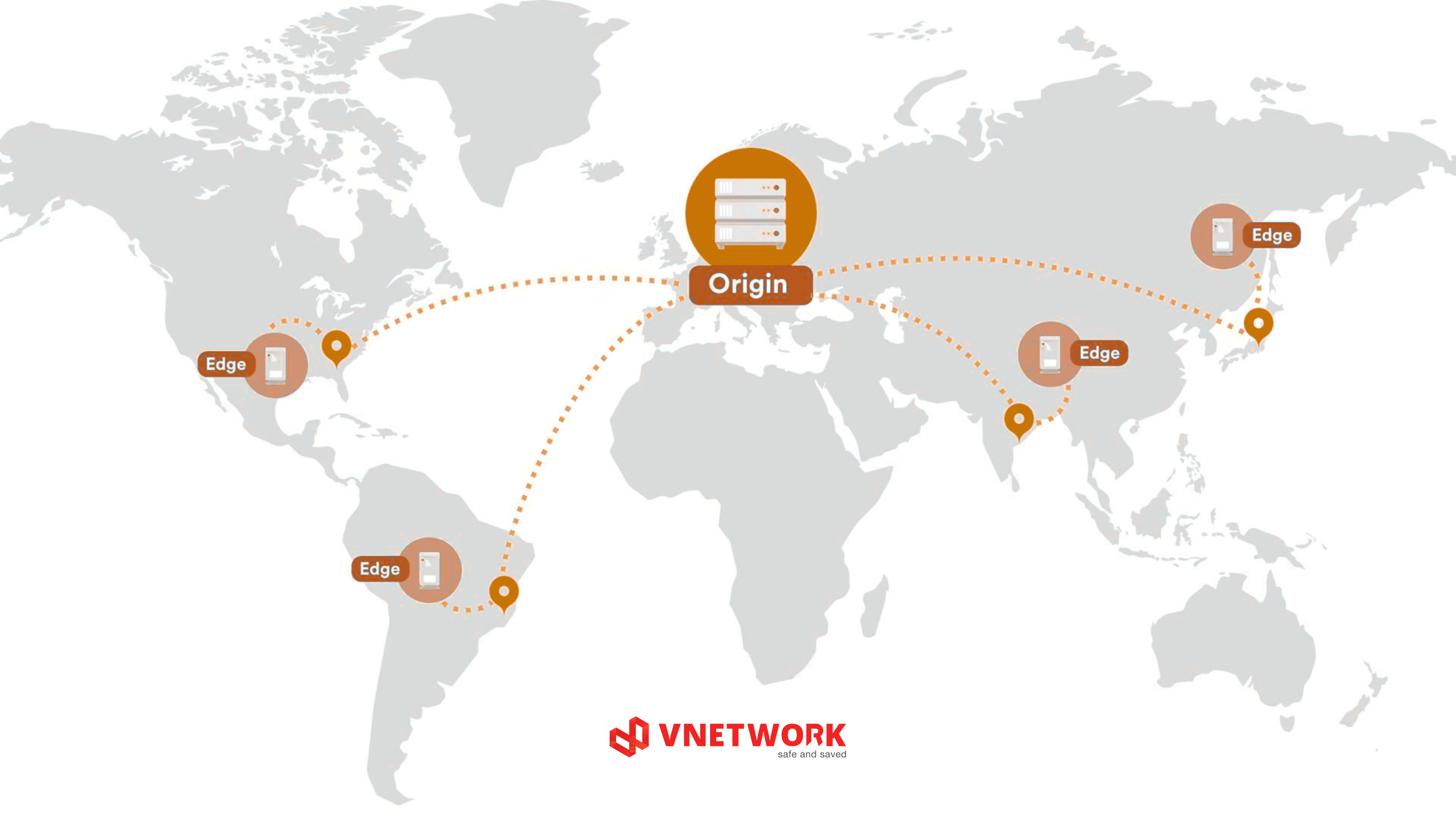
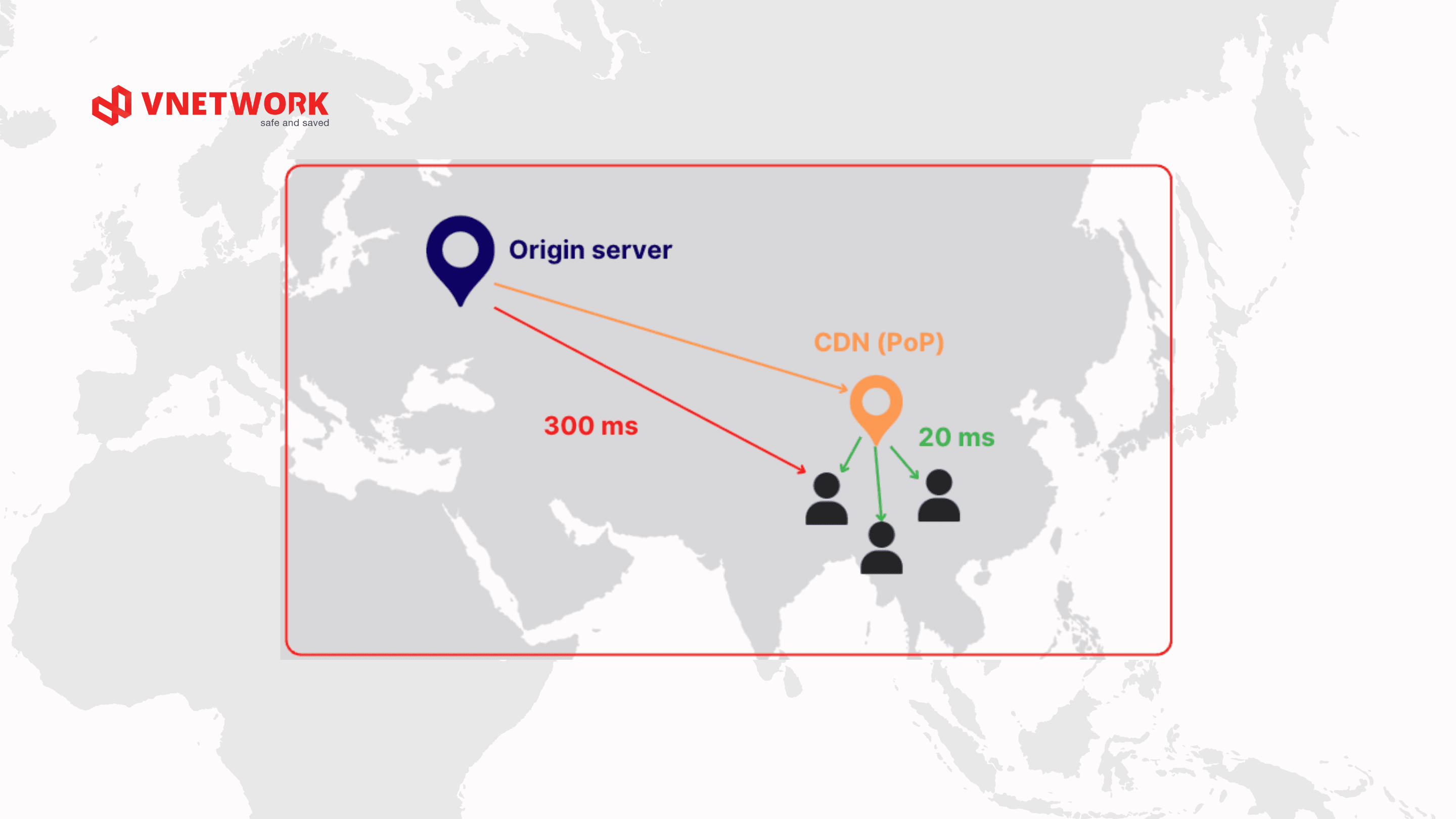
Instead of every access request having to travel all the way back to the origin server (Origin Server) located at a fixed location, a CDN automatically routes users to the nearest edge server (Edge Server) to retrieve content. As a result, page load times are significantly reduced, the load on the origin server decreases substantially, and the overall user experience is greatly improved.
A CDN works closely with the DNS system to route requests to the correct Edge Server. A CDN is also a complementary infrastructure layer for traditional hosting, not a replacement: hosting stores the original data and handles backend logic, while the CDN is responsible for distributing content to end users as quickly as possible.
2. The history and evolution of CDN
2.1 Three generations of CDN from 1998 to the present
CDN technology emerged in 1998, pioneered by one of the world's largest CDN providers at the time. The technology arose from the "Flash Crowd" phenomenon: major events caused sudden traffic spikes that brought down many websites. CDN was created to distribute load and ensure availability.
CDN development has gone through three main generations:
- Generation 1 (1998-2005): Focused on datacenter network connectivity and intelligent traffic management, primarily serving static content.
- Generation 2 (2005-2015): Addressed the explosion of audio and video streaming. Integrated cloud computing, optimized for mobile devices and VoD (Video on Demand).
- Generation 3 (2015-present): Community-based distributed CDN models, AI integration, edge computing, with a focus on optimizing end-user experience. Service costs have dropped significantly, making CDN a mainstream technology.
2.2 How does CDN differ from traditional hosting?
Hosting and CDN are two complementary infrastructure layers. The table below clarifies the key differences:
| Criteria | Traditional hosting | CDN |
| Server | 1 fixed location (e.g., Ho Chi Minh City) | Hundreds/thousands of PoPs worldwide |
| Geographic distance | Fixed — distant users = slow loading | Automatically selects the nearest server |
| Latency | High if user is far from datacenter | Low — content served from the edge |
| Scalability | Limited, requires hardware upgrades | Auto-scales with traffic |
| DDoS protection | Very limited | Absorbs and distributes attacks |
| Bandwidth cost | Expensive when traffic spikes | Significantly reduced through edge caching |
3. How does a CDN work?
To understand how a CDN works, follow the journey of an access request from a user in Vietnam to a website whose origin server is located in the United States.
Without a CDN, every request must travel a long route: from a user's computer in Hanoi, across thousands of kilometres of undersea fibre optic cables, all the way to a server in New York, and then back again. The greater the distance, the higher the latency.
With a CDN, that journey is dramatically shortened through 4 steps:
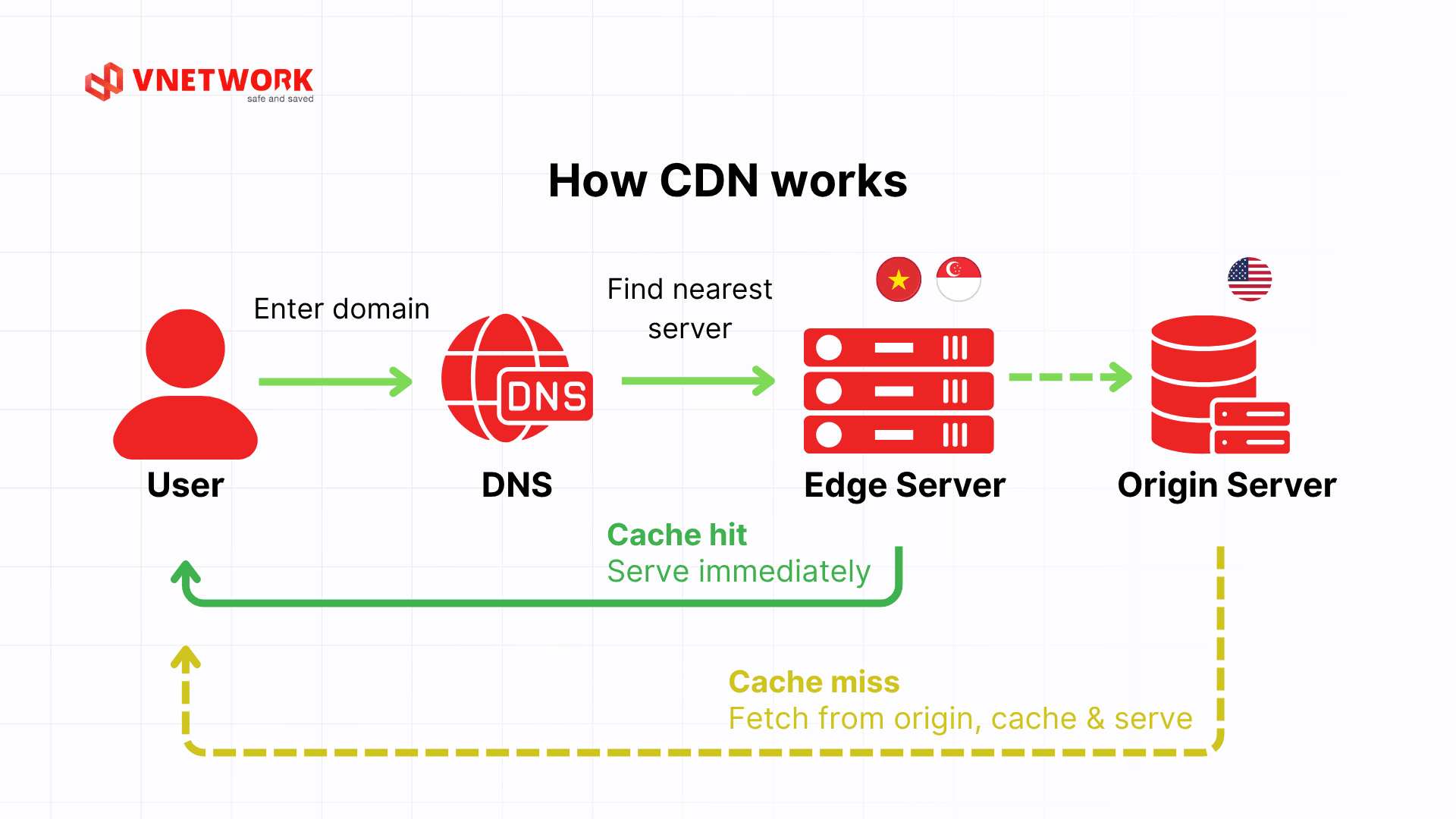
- Step 1: The user types a domain name into the browser. The browser queries the DNS system to find the server address.
- Step 2: The DNS recognises that the domain has CDN enabled, automatically finds the Edge Server nearest to the user, and returns the address of that server instead of the origin server in the US.
- Step 3: The browser connects directly to the nearest Edge Server, for example in Hanoi or Singapore.
- Step 4: The Edge Server checks whether the content is already stored in cache. If yes (cache hit): the content is returned immediately, with no need to contact the origin server in the US. If not (cache miss): the Edge Server pulls the content from the origin server, stores it in cache, and delivers it to the user. From that point on, subsequent users in the same region will receive the content directly from cache.
A simple analogy: imagine a nationwide convenience store chain. Instead of every purchase requiring a trip back to an overseas factory, the local warehouse already has stock ready to deliver on the spot.
What types of content does a CDN handle?
Not all content types behave the same way within a CDN:
- Static content (images, CSS, JavaScript, video, PDF files): Stored in cache at Edge Servers. All subsequent requests from the same region are served directly from cache, with no need to contact the origin server. This is the core strength that enables CDN to significantly accelerate page loading.
- Dynamic content (account information, shopping carts, transaction data): Cannot be cached because it changes per user. However, a CDN still supports dynamic content acceleration through network path optimisation, data compression, and TCP connection reuse.
How long does cache last?
Each piece of cached content has an expiration period called TTL (Time-to-Live). Once the TTL expires, the Edge Server retrieves fresh content from the origin server:
- Short TTL (minutes to hours): Suitable for frequently updated content such as news or product prices.
- Long TTL (days to weeks): Suitable for stable content such as logo images, CSS files, and product videos.
- Cache Purge (manual cache invalidation): Used when content needs to be updated immediately without waiting for the TTL to expire.
The first time a piece of content is requested, the Edge Server must pull it from the origin ("cache miss"), which is slower. From the second request onward, content is served from cache ("cache hit") at optimal speed.
4. Key benefits of CDN
4.1 Faster page loading and improved Core Web Vitals
A CDN accelerates page loading by automatically routing users to the nearest Edge Server rather than connecting back to the origin server at a fixed location. For e-commerce businesses, this means product pages and banner images load almost instantly during flash sales, rather than making customers wait and abandon their carts. A CDN also directly improves Core Web Vitals metrics such as LCP (Largest Contentful Paint), a factor that influences Google search rankings.
4.2 Reduced load on the origin server
Static files are stored in the Edge Server's cache, so the origin server does not need to reprocess every request. For websites receiving millions of visits per day, a CDN can reduce direct requests to the origin server by over 90%, allowing the system to operate stably and consume far fewer resources, especially during traffic spikes.
4.3 Optimised bandwidth and infrastructure costs
Because most content is served from Edge Servers, businesses significantly reduce international bandwidth costs and avoid heavy investment in centralised server infrastructure. This benefit is especially clear for businesses with large media content volumes, such as online news outlets, video platforms, and e-commerce marketplaces, where bandwidth costs typically account for a large share of total infrastructure operating expenses.
4.4 Enhanced security: DDoS protection and WAF integration
A CDN can protect against DDoS attacks at the network layer (Layer 3/4) within the OSI model. In particular, when combined with a web application firewall (WAF), a CDN can also block application-layer (Layer 7) attacks such as SQL Injection, XSS, and unauthorised access, helping to protect both the origin server and user data.
4.5 High availability and scalability
When an Edge Server within the CDN network encounters a failure, the system automatically triggers a failover mechanism, redirecting all traffic to another Edge Server without manual intervention. This capability is especially critical for financial institutions and banks, where any service interruption directly affects online transactions.
4.6 Stable global content delivery
With a network of PoPs (Points of Presence) deployed across multiple regions worldwide, a CDN ensures that website content is delivered quickly and consistently to users everywhere. Whether accessing from Vietnam, the United States, or Europe, users receive the same smooth and consistent experience. This is a key factor for businesses expanding into international markets or serving cross-border user communities.
5. Common CDN types
Not all CDNs operate under the same model. Below are four common CDN architectures and their core differences:
| CDN type | How it works | Advantages | Best suited for |
|---|---|---|---|
| Pull CDN | CDN fetches content from origin on demand | Easy setup; no manual uploads required | Blogs, standard websites |
| Push CDN | Admin proactively pushes content to CDN | Full control over cached content | Large files, software/game distribution |
| P2P CDN | End users act as distribution nodes | Low cost; leverages community resources | NGOs, decentralized streaming |
| Cloud CDN | CDN integrated into cloud platform | Easy management, flexible, AI/analytics integration | Enterprises using cloud computing |
Most Vietnamese businesses currently use Pull CDN or Cloud CDN. Cloud CDN is the leading trend due to its seamless integration with cloud infrastructure and modern management tools. For a deeper comparison of these models, refer to the comparison of Multi CDN vs Single CDN.
6. Which businesses need a CDN?
6.1 E-commerce and omnichannel retail
Flash sales and peak shopping seasons cause sudden traffic spikes in a short period. A CDN caches static content such as product images and banners, reducing the load on the origin server and maintaining stable page load speeds even with hundreds of thousands of concurrent users. For omnichannel retail models combining online, app, and in-store channels, a CDN delivers content uniformly across multiple channels through GSLB and automatic failover, ensuring a seamless customer experience at every touchpoint.
6.2 Finance, banking, and Fintech
The financial sector demands ultra-low latency and absolute security. A CDN combined with Layer 3/4 DDoS protection and WAF safeguards online transactions around the clock. When an Edge Server encounters a failure, the CDN's failover mechanism redirects traffic to another node within seconds, ensuring banking applications and payment gateways are never interrupted, even during peak hours or under attack.
6.3 Media, news, and video streaming
Breaking news can attract millions of visits within minutes. A CDN ensures articles, images, and videos load immediately, preventing server crashes at the most critical moments. For video streaming content, some CDN providers support HLS streaming distribution with low latency, ensuring stable broadcast quality to millions of screens simultaneously.
6.4 Online education, gaming, and mobile applications
Large lecture videos and PDF course materials need to be distributed to thousands of students simultaneously during peak hours. A CDN reduces latency and buffering issues during live sessions. For online game publishers and mobile app developers, a CDN also addresses two core challenges: shortening update file (patch) download times and reducing in-game latency (ping). Even SMEs with websites receiving fewer than 10,000 visits per month benefit from CDN, especially when using cloud storage for media and a CDN for delivery, helping to reduce bandwidth costs and improve Core Web Vitals scores for SEO.

7. How to choose the right CDN for your business
Not every CDN provider can meet every requirement. Use the following seven-point checklist to evaluate and select the right fit:
| Criteria | What to evaluate | |
|---|---|---|
| 1 | PoP coverage and infrastructure | Number of PoPs, geographic coverage in target regions (Vietnam, Southeast Asia, global) |
| 2 | DDoS protection and security | Layer 3/4 DDoS mitigation, WAF integration, SSL/TLS, Rate Limiting, Token Access |
| 3 | Feature set and protocol support | HTTP/3, QUIC, dynamic content acceleration, video streaming (HLS, DASH), image optimization |
| 4 | Flexible pricing model | Usage-based vs. flat-rate billing; SME-friendly packages available |
| 5 | SLA uptime and 24/7 support | Minimum 99.9% uptime commitment; technical support available 24/7 including public holidays |
| 6 | API and system integration | API support for automation; CI/CD pipeline integration; monitoring system compatibility |
| 7 | Real-time reporting and analytics | Intuitive dashboard; live traffic, bandwidth, and cache hit ratio charts |
When comparing the leading CDN providers available today, businesses should pay particular attention to PoP coverage in Vietnam and Southeast Asia, as this directly determines performance for domestic users.
8. VNCDN - A leading CDN provider in Asia
8.1 VNCDN infrastructure and technical capabilities
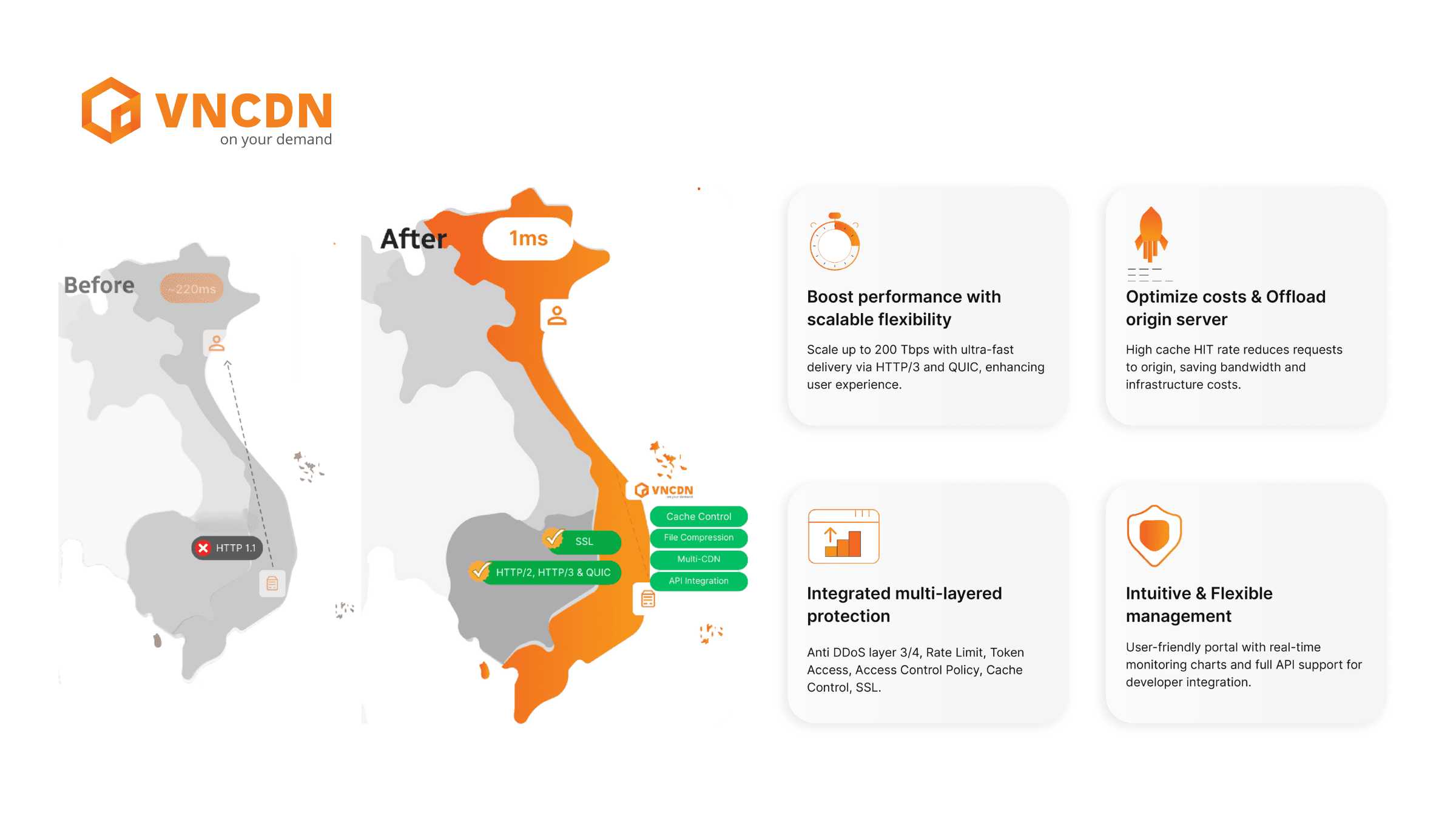
For businesses whose user base is primarily in Vietnam, choosing a CDN provider with infrastructure deployed directly in-country is a critical factor. VNETWORK's VNCDN has PoPs co-located and directly connected on the infrastructure of all major ISPs in Vietnam, including Viettel, Mobifone, VNPT, and FPT, ensuring content is always served from the point closest to the end user.
In terms of technical capacity, VNCDN supports up to 10 million concurrent users and 20 billion requests per day, with domestic uplink bandwidth reaching 15 Tbps. This infrastructure extends globally with over 2,300 PoPs across 146 countries and international bandwidth of 200 Tbps, meeting the demands of any scale, from e-commerce and media to finance and online education.
Key highlights of VNCDN:
- Performance improvement & flexible scaling: supports the latest HTTP/3 and QUIC protocols, with bandwidth scalable up to 200 Tbps.
- Cost optimisation & reduced origin server load: intelligent caching system that significantly reduces requests and saves bandwidth.
- Robust security integration: Layer 3/4 DDoS protection, Rate Limiting, Token Access, SSL, and comprehensive access control policies.
Intuitive & flexible management: easy-to-use portal interface, real-time charts, and API support enabling developers to monitor and optimise performance rapidly.
8.2 VTV x VNETWORK: Live broadcasting Vietnam's National Day to millions of screens
A live broadcast of the National Day parade leaves no room for error. Even a few seconds of buffering or signal loss would be felt immediately by millions of viewers watching simultaneously across the country.
VNETWORK partnered with VTV for this landmark event, taking full responsibility for the video distribution infrastructure. A high-quality live stream was delivered stably and continuously to every device, from smartphones and laptops to smart TVs, with zero interruptions throughout the entire broadcast.
This stands as the clearest proof of VNETWORK's capacity to operate large-scale video CDN infrastructure when the stakes are highest.

9. Conclusion
CDN is no longer technology reserved for large corporations. When every second of load time directly impacts revenue and customer experience, investing in a CDN is investing in sustainable business growth.
If you are looking for a CDN solution that is not only fast but genuinely built for Vietnam's internet infrastructure, VNCDN from VNETWORK backed by a 24/7 technical support team ready to guide your business from day one.
- Hotline 24/7: +84 (028) 7306 8789
- Email: contact@vnetwork.vn
- Learn more and start a free trial: vnetwork.vn/en-US/products/cdn/
FAQ - Frequently Asked Questions About CDNs
1. What is a CDN ?
A Content Delivery Network (CDN) is a distributed system of servers positioned across various geographic locations. It accelerates, stabilizes, and secures data delivery from the origin server to end users. CDNs are particularly effective for static assets such as images, videos, CSS, JavaScript, and streaming media.
2. How does a CDN work ?
A CDN caches copies of static data on multiple edge servers. When a user requests content, it is served from the nearest edge server rather than the origin, resulting in faster page loads and reduced latency.
3. Does a CDN completely replace the origin server ?
No. A CDN only handles content distribution. The origin server remains responsible for storing source data, processing dynamic requests (APIs, databases, backend logic), and managing content updates.
4. Is a CDN necessary for small websites ?
Yes. Even with modest traffic, a CDN improves access speeds, especially for users in diverse regions. Fast and reliable performance is a critical factor for websites of any scale.
5. Does a CDN improve SEO rankings ?
A CDN enhances page load times and Core Web Vitals, indirectly supporting SEO. However, search rankings depend on multiple factors, including content quality, backlinks, site structure, and domain authority. A CDN cannot substitute for a comprehensive SEO strategy.
6. Does a CDN enhance security ?
Yes. CDNs mitigate and block network-layer DDoS attacks (Layers 3 and 4) through their distributed edge infrastructure. Many modern CDNs also integrate Web Application Firewalls (WAF) for application-layer protection (Layer 7), provide SSL/TLS encryption, and conceal the origin server IP, strengthening overall security.
7. How does a CDN differ from a load balancer ?
A load balancer distributes traffic across multiple servers within the same system, whereas a CDN delivers static content to users across global regions. The two are frequently combined to optimize performance and availability.
8. How do I choose the right CDN provider ?
Evaluate the following criteria:
- Coverage areas (PoP locations), prioritizing proximity to your target markets
- Response speed and reliability
- Integrated security features (WAF, DDoS protection, SSL)
- Pricing and depth of technical support
9. What makes VNETWORK’s VNCDN stand out?
VNETWORK operates a large-scale infrastructure with over 2,300 Points of Presence (PoPs) across 146 countries, deployed on leading ISP networks, powered by modern technology, and backed by 24/7 Network Operations Center (NOC) support. For businesses targeting users in Vietnam and Asia, VNCDN is a top-tier choice.