
1. Why is the banking sector a prime target for DDoS attacks?
Before diving into the technical details, it is important to understand why banks consistently remain in the crosshairs of DDoS attacks. Banking institutions and financial organizations are priority targets for three core reasons: uptime directly impacts revenue, transaction data holds high value, and regulatory compliance pressure means that every incident carries serious consequences.
- Service availability is a matter of survival. In banking, every minute of downtime means thousands of cancelled transactions and direct and indirect financial losses worth millions. Internet banking, mobile banking apps, and interbank payment systems operate continuously 24/7. Unlike other industries, financial systems have no "maintenance window" that customers would find acceptable.
- The financial sector processes an enormous volume of sensitive data every day, including account information, transaction histories, and customer identity records. This makes banks a prime target for combined attacks: DDoS is used as a smokescreen to distract the security team while attackers simultaneously exploit other vectors to breach the system, creating the risk of a large-scale data breach.
- Regulatory pressure and brand reputation amplify the impact of every attack. Under the Cybersecurity Law and State Bank regulations, financial institutions must report incidents within specified timeframes and are held responsible for ensuring service continuity. A successful DDoS attack not only causes immediate financial losses but also leaves lasting legal consequences and erodes long-term customer trust.
Furthermore, the widespread availability of DDoS-for-hire services on the dark web has lowered the technical barrier to launching attacks, enabling even groups with limited technical expertise to target financial institutions at very low cost.

2. What is a DDoS attack?
So how exactly does this type of attack - the kind targeting banks - actually work? A DDoS (Distributed Denial of Service) attack is a form of cyberattack in which adversaries use thousands to millions of compromised devices to simultaneously flood a target system with requests, overwhelming it to the point where it becomes unavailable to legitimate users.
Unlike traditional DoS attacks launched from a single source, DDoS exploits a globally distributed network of malware-infected devices, commonly known as a botnet. This distributed nature makes mitigation far more complex than simply blocking a single IP address. Attackers can target multiple layers of a system simultaneously, from the network infrastructure layer all the way up to the application layer and transaction APIs.
There are three main categories of DDoS attacks that financial institutions need to understand:
- Volumetric attacks: overwhelm network infrastructure by flooding it with massive traffic volumes.
- Protocol attacks: exploit weaknesses at the network connection layer to exhaust server resources.
- Application-layer attacks (Layer 7): simulate legitimate user behavior to directly target transaction processing logic.
Depending on the objective and technique, each category requires a different defensive approach. This is especially dangerous for banking systems, which are already priority targets as analyzed above. It is why an effective DDoS protection solution for banks must provide simultaneous protection across multiple layers rather than blocking at a single point.

3. The challenges banks face when hit by a DDoS attack
Not all DDoS attacks leave the same consequences. For the banking sector, the impact extends far beyond purely technical disruption and directly affects the organization's revenue, reputation, and legal obligations.

3.1. Direct financial losses measured by the minute
Internet banking, mobile apps, and payment gateways are direct revenue channels for modern banks. Every minute of downtime during peak hours can cause thousands of transactions to be cancelled or fail, directly impacting service fee revenue, refund costs, and post-incident complaint handling. Unlike e-commerce, which can tolerate a brief maintenance window, banking systems have no "offline hours" that customers would consider acceptable.
3.2. Loss of customer trust is a long-term consequence that cannot easily be undone
When customers cannot log into their accounts or complete transactions when they need to, their first reaction is typically to question the bank's security capabilities. A DDoS attack covered by the media can trigger a wave of withdrawals, account closures, or migration to competitors. This type of damage does not materialize immediately but accumulates over time and cannot easily be offset by subsequent marketing campaigns.
3.3. Legal risk and compliance obligations when under attack
Under the Cybersecurity Law and Circular 09/2020/TT-NHNN, financial institutions are obligated to maintain service continuity and report information security incidents within the prescribed timeframe. A DDoS attack that causes prolonged disruption without a timely response is not just a technical incident; it constitutes a breach of legal obligations and may trigger regulatory inspections and associated penalties.
3.4. Risk of data theft
One of the most dangerous scenarios is not the DDoS attack itself but what happens behind it. While the security team is focused on responding to the DDoS traffic, attackers simultaneously exploit other vulnerabilities to breach the system, steal data, or plant malware. The risk of a data breach in this combined attack scenario is particularly serious for banks, as financial data and customer identity information commands very high value on underground markets.
4. Common DDoS attack types targeting banking systems
Understanding the technical mechanics of each attack type is the foundation for selecting an appropriate DDoS protection solution for banks. Each attack type targets a different layer of the OSI model and requires a distinct defensive approach.
4.1. Volumetric Layer 3/4 attacks that overwhelm network infrastructure bandwidth
This is the most common and most easily recognizable attack type. Attackers coordinate a botnet to simultaneously send hundreds of Gbps of traffic to the target system, consuming all available bandwidth. Typical techniques include UDP flood, SYN flood, and ICMP flood. Despite their straightforward mechanism, large-scale volumetric attacks can still overwhelm network infrastructure if there is no filtering system with sufficient capacity deployed at the upstream layer, before malicious traffic reaches the bank's infrastructure.
4.2. Protocol attacks that exploit weaknesses in connection mechanisms
This attack category does not require extremely high traffic volumes. Instead, it exploits weaknesses in how network devices handle connections. ACK floods and RST floods continuously generate abnormal packets that exhaust the state tables of firewalls and routers. The attack's effectiveness comes not from bandwidth but from the exhaustion of intermediate networking devices, rendering them unable to process legitimate connections.
4.3. Application-layer Layer 7 attacks targeting financial APIs directly
This is the most dangerous attack type for banking systems. Layer 7 attacks use syntactically valid HTTP/HTTPS requests to overwhelm the processing logic of application servers. Because the requests look identical to real traffic, traditional filtering solutions based on IP or port cannot detect them. Attackers can target login endpoints to trigger continuous encryption processing, balance inquiry endpoints to generate large numbers of database queries, or transaction APIs to exhaust the server's connection pool.
To detect and mitigate Layer 7 attacks, systems must be capable of analyzing request behavior in real time and distinguishing malicious bots from real users based on behavioral patterns rather than IP origin alone. This is why WAF and WAAP solutions with integrated AI have become indispensable components of a bank's application-layer defense architecture.
4.4. Ransom DDoS - organized attacks combined with extortion
Ransom DDoS (RDDoS) is a highly organized attack type that has grown significantly in the global financial sector. Attackers typically follow a structured process: they send a threat notice in advance, launch a demonstration attack to prove their capability, and then issue financial demands with a specific deadline. The hallmark of RDDoS is that it combines both volumetric and Layer 7 attacks simultaneously, aiming to bypass multiple layers of protection at once and maximize pressure on the target organization. For banks, the pressure is even greater because every hour of disruption has a measurable financial value, making the "pay or not pay" decision far more complex than in other industries. However, paying the ransom does not guarantee the attack will stop and typically encourages further attacks. Proactive defense is the only sustainable approach, including the ability to handle zero-day vulnerabilities that are often exploited in complex RDDoS scenarios.
The table below summarizes the technical characteristics of the main attack types:
| Attack type | Layer | Attack technique | Damage mechanism | Detectable by conventional solutions? |
| Volumetric | Layer 3/4 | UDP flood, SYN flood, ICMP flood | Saturates bandwidth, paralyzes network connectivity | Easy (anomalous traffic is clearly visible) |
| Protocol | Layer 3/4 | ACK flood, RST flood, Ping of Death | Exhausts state tables of network devices | Moderate |
| Application | Layer 7 | HTTP flood, API abuse, credential stuffing | Depletes transaction logic processing resources | Difficult (resembles legitimate traffic) |
| Ransom DDoS | Multi-layer | Combined volumetric + Layer 7 + extortion | Service disruption combined with financial threat | Difficult (multi-vector simultaneous) |
5. Security standards banks must comply with when deploying DDoS protection
Not every DDoS protection solution is suitable for the financial sector. Beyond technical capability, a solution deployed in a banking environment must simultaneously meet domestic legal requirements, international standards, and the operational requirements of a continuous 24/7 financial transaction system.
5.1. The Cybersecurity Law 2025 and Decree 53/2022 impose mandatory compliance requirements on banks
This is the most important mandatory legal framework for financial institutions in Vietnam. The Cybersecurity Law 2025 and Decree 53/2022/ND-CP classify banking information systems as critical national information infrastructure, requiring organizations to have proactive protection measures, conduct periodic reviews, and report cybersecurity incidents within 12 hours of detection. For DDoS attacks, this means organizations must not only have defensive solutions in place but also maintain clear, auditable incident recording, analysis, and reporting processes that regulatory authorities can inspect.
5.2. Circular 09/2020/TT-NHNN governs information security in electronic banking
Circular 09/2020/TT-NHNN issued by the State Bank of Vietnam sets out specific requirements for ensuring information system security in banking operations, including access control, continuous monitoring, and incident recovery capabilities. DDoS protection solutions deployed in a banking environment must meet the technical requirements of this circular: they must not store transaction data in violation of regulations, must support comprehensive logging for audit purposes, and must not increase transaction latency beyond permissible thresholds.
5.3. ISO 27001 establishes a comprehensive security management framework
Unlike the two regulatory requirements above, which are legally mandatory, ISO 27001 is an international standard that is highly recommended in the global financial sector. ISO 27001 provides a comprehensive information security management framework in which DDoS risk controls are integrated into periodic risk assessment processes and incident response plans. Banks that achieve ISO 27001 certification demonstrate a systematic commitment to security to partners, customers, and regulators, while also establishing a structured foundation for selecting and evaluating security solution providers.
The table below summarizes the key standards and their applicability to banking systems in Vietnam:
| Regulation / Standard | Specific requirements for banking systems | Applicability in Vietnam |
| Cybersecurity Law 2018 & Decree 53/2022 | Protect critical information systems, report incidents within 12 hours | Mandatory |
| Circular 09/2020/TT-NHNN | Ensure information security in electronic banking operations | Mandatory |
| ISO 27001 | Comprehensive information security management, systemic risk control | Highly recommended |
6. DDoS protection for banks: how VNIS safeguards financial systems
VNIS is an integrated Web/App/API security and acceleration platform designed to provide comprehensive protection for financial systems against multi-layer DDoS attacks, including Layers 3, 4, and 7, while maintaining zero impact on transaction latency. The entire VNIS architecture and operational processes are built to ISO 27001 standards, ensuring direct integration with a bank's information security management system without introducing compliance gaps.
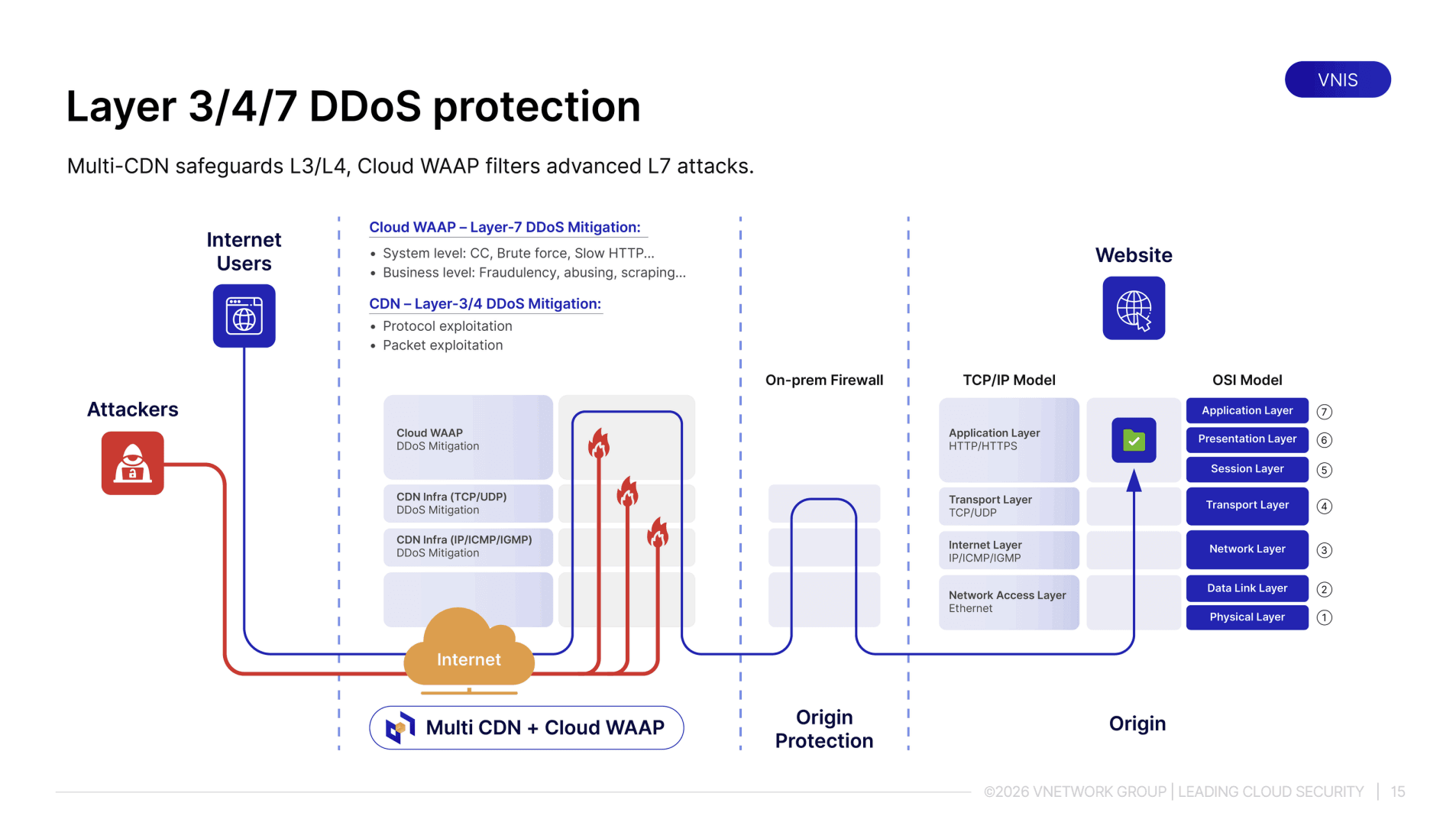
Banking systems cannot be effectively protected by a single-layer solution. Today's attacks combine multiple vectors simultaneously: while volumetric traffic assaults the network infrastructure, malicious HTTP requests quietly exploit transaction API logic. To counter this, VNIS deploys a two-layer protection model:
- Infrastructure-layer attack processing: AI Smart Load Balancing with a global Multi-CDN system to absorb and distribute Layer 3/4 DDoS traffic before it reaches the bank's infrastructure. AI continuously analyzes traffic behavior, automatically distributes legitimate traffic, and eliminates anomalous sources without requiring manual intervention. The system operates in real time, ensuring legitimate transactions are processed without interruption even during an active attack.
- Application and API protection layer: WAAP (Web Application and API Protection) applies AI to analyze every request in real time, identifying anomalous behavior and blocking Layer 7 DDoS attacks before they consume application server resources. Intelligent rate limiting based on behavioral analysis allows the system to distinguish real users from malicious bots even when they originate from the same IP address, satisfying the Zero Trust principles that banking systems require. Security rule sets are continuously updated against the OWASP Top 10 list and protect financial APIs against sophisticated abuse and exploitation attempts.
When an incident occurs, VNETWORK's SOC works directly with the bank's technical team to isolate the attack, analyze the root cause, and restore operations in the shortest possible time. All attack events are fully logged and can be exported as audit reports on demand from regulatory authorities, enabling banks to fulfill their incident reporting obligations under the Cybersecurity Law within the required timeframe. The entire process is automated to the greatest extent possible, minimizing manual intervention and the risk of human error under high-pressure conditions.

Given the specific characteristics of the banking and financial sector, the greatest advantage VNIS delivers is not just its ability to block attacks but its capacity to maintain a seamless transaction experience for customers throughout the incident handling process, while simultaneously providing the complete technical evidence banks need to fulfill their reporting and auditing obligations in accordance with current legal requirements.
7. Conclusion
DDoS attacks targeting banks are no longer a latent risk; they have become a real and present threat with growing frequency and sophistication. An effective DDoS protection solution for banks must provide simultaneous protection from the infrastructure layer through the application API layer, meet the regulatory requirements of the financial sector, and most importantly, maintain uninterrupted transaction service continuity even under active attack.
FAQ - DDoS Protection for Banks
1. Can a DDoS attack disrupt online banking transactions?
Yes. DDoS attacks targeting banking systems can overload network infrastructure or application servers, causing disruptions to internet banking, mobile applications, and payment gateways. Depending on the layer targeted and the level of protection in place, downtime can range from a few minutes to several hours if no appropriate defense solution is deployed.
2. What security standards must banks comply with when deploying DDoS protection?
Banks in Vietnam must comply with the Cybersecurity Law 2025, Decree 53/2022/ND-CP, and Circular 09/2020/TT-NHNN issued by the State Bank of Vietnam on information security in electronic banking. At the international level, ISO 27001, the Defense in Depth model, and a Zero Trust approach are the most widely adopted reference frameworks in the global financial sector.
3. How is a Layer 7 DDoS attack more dangerous than a Layer 3/4 attack for financial systems?
Layer 7 attacks simulate legitimate user behavior, making them undetectable by traditional firewalls and filtering solutions. This type of attack directly targets transaction processing logic and financial APIs, exhausting application server resources without requiring high traffic volumes. What makes them more dangerous is that Layer 7 attacks are often combined with volumetric attacks to simultaneously congest the infrastructure and exploit the application layer at the same time.
4. How does VNIS protect banking systems?
VNIS protects via a two-layer model: Layer 1 uses a global Multi-CDN and AI Smart Load Balancing to absorb and distribute Layer 3/4 DDoS attacks at the infrastructure level. Layer 2 deploys AI-integrated WAAP to analyze every request in real time, blocking Layer 7 DDoS, malicious bots, and OWASP vulnerabilities. A 24/7 SOC team provides continuous monitoring and timely incident response, ensuring banking systems maintain continuous operation even while under attack.
5. Does deploying a DDoS protection solution affect transaction speed?
When properly designed, a DDoS protection solution does not increase latency and can actually improve overall performance through traffic routing optimization via the Multi-CDN system. VNIS is optimized to handle traffic filtering at the distributed infrastructure layer, reducing the load on the bank's origin servers. In the case of FireAnt, data transfer performance during peak trading hours showed a clear improvement after deploying VNIS.