
1. What is Cloud Native?
Cloud Native is a methodology for building and operating applications designed specifically to take full advantage of the power of cloud computing environments. Unlike the traditional approach of moving existing applications to the cloud, Cloud Native requires applications to be designed from the ground up with a cloud-first mindset, featuring flexible scalability, self-healing, and continuous deployment.
Cloud Native is not a specific product or platform, but rather a set of principles, architectures, and technologies that enable software to operate optimally on cloud infrastructure. Cloud Native applications can run consistently across any environment, from a developer's personal computer to large-scale production systems, without being tied to specific physical infrastructure.
The Cloud Native Computing Foundation (CNCF), the leading standards body in this field, defines Cloud Native as the use of techniques such as containers, microservices, immutable infrastructure, and declarative APIs to build applications that are resilient, manageable, and observable. Combined with powerful automation, Cloud Native enables engineers to make high-impact changes frequently, easily, and predictably.
Under this definition, Cloud Native encompasses not only technology but also work culture and operational processes. An organization that truly adopts Cloud Native needs to shift its mindset from managing individual servers to managing a distributed service ecosystem, operating continuously and responding quickly to change.
.png)
2. Programming languages in Cloud Native applications
Cloud Native does not restrict programming languages, however certain languages are preferred due to their performance, tooling ecosystem, and integration capabilities with cloud platforms. Understanding the differences between IaaS, PaaS, and SaaS helps businesses better determine which infrastructure layer suits each language in a Cloud Native architecture.
- Go (Golang) is widely used in Cloud Native projects due to its ability to compile into compact binaries, high performance, and strong concurrency support. Many foundational tools such as Kubernetes and Docker are written in Go.
- Java remains popular in enterprise environments, particularly with frameworks like Spring Boot and Quarkus that are optimized for containerization.
- Python is extensively used in data processing, AI, and machine learning services within Cloud Native architectures.
- Node.js is suitable for microservices requiring low-latency asynchronous I/O processing.
- Rust is emerging as a choice for core components requiring maximum performance and memory safety.
The choice of language in Cloud Native architecture depends on each specific microservice. One of the advantages of this architecture is that each service can use the language best suited to its technical requirements, as long as it adheres to a common communication protocol.
3. Components of Cloud Native architecture
Cloud Native architecture is composed of multiple tightly integrated technology components. Understanding each component helps businesses plan effective deployments and avoid common mistakes when starting the transformation.
3.1 Microservices
Microservices is an architectural approach that breaks large applications into many small, independent services, each responsible for a specific business function. For example, an e-commerce platform can separate microservices for order management, payment, inventory management, and user notifications.
Each microservice can be developed, tested, deployed, and scaled completely independently from the others. This means a small team can update payment functionality without affecting the entire system. However, as the number of microservices grows, businesses need to invest in appropriate orchestration and monitoring tools to manage them effectively.
3.2 Containers
Containers are a technology for packaging applications along with all their dependencies (libraries, configurations, runtimes) into a single, consistent unit. Containers ensure that applications run identically across all environments, from a developer's local machine to production servers.
Docker is the most popular container standard and is supported by virtually all cloud platforms. As the number of containers grows, Kubernetes serves as a container orchestration tool, automating deployment, scaling, failure recovery, and load balancing across services. Cloud Native architecture relies heavily on the Docker and Kubernetes combination to ensure flexibility and stable operations.
3.3 DevOps and CI/CD
DevOps is a culture and set of practices that combines Development and Operations teams to shorten the software development lifecycle. In Cloud Native architecture, DevOps is not optional but a mandatory requirement to fully exploit the value of distributed architecture.
CI/CD (Continuous Integration and Continuous Delivery) is a pair of processes that automates code testing and deployment. CI ensures every code change is automatically tested as soon as it is pushed to the system, while CD automates the process of releasing new versions to the production environment. Thanks to CI/CD, Cloud Native development teams can release new features daily instead of monthly as in traditional models.
3.4 Dynamic infrastructure
Dynamic infrastructure in Cloud Native refers to the ability to provision, configure, and decommission resources on demand, typically through Infrastructure as Code (IaC). Instead of manually configuring servers, operations teams describe infrastructure as code (Terraform, Ansible) and automate the entire provisioning process.
The concept of immutable infrastructure is an important principle: instead of patching running servers, businesses create a new complete version and replace the old one. This approach eliminates environment inconsistencies and minimizes deployment risk.
3.5 Service mesh
A Service Mesh is an infrastructure layer that handles all communication between microservices in a Cloud Native architecture. Instead of each microservice independently managing retry logic, timeouts, encryption, and load balancing, the Service Mesh handles these tasks at the infrastructure layer, allowing application code to remain simple and focused on business logic.
A Service Mesh provides comprehensive observability, allowing operations teams to monitor traffic flows between each pair of services, detect bottlenecks, and quickly identify the root cause of failures. In environments with dozens to hundreds of microservices, a Service Mesh becomes an indispensable tool for ensuring system reliability.
3.6 Configuration and state management
Centralized configuration management is an essential requirement when deploying Cloud Native. Application configuration (connection strings, feature flags, API keys) must be separated from code and stored in a dedicated configuration management system, enabling configuration changes without rebuilding or redeploying the application.
State management in distributed architecture requires a different approach compared to monolithic applications. Cloud Native microservices are typically designed to be stateless where possible, with state stored in centralized databases or caches. This allows services to be scaled or restarted without losing user session data.
.png)
4. Architectural principles in Cloud Native applications
To build truly effective Cloud Native applications, engineering teams need to follow a set of architectural principles. These principles guide every design decision and help applications maintain flexibility and sustainability over time.
4.1 Design for automation
Every repetitive process in the application lifecycle, from testing and deployment to incident recovery, must be automated. Automation reduces human error, increases release velocity, and allows the system to operate at a high degree of self-sufficiency. A good indicator of Cloud Native architecture is when engineers can deploy a new version to production with a single command.
4.2 Understand and master system state
In distributed architecture, the system must be capable of self-assessing the state of each component and automatically recovering when it detects failures. This principle requires designing health check mechanisms, circuit breakers, and self-healing from the outset, rather than handling errors after problems have already occurred in the production environment.
4.3 Prioritize managed services
Cloud Native encourages businesses to use pre-managed services such as databases, message queues, and cloud storage, rather than self-managing all infrastructure. This approach reduces the operational burden on engineering teams, allowing them to focus on developing features that deliver real business value.
4.4 Practice defense in depth
Security in Cloud Native is designed in multiple layers, from the network, container, and application layers through to the data layer. The zero trust principle requires authentication and authorization for every request, including internal communications between microservices. This represents a fundamental shift from traditional security models that only protect the outer perimeter of the system, applying defense in depth across every layer.
4.5 Continuously review and innovate architecture
Cloud Native architecture is not a fixed destination but a continuous improvement journey. Businesses need to periodically reassess their architecture, experiment with new technologies, and be willing to refactor when necessary. A culture of experimentation and learning from failure is a key factor in maintaining competitiveness in a rapidly changing technology environment.
.png)
5. Key benefits of Cloud Native for businesses
Cloud Native delivers many practical benefits for businesses of all sizes. From startups that need rapid development speed to large enterprises that require high stability, Cloud Native can meet these needs when properly implemented.
5.1 Accelerated application development and deployment
With microservices architecture and CI/CD processes, development teams can work in parallel on multiple features without blocking each other. Release cycles are shortened from months to weeks or even days. Businesses can respond faster to user feedback and market changes, creating a clear competitive advantage over rivals still using traditional development models.
5.2 Long-term operational cost savings
Although the initial transformation cost may be high, Cloud Native helps optimize long-term operational costs through more efficient resource utilization. The pay-as-you-go model combined with automatic resource scaling means businesses only pay for what they actually use, rather than purchasing hardware upfront at a high fixed cost.
5.3 Flexible scalability and high availability
Cloud Native architecture allows individual microservices to be scaled independently based on actual demand, rather than scaling the entire application. When traffic spikes during peak periods, the system automatically allocates more resources to services under load and scales back down once demand subsides. High availability is ensured through multi-zone deployment and automatic self-healing mechanisms.
5.4 Enhanced resilience and reduced downtime
In microservices architecture, a failure in one service does not bring down the entire application. Circuit breaker mechanisms automatically isolate the failing service and redirect traffic to services that continue to operate normally. Combined with the self-healing capabilities of container orchestration, Cloud Native significantly reduces downtime compared to traditional monolithic models.
5.5 Improved security and automation
Cloud Native integrates cloud security into every layer of the architecture through a DevSecOps approach, rather than treating security as a separate step at the end of the development process. Automated vulnerability scanning in the CI/CD pipeline, centralized secrets management, and encrypted traffic between services become default standards in a Cloud Native environment.
5.6 Optimized operational costs
Operational automation through Infrastructure as Code and GitOps tools reduces repetitive manual work. Operations teams can manage hundreds of services with the same headcount previously required to manage a few dozen traditional servers. These personnel savings free businesses to reinvest in developing new features rather than simply maintaining existing infrastructure.
5.7 Improved user experience
Faster feature releases, higher availability, and lower response times directly improve the end-user experience. Businesses can conduct A/B testing to experiment with new features for a small group of users before full-scale deployment, reducing risk and ensuring product quality before it reaches customers.
6. Challenges when transitioning to Cloud Native
Transitioning to Cloud Native is a journey that requires careful preparation. Understanding common challenges helps businesses plan realistically and avoid common pitfalls during implementation.
6.1 Complexity management
Distributed microservices architecture creates significantly higher operational complexity compared to monolithic applications. Instead of monitoring a single application, operations teams need to track dozens to hundreds of individual services, with complex interdependencies. Tracing the root cause of incidents in a distributed environment requires specialized observability tools such as distributed tracing and log aggregation.
6.2 High specialized skill requirements
Cloud Native requires engineering teams to master multiple technologies simultaneously: containers, Kubernetes, CI/CD pipelines, Service Mesh, and Infrastructure as Code. These are advanced skills that most traditional IT teams do not yet possess, requiring significant investment in training and recruitment. The cultural shift from a shift-based operations model to an autonomous DevOps model is also a considerable challenge.
6.3 High initial transformation cost
The initial phase of transitioning to Cloud Native typically requires significant investment in tooling, training, and re-architecting legacy applications. Decomposing monolithic applications into microservices is a complex, time-consuming process that can risk service disruption if not carefully planned. Businesses need to carefully consider the migration roadmap to balance long-term benefits against short-term costs.
6.4 Robust infrastructure platform requirements
Cloud Native requires an infrastructure platform capable of supporting container orchestration, managed databases, monitoring, and logging at scale. An unsuitable data center or infrastructure platform will create technical bottlenecks and negate many of the benefits Cloud Native offers. Choosing the right cloud infrastructure partner, especially one familiar with local context and compliance requirements, is a key factor for a successful transformation.
7. Popular Cloud Native services
The Cloud Native service ecosystem includes many specialized services supporting each layer of the architecture. Below are the most commonly used service categories in real-world Cloud Native deployments.
7.1 Container registry
A Container Registry is a centralized repository for container images. This service allows development teams to build an image once and deploy it consistently across any environment. Container Registries are typically tightly integrated with CI/CD pipelines to automatically build, scan for security vulnerabilities, and distribute new images when code is updated.
7.2 Notification service
Notification services in Cloud Native architecture handle asynchronous communication between microservices and deliver notifications to users across multiple channels such as email, SMS, and push notifications. Event-driven architecture based on message queues reduces direct dependencies between services, increasing the overall fault tolerance of the system.
7.3 Real-time data processing (streaming)
Streaming services enable processing of continuous data streams with low latency, suited for applications requiring real-time analytics such as financial transaction monitoring, user behavior tracking, and system incident alerting. Streaming is a core component in large-scale event-driven Cloud Native architectures.
7.4 Container engine for Kubernetes
Container Engine for Kubernetes is a fully managed Kubernetes service provided by cloud providers, enabling businesses to deploy and operate Kubernetes clusters without managing the control plane themselves. This service automatically updates Kubernetes versions, handles worker node scaling, and provides built-in integration with the platform's security, monitoring, and logging services.
7.5 Functions (serverless)
Serverless Functions allow code to run on a per-event basis without managing servers or containers. This model is suitable for non-continuous processing tasks such as image resizing, webhook handling, scheduled report generation, or responding to events from other services. Serverless automatically scales to zero when there are no requests, optimizing costs for intermittent workloads.

8. VCLOUD — The cloud computing platform optimized for Cloud Native architecture
In the current context of rapid digital transformation, Cloud Native is becoming an inevitable trend for businesses looking to build flexible, highly scalable applications that operate reliably in cloud environments. However, to truly maximize the value of Cloud Native, choosing the right infrastructure platform plays a pivotal role.
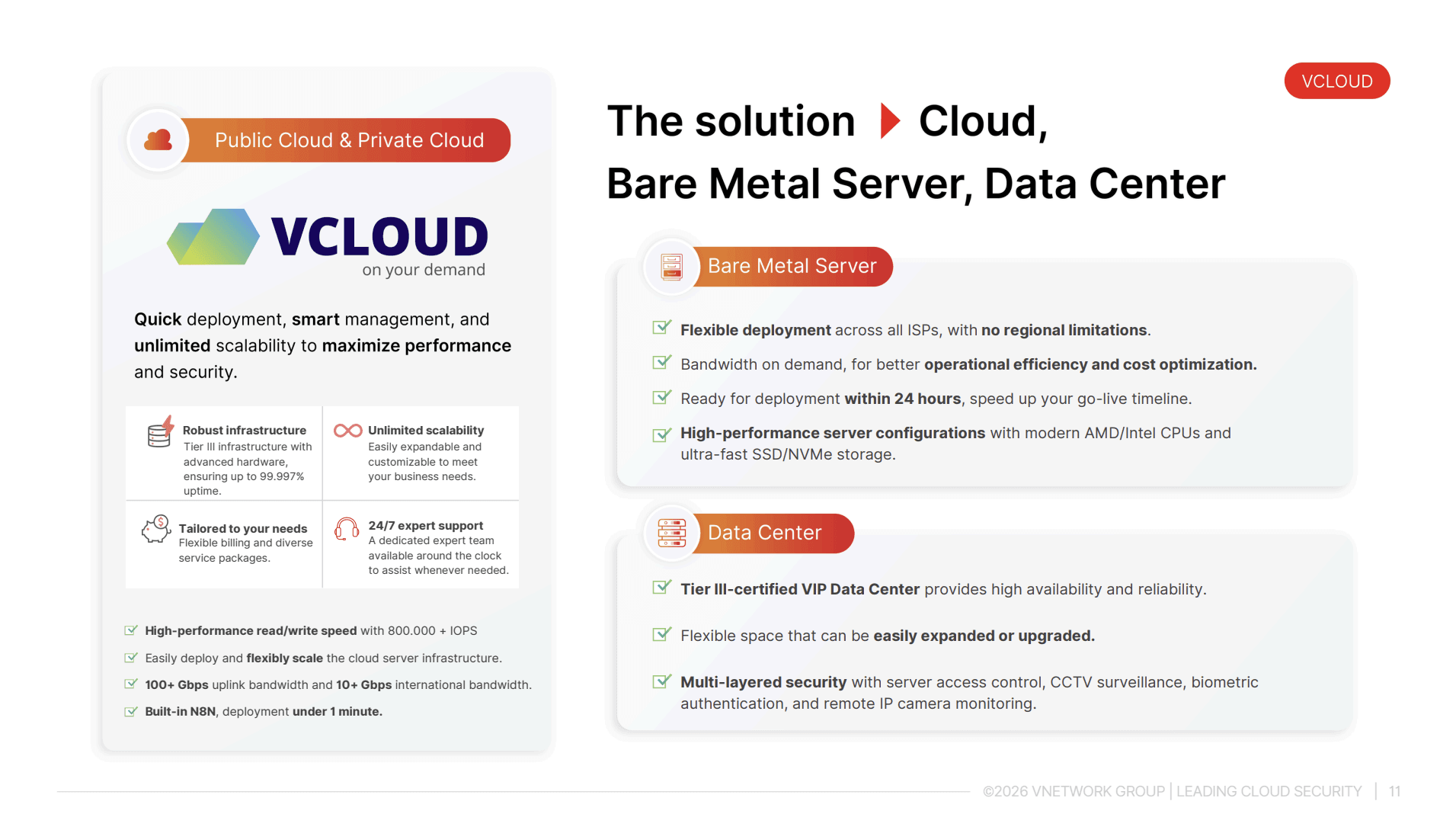
VCLOUD by VNETWORK is a Cloud and infrastructure solution designed with strong support capabilities for Cloud Native applications. Beyond simply providing server resources, VCLOUD delivers a complete ecosystem that helps businesses easily adopt and operate this modern architecture.
When building Cloud Native applications, organizations commonly face challenges around container management, orchestration, observability, and security. VCLOUD helps address these issues through its key capabilities:
- Flexible Hybrid Cloud deployment capability, combining Public Cloud, Private Cloud, and Bare Metal Server, suited to data control and regulatory compliance requirements in Vietnam.
- Comprehensive security layer with WAF, Anti-DDoS, and Security Group, together with a Tier 3-certified Data Center infrastructure, ensuring high availability (uptime up to 99.997%) and rapid recovery.
- Support for AI systems, Big Data, and high-performance cloud storage, suited to businesses processing large-scale data in real time.
- VNETWORK's technical team provides 24/7/365 support, from model selection consulting and deployment to continuous operations.
As a result, businesses using VCLOUD not only transition to Cloud Native faster but also operate more reliably, reduce long-term costs, and accelerate time to market. Rather than investing heavily in an infrastructure operations team, businesses can focus their resources on feature development and improving the user experience.
With experience supporting hundreds of businesses in Vietnam, VNETWORK understands the practical challenges of implementing Cloud Native. VCLOUD is the platform built to help Vietnamese businesses overcome those barriers effectively and sustainably.
Conclusion
Cloud Native is no longer a future trend; it has become the standard for modern software development. By combining microservices, containers, DevOps, and flexible infrastructure, Cloud Native enables businesses to build highly scalable, fast-recovering, and continuously deployable applications. While the transformation journey is not without challenges, the benefits in terms of development speed, operational costs, and user experience are clear and measurable.
FAQ — Frequently asked questions about Cloud Native
1. How is Cloud Native different from traditional applications running on the cloud?
Traditional applications running on the cloud (also known as lift and shift) simply move existing applications to virtual servers without changing the architecture. Cloud Native is entirely different: applications are redesigned from the ground up to fully leverage cloud characteristics through microservices distribution, container packaging, CI/CD automation, and on-demand resource scaling. The result is that Cloud Native applications offer superior scalability, availability, and development speed compared to applications that are simply migrated to the cloud.
2. Do small and medium-sized businesses need to adopt Cloud Native?
Cloud Native is not exclusively for large enterprises. Many small and medium-sized businesses have successfully applied Cloud Native principles at a scale appropriate to their size. Cloud Native can be especially beneficial for startups and SMEs because it helps reduce infrastructure costs through a pay-as-you-go model, accelerates product development, and creates a scalable technical foundation as the business grows. The key is to choose an appropriate level of adoption and have a clear roadmap rather than trying to implement everything at once.
3. Is Kubernetes mandatory in Cloud Native architecture?
Kubernetes is the most popular container orchestration tool and is recommended for use in medium to large-scale Cloud Native deployments, but it is not mandatory in every situation. For small-scale applications or teams without much experience, businesses can start with simpler solutions such as Managed Container Service or Serverless Functions. Kubernetes should be adopted when businesses have sufficient workloads to justify the operational complexity it introduces.
4. How long does it take to transition to Cloud Native?
The time required to transition to Cloud Native depends on the scale of the current application, the complexity of the architecture, and the technical team's capabilities. A small application can be re-architected in a few months, while a large enterprise system may take one to two years to complete a full transformation. The recommended approach is incremental migration (the strangler fig pattern), starting with new features or the least risky modules, then gradually expanding to the entire system.
5. What Cloud Native technologies does VCLOUD support?
VCLOUD comprehensively supports the Cloud Native ecosystem, including Managed Kubernetes for container orchestration, Containers as a Service for rapid application deployment, Managed Database (MySQL, PostgreSQL, MongoDB, Redis) to reduce database administration burden, CI/CD Pipeline integration, and observability tools such as Monitoring, Logging, and Distributed Tracing. VCLOUD also supports a Hybrid Cloud model combining Public Cloud, Private Cloud, and Bare Metal Server, suited to the data compliance requirements of businesses in Vietnam.