
1. What is cloud service?
Cloud service is a model for delivering IT resources over the internet on demand, including servers, storage, networking, software, and application development platforms, with third-party providers managing the underlying infrastructure.
Instead of building and maintaining an in-house IT system, enterprises access cloud resources via internet connection and pay based on actual usage. This model eliminates the burden of upfront hardware investment, reduces operating costs, and allows technical teams to focus on product development rather than infrastructure management.
Cloud service differs fundamentally from the traditional on-premise model: instead of purchasing servers, perpetual software licenses, and hiring operations staff, enterprises shift to a flexible service subscription model. Resources can scale up or down based on actual load without any service interruption. This is the foundation of modern cloud computing.

2. Benefits of cloud service for enterprises
Cloud service delivers numerous practical benefits to enterprises of all sizes, from startups to large corporations. Below are the core benefits that most organizations report after migrating to the cloud:
- Lower upfront investment costs: Enterprises do not need to purchase physical servers, networking equipment, or storage systems. Large CAPEX outlays are converted to flexible OPEX, billed monthly or hourly based on actual usage.
- Instant resource scaling: Cloud systems allow CPU, RAM, and storage capacity to increase within minutes without service interruption. This is especially important for businesses with traffic that fluctuates seasonally or around specific events.
- Access from anywhere: Teams can work remotely, accessing applications and data over the internet without being tied to a specific location or device.
- Security and international compliance: Reputable cloud providers operate data centers certified to international standards (Tier III, ISO 27001), with integrated firewalls, data encryption, and multi-layer access controls.
- Automated backup and disaster recovery: Data is backed up regularly and can be restored quickly after an incident, minimizing data loss risk and downtime that could impact business operations.
- Comprehensive digital transformation support: Cloud service is the foundational infrastructure for AI, Big Data, data analytics, and process automation applications, helping enterprises accelerate digital transformation in an increasingly competitive landscape.
- Reduced burden on IT teams: Cloud providers take responsibility for operating, maintaining, and updating infrastructure, freeing internal technical teams to focus on higher-value projects.
- Compliance with data regulations: In particular, using cloud services from providers with domestic infrastructure helps enterprises meet local data storage requirements under Law No. 91/2025/QH15 and Data Law 2024. This factor is increasingly critical for businesses in finance, healthcare, and e-commerce, where customer data must be stored and processed in accordance with regulations to avoid legal risk.
3. Common types of cloud service
There are three fundamental cloud service models, differentiated by the layer of resources provided and the degree of control retained by the enterprise. Understanding each type helps businesses select the right model for their actual needs, avoiding budget waste on unnecessary features or resource shortfalls during operations.
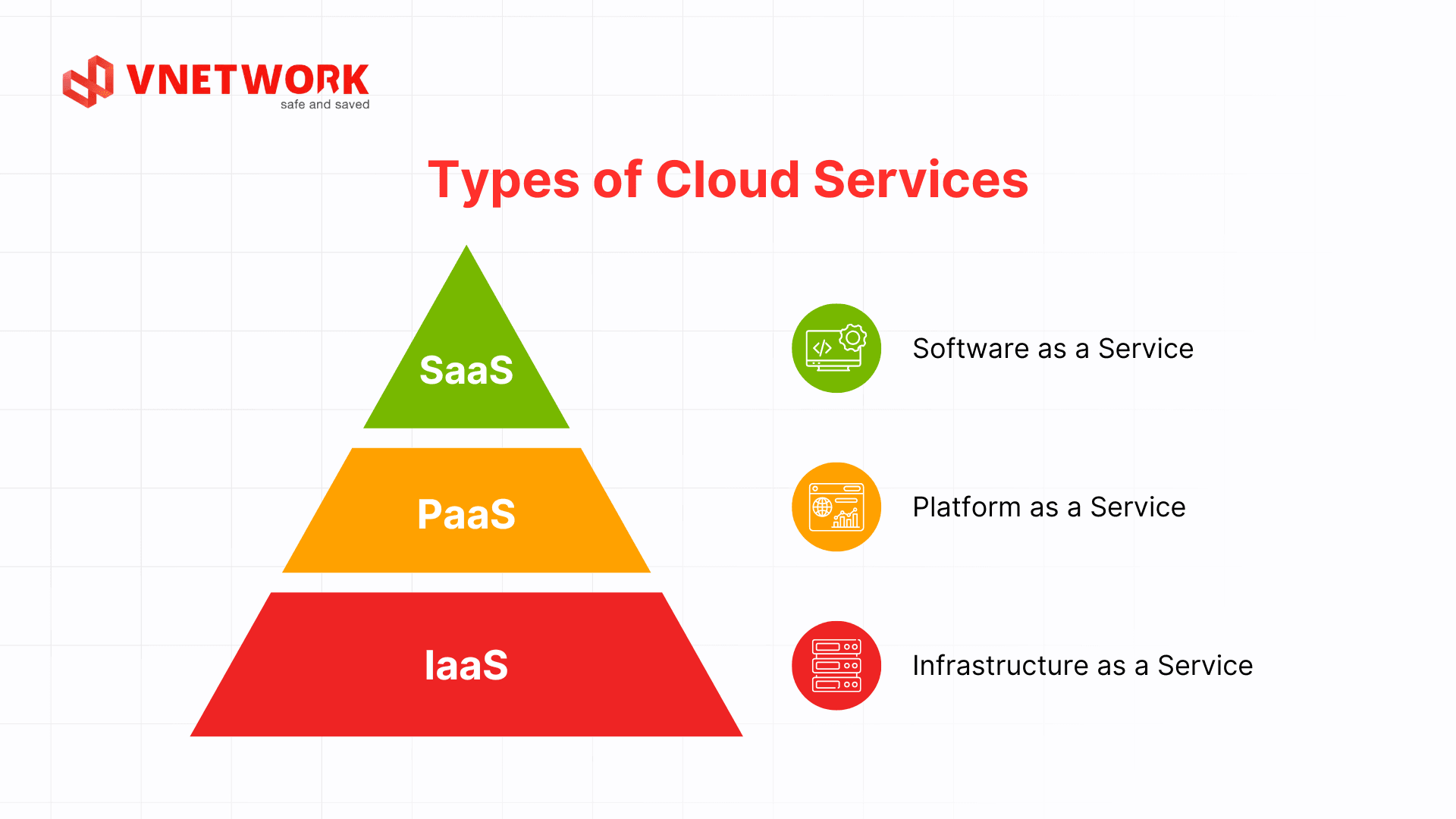
3.1. IaaS - Infrastructure as a Service
IaaS provides the raw infrastructure layer, including virtual machines, storage capacity, networking, and compute power. The provider manages the underlying physical hardware and virtualization layer, while the enterprise retains full control over the operating system, middleware, and applications deployed on top.
IaaS is suited for IT managers and experienced technical teams who need flexibility to customize environments to specific requirements. It is also a popular choice when enterprises want to migrate on-premise systems to the cloud without changing their existing application architecture. VPS is a widely adopted form of IaaS used by many SMEs.
3.2. PaaS - Platform as a Service
PaaS provides a complete application development platform including runtimes, frameworks, databases, and CI/CD tooling. The provider manages all underlying infrastructure, and development teams focus solely on writing and deploying code without dealing with OS installation or patching.
PaaS significantly reduces time-to-market, particularly for software development teams looking to accelerate build-test-deploy workflows. Systems with Kubernetes support for container orchestration are commonly integrated into the PaaS layer of modern cloud providers.
3.3. SaaS - Software as a Service
SaaS is a fully managed software application delivered via a web browser, requiring no installation or technical management from end users. Providers manage the entire stack from infrastructure and platform to application, continuously pushing feature updates and security patches.
SaaS is the most popular and accessible model, suitable for enterprises without a dedicated IT team or those looking to deploy quickly without technical staff. Business email management, CRM, ERP, and collaboration tools all fall under the SaaS category.
4. Cloud deployment models
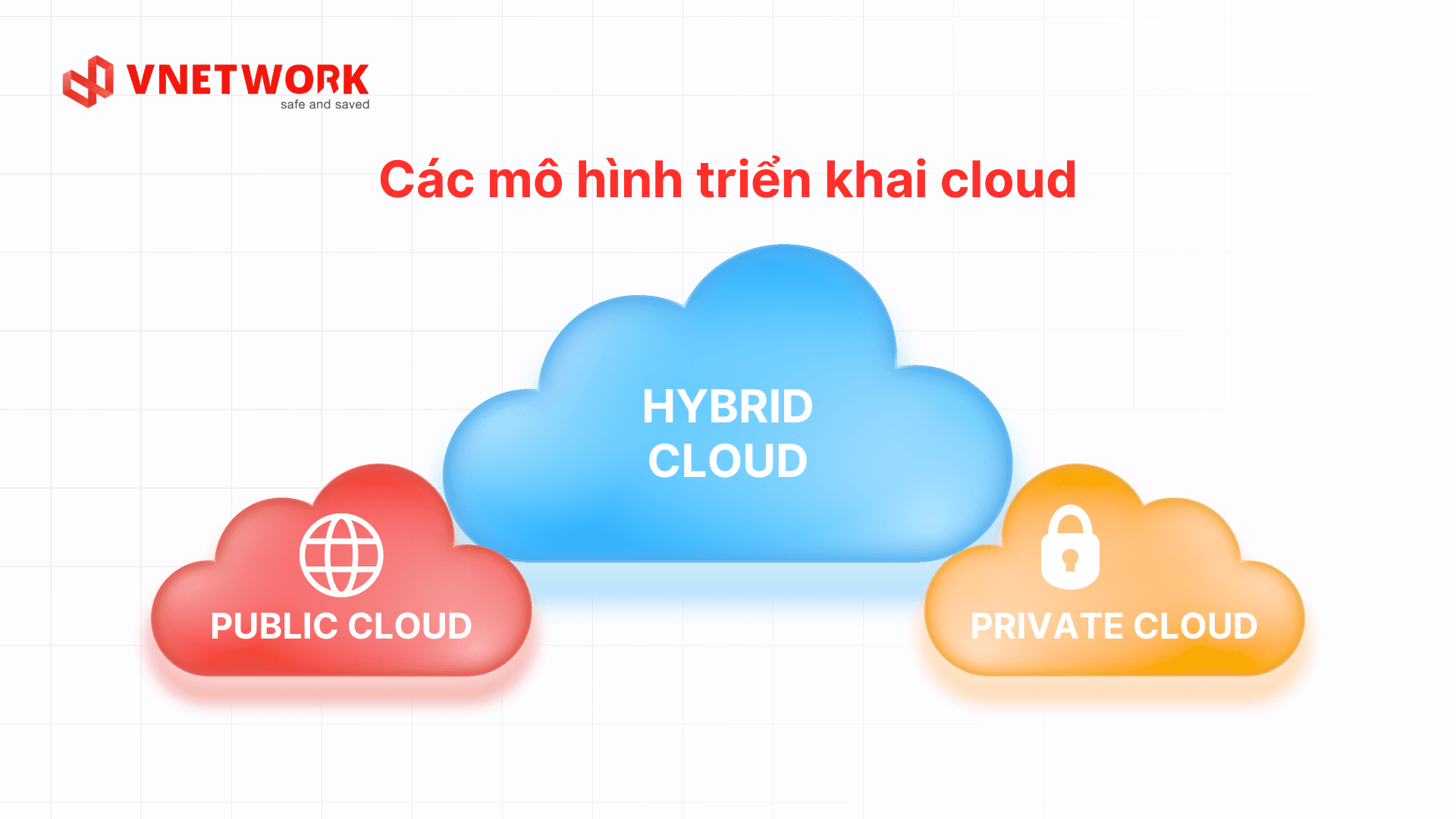
In addition to the service type (IaaS/PaaS/SaaS), enterprises need to select a cloud deployment model that fits their security requirements, budget, and data governance strategy. The three main models are Public Cloud, Private Cloud, and Hybrid Cloud, each with distinct characteristics in terms of cost and level of control.
4.1. Public Cloud
Public Cloud is a shared-infrastructure cloud service model (multi-tenant) fully managed by a third-party provider. Enterprises access resources over the internet and pay based on actual usage, with no hardware investment or maintenance required.
Public Cloud is well suited for SMEs, startups, and workloads with variable traffic patterns. Low cost and near-unlimited scalability are the primary advantages. However, because infrastructure is shared, enterprises have less control over the underlying hardware layer.
4.2. Private Cloud
Private Cloud deploys cloud infrastructure exclusively for a single organization, either on-premise at an internal data center or operated by a provider with complete isolation (hosted private cloud). The enterprise retains full control from hardware to security configuration.
Private Cloud is suited for large enterprises in finance and healthcare, as well as government agencies with high data security and legal compliance requirements. Operating costs are higher, but in return the enterprise gains near-absolute control and customization.
4.3. Hybrid Cloud
Hybrid Cloud combines both Private Cloud and Public Cloud, allowing data and applications to move flexibly between the two environments. Enterprises store sensitive data on private cloud while using public cloud for lower-risk workloads or temporary scaling needs (cloud bursting).
Hybrid Cloud is becoming the preferred approach for many enterprises and mid-sized businesses because it balances security, control, and cost effectively. This model is particularly suited for organizations transitioning from on-premise infrastructure to the cloud, allowing phased migration without requiring a full system replacement.
The table below summarizes the three cloud deployment models:
| Criteria | Public Cloud | Private Cloud | Hybrid Cloud |
| Cost | Low, pay-as-you-go | High, infrastructure investment | Medium, flexible |
| Control | Limited | Full control | High for private portion |
| Security | Provider standard | Custom per requirements | Flexible combination |
| Scalability | Very easy, instant | Limited by hardware | Flexible per workload |
| Best for | SMEs, startups, variable workloads | Enterprises, finance, healthcare | Businesses needing both |
5. Key technical metrics in cloud service
Before signing a contract with any provider, enterprises need to understand measurable technical indicators to accurately evaluate real service quality and avoid being swayed by vague commitments in marketing materials.
- SLA (Service Level Agreement) / Uptime: The guaranteed service availability expressed as a percentage per year. A 99.9% SLA (three nines) equates to roughly 8.7 hours of downtime per year, while 99.99% allows only about 52 minutes. Enterprises should read SLA terms carefully to understand the scope of compensation when a provider misses its commitment, as many contracts only issue service credits rather than compensating for actual losses.
- RTO (Recovery Time Objective): The maximum time allowed for full system recovery after an incident. A lower RTO means faster recovery but typically requires higher redundant infrastructure costs. For business-critical workloads, an RTO under 4 hours is a commonly accepted target.
- RPO (Recovery Point Objective): The maximum amount of data that can be lost after an incident, typically measured in units of time. An RPO of 1 hour means the backup system must run at least once per hour. For financial or e-commerce applications, RPO should be kept as low as possible to prevent transaction loss.
- Scalability: Measures the speed and degree to which a system can increase or decrease resources (CPU, RAM, storage, network) in response to actual load. Auto-scaling without downtime is the minimum standard to require. Enterprises should distinguish between vertical scaling (upgrading a single instance) and horizontal scaling (adding new instances), as each suits different application architectures.
- Latency: The response time between end-user devices and cloud resources, directly impacting end-user experience. Providers with data centers in Vietnam or nearby regions help achieve sub-50ms latency, significantly improving performance for real-time or streaming applications.
- IOPS (Input/Output Operations Per Second): A metric measuring the read and write performance of cloud storage. Low IOPS is a common cause of slowdowns in database applications, e-commerce platforms, and transaction processing systems. Enterprises should request specific IOPS figures for each storage tier rather than relying solely on capacity specifications.
- Bandwidth and egress costs: Many cloud providers charge separately for outbound data transfer (egress traffic), a cost often overlooked when estimating initial budgets. Enterprises should verify the provider's bandwidth pricing policy and estimate actual system traffic volumes before signing any contract.
6. Criteria for selecting a cloud service provider

Technical metrics indicate what a service can achieve, but they are not sufficient to make a decision. Below are the qualitative and quantitative criteria to evaluate when comparing providers, particularly in the context of enterprises optimizing long-term infrastructure costs:
- Actual uptime and operational history: Prioritize providers who can supply historical uptime reports, not just contractual commitments. A stable operational track record over multiple years is more reliable evidence than any SLA figure presented in sales materials.
- Domestic data center infrastructure: Providers with data centers in Vietnam ensure low latency, compliance with domestic data storage requirements under Data Law 2024 and Law No. 91/2025/QH15, and reduced risk during international connectivity disruptions.
- International security certifications: Require proof of ISO 27001, SOC 2, or Tier III certification to ensure infrastructure is managed at a professional security level. This is a mandatory criterion for enterprises in finance, healthcare, and education.
- Transparent pricing model: Avoid providers with complex pricing structures or undisclosed surcharges. Request detailed quotes based on actual usage scenarios to accurately compare total cost of ownership (TCO).
- Scalability and service plan flexibility: Providers should allow resources to be scaled up or down easily without generating large migration fees. This is especially important for growing businesses or those with seasonally variable workloads.
- Proactive technical support: 24/7 support teams with clearly committed response times, with preference for providers whose engineers understand the Vietnamese business context and can offer support in the local language. For organizations without a dedicated internal IT team, support quality effectively substitutes for in-house technical personnel.
- Backup and data recovery policy: Confirm the frequency of automated backups, backup retention period, and specific recovery procedures. Reputable providers should be able to demonstrate a real restore process so enterprises can verify it independently before signing a contract.
- Integration with existing systems: Verify connectivity with ERP, CRM, or in-house management software currently in use. Comprehensive APIs and clear technical documentation are signs of a provider with a mature ecosystem, which helps reduce integration costs and shorten deployment timelines.
- Product development roadmap: Providers with long-term infrastructure investment plans and continuous feature updates will help enterprises avoid costly platform migration when technology needs evolve in the future.
7. VCLOUD - Cloud service platform from VNETWORK
In the Vietnamese cloud service landscape, VNETWORK positions VCLOUD as a cloud computing platform built specifically for the Vietnamese enterprise context, where requirements for low latency, domestic data compliance, and native-language technical support are as important as technical specifications.
Key features of VCLOUD:
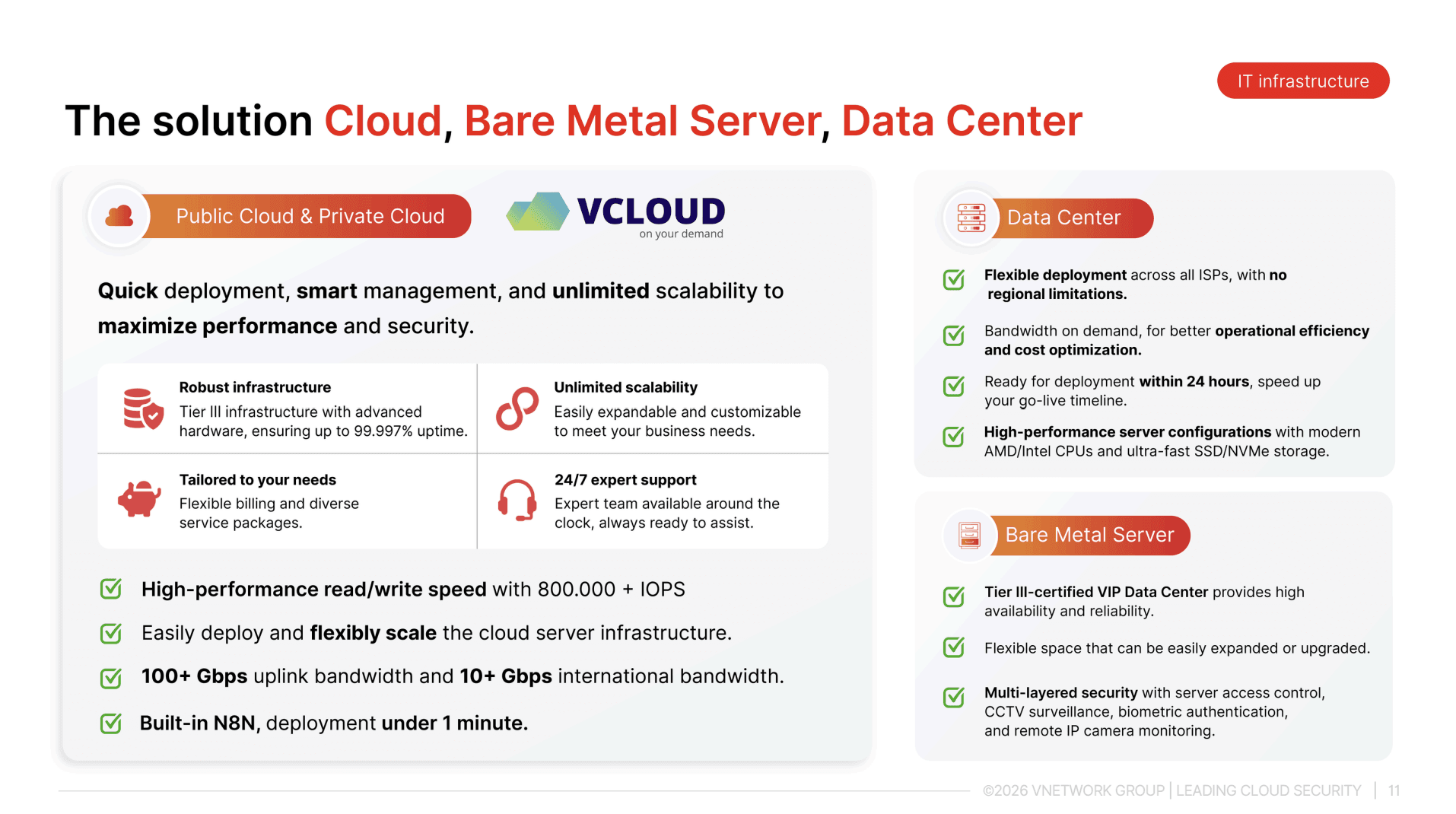
- Tier III infrastructure, high uptime: VCLOUD operates on a Tier III-certified international data center system, ensuring high availability and minimizing service disruption risk. Suitable for continuously operating systems such as e-commerce, finance, and enterprise applications.
- High-performance storage for AI and Big Data: VCLOUD's high-speed storage infrastructure handles systems requiring high IOPS such as high-traffic websites, AI applications, and big data processing pipelines.
- Multi-layer security, ISO 27001 certified: Integrates Firewall, Security Groups, two-factor authentication (2FA), and SSH Key Pairs for strict access control. VCLOUD complies with ISO 27001, meeting the cloud security requirements of enterprises in finance, healthcare, and education.
- Auto-scaling without downtime: Automatically increases or decreases CPU, RAM, and storage capacity based on actual load without service interruption. Enterprises can start with a small configuration and scale flexibly as they grow.
- 24/7/365 technical support: VNETWORK's technical team is always ready to respond to incidents promptly, with practical knowledge of Vietnamese enterprise infrastructure and applications.
Reasons for Vietnamese enterprises to prioritize VCLOUD in their cloud service selection journey:
- Domestic infrastructure, data residency in Vietnam: VCLOUD helps enterprises comply with domestic data storage regulations under Law No. 91/2025/QH15, avoiding legal risk when customer data is stored on overseas servers.
- Comprehensive security and acceleration ecosystem: When using VCLOUD within the VNETWORK ecosystem, enterprises can easily add DDoS protection, WAF, and CDN layers from a single provider, reducing operational complexity and accelerating incident resolution.
- Transparent pricing, budget-friendly: VCLOUD offers a clear pay-per-use pricing model with no hidden fees, and a consulting team that helps enterprises select cost-optimized configurations suited to each stage of growth.
8. Conclusion
Cloud service is no longer the exclusive domain of large enterprises. With flexible payment models, instant scalability, and international-standard security systems, cloud service is becoming the foundational infrastructure for any organization seeking to optimize IT costs and accelerate digital transformation. Choosing the right service model (IaaS, PaaS, or SaaS), deployment type (public, private, or hybrid), and provider will determine long-term return on investment. Contact VNETWORK today for consultation on the VCLOUD solution best suited to your enterprise's scale and industry.
FAQ - Frequently asked questions about cloud service
1. What is the difference between cloud service and cloud computing?
Cloud computing is a general concept referring to the model of delivering IT resources over the internet. Cloud service refers to the specific services built on the cloud computing platform, including IaaS, PaaS, and SaaS. Cloud computing is the underlying technology foundation, while cloud services are the products and services delivered on top of that foundation.
2. Should small and medium enterprises (SMEs) use cloud service?
Cloud service is particularly well suited to SMEs because it eliminates the burden of upfront infrastructure investment. Rather than purchasing servers and hiring operations specialists, SMEs can start with a small configuration, pay monthly, and scale as needed. This allows SMEs to access enterprise-grade infrastructure technology with a flexible budget.
3. How is the cost of cloud service calculated?
Most cloud providers use a pay-as-you-go model, billing hourly or monthly based on actual resource consumption (CPU, RAM, storage, bandwidth). Some providers also offer reserved instance plans at lower rates for enterprises with stable, long-term workloads.
4. Is cloud service safe for enterprise data?
Reputable cloud providers apply multiple layers of security including data encryption at rest and in transit, role-based access control, firewalls, and continuous security monitoring. Enterprises should choose providers that hold ISO 27001 certification and have clearly defined backup and data recovery policies to ensure maximum data protection.
5. When should an enterprise move from public cloud to hybrid cloud?
Enterprises should consider hybrid cloud when they have sensitive data (customer information, financial records, medical data) that must be stored internally per legal requirements, while lower-risk applications can continue running on public cloud to benefit from lower costs and scalability. This is a common model for fast-growing businesses or those operating in finance, healthcare, and education.