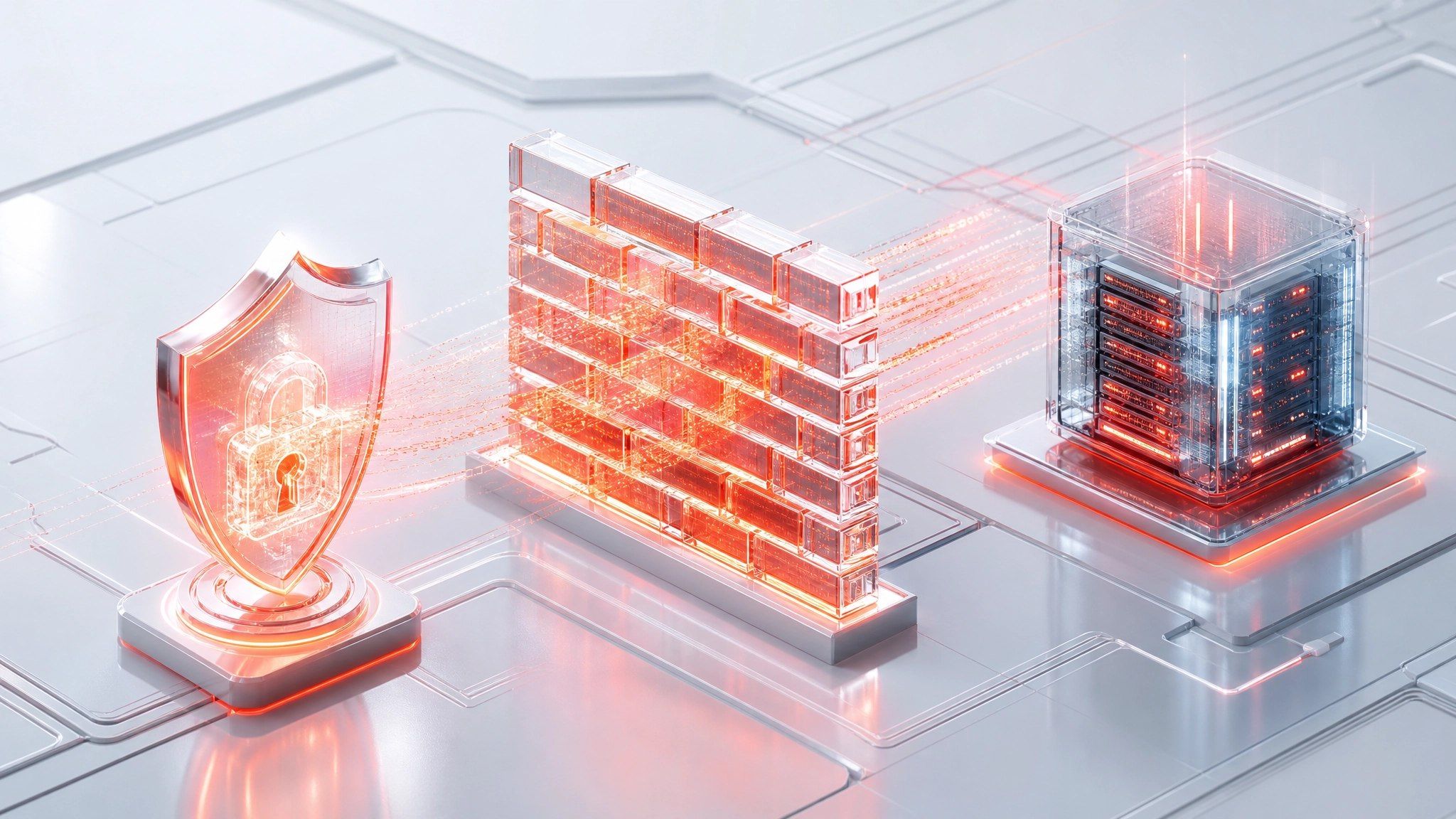
1. What is an enterprise firewall?
An enterprise firewall is a network security system designed to inspect and filter all data traffic flowing in and out of an organization's network environment. According to the National Institute of Standards and Technology (NIST SP 800-41), a firewall is a device or program that controls network traffic flow between networks or hosts with different security policies. At the enterprise level, a firewall does more than filter packets: it enforces a comprehensive security policy across the entire infrastructure.
Unlike personal firewalls, enterprise firewalls are deployed as a core component of a multi-layered security architecture. They control connections from the external internet into internal systems while segmenting the internal network to restrict access between sensitive departments such as accounting, human resources, and central administration systems. NIST emphasizes that organizations frequently need to deploy firewalls to satisfy mandatory standards such as PCI DSS (Payment Card Industry Data Security Standard) and FISMA.
From a technical perspective, enterprise firewalls operate in a layered model derived from the OSI model. Next-generation firewalls (NGFW) can inspect traffic from the network layer (Layer 3/4) all the way up to the application layer (Layer 7), including Deep Packet Inspection. This enables firewalls to identify specific applications, verify user identity, and maintain detailed event logs for security auditing.
2. Why do organizations need a firewall?
The modern business environment demands continuous connectivity across multiple systems, remote workers, cloud applications, and external partners. Each connection point is a potential attack surface. Threats such as DDoS, SQL Injection, XSS, and zero-day exploits can all compromise a system without sufficient traffic control layers in place.
Specifically, an enterprise firewall addresses these core security needs:
- Network access control: Allows only authorized traffic in and out, blocking unauthorized connections from external sources as well as lateral movement within the network toward sensitive segments.
- Threat detection and prevention: Next-generation firewalls integrate Intrusion Prevention Systems (IPS), access control list (ACL) filtering, and real-time behavioral anomaly analysis.
- Regulatory compliance: Many international standards including PCI DSS, ISO 27001, and Vietnam's Law on Cybersecurity require organizations to implement network traffic control solutions.
- Logging and auditing: Enterprise firewalls record all access logs and security events, supporting incident investigation and compliance reporting.
- Network segmentation: Dividing the network into segments limits the blast radius of an incident, an essential requirement in a Zero Trust architecture.
For organizations undergoing digital transformation, firewalls also serve as the foundation for extending security coverage to cloud environments, web applications, and APIs without disrupting business operations.
3. How does an enterprise firewall differ from a standard firewall?
While a standard firewall protects a single device or a simple connection point, an enterprise firewall must secure a complex network environment with multiple segments, many users, and numerous applications running concurrently.

Main distinctions:
- Scale and performance: Enterprise firewalls handle traffic from thousands to millions of concurrent sessions, while standard firewalls typically serve only a few dozen devices in a small local network.
- Centralized management: Enterprise firewalls support centralized security policy management across the entire infrastructure rather than manual configuration of individual devices.
- Redundancy and high availability: Enterprise environments require firewalls that operate continuously 24/7 with failover and load balancing mechanisms to ensure uninterrupted service.
- Compliance and auditing: Enterprise firewalls provide detailed logs, compliance reports, and SIEM integration to satisfy audit requirements under standards such as ISO 27001.
4. Common types of enterprise firewalls
Depending on their scale, industry, and infrastructure architecture, organizations can choose from a range of firewall types. The following are the most widely used, based on the classification in NIST SP 800-41 and international security research.
4.1 Packet filtering firewalls
Technical mechanism: Operate primarily at the network layer (Layer 3) and transport layer (Layer 4). The device examines the header fields of each individual packet including source/destination IP addresses, source/destination ports, and protocol type (TCP, UDP, ICMP) and compares them against an access control list (ACL).
Benefits: The primary strength is performance optimization through near-zero latency hardware-level processing. However, the main limitation is the lack of session-state awareness or application-layer content visibility, making it susceptible to advanced attack techniques.
4.2 Stateful inspection firewalls
Technical mechanism: Addresses the limitations of packet filtering by maintaining a state table that tracks the full lifecycle of each connection session. Rather than inspecting only headers, the device also validates whether an incoming packet belongs to a previously established, legitimate communication session.
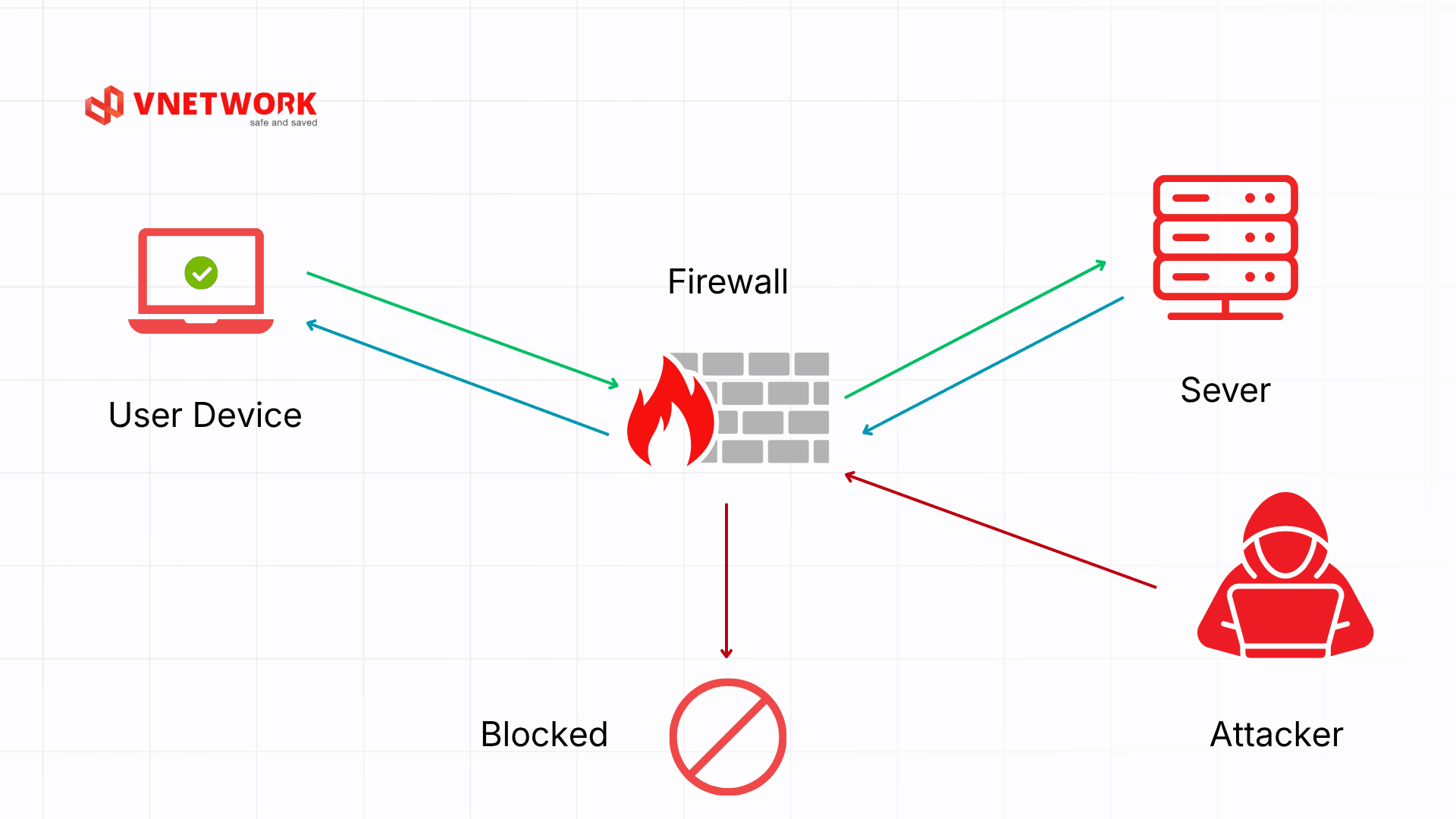
Benefits: Significantly enhances security by blocking port scanning and packet spoofing attacks. The system achieves an optimal balance between internal network security capability and operational performance.
4.3 Application-proxy gateways / Application-level firewalls
Technical mechanism: Acts as a full intermediary at the application layer (Layer 7). Unlike other firewalls that allow packets to pass through directly, an application proxy terminates the connection from the source, fully inspects and processes the data payload, and then initiates a new connection on behalf of the user to the destination.
Benefits: Provides maximum security by completely concealing the internal network structure from the outside and enabling deep analysis of application protocols such as HTTP, FTP, and SMTP. The trade-off is that this mechanism consumes significant hardware resources and introduces latency, which can create a performance bottleneck.
4.4 Next-generation firewalls (NGFW)
Technical mechanism: Represents a recognized convergent evolution in security standards. NGFW combines traditional stateful inspection with Deep Packet Inspection (DPI) to accurately identify the specific application in use and the identity of the user, regardless of whether the application attempts to disguise itself by using standard ports such as port 80 or 443.
Benefits: Enables enforcement of granular, practical security policies, for example allowing staff to use SaaS applications for productivity while blocking configuration file downloads. Integrates built-in Intrusion Prevention System (IPS) architecture and threat intelligence feed connectivity.
4.5 Unified Threat Management (UTM)
Technical mechanism: A unified security platform that consolidates multiple independent security functions into a single device or service. Within a UTM appliance, organizations can simultaneously run a stateful inspection firewall, Intrusion Detection and Prevention System (IDS/IPS), VPN gateway, web content filtering, antivirus, anti-malware, and email filtering, all managed through a single interface rather than multiple separate systems.
Benefits: UTM enables small and medium-sized businesses (SMBs) to deploy comprehensive security without needing a specialized IT team or a large budget to operate multiple parallel solutions. Management costs are significantly lower since only one platform needs to be configured, monitored, and updated. However, in very high-traffic environments, routing all functions through a single point can create a performance bottleneck, which is why larger enterprises typically prefer specialized solutions for each security layer.
4.6 Web Application Firewall (WAF)
Technical mechanism: While the firewall types above control traffic at the network and transport layers, a WAF operates exclusively at the application layer (Layer 7), reading and analyzing the full content of every HTTP/HTTPS request. WAF is deployed in reverse proxy mode: all incoming requests from external users pass through the WAF before reaching the application server. The WAF then matches each request against security rulesets to detect exploitation attempts such as SQL Injection, Cross-Site Scripting (XSS), Command Injection, path traversal, and vulnerabilities listed in the OWASP Top 10.
Benefits: A WAF directly protects web application and API business logic from exploitation, even when the application contains unpatched vulnerabilities (virtual patching). This is a key differentiator: an NGFW cannot protect a web application from SQL Injection because it does not read HTTP content, whereas a WAF is purpose-built for exactly this task. WAF also supports inspection of TLS/SSL-encrypted traffic, detailed per-request and anomalous-response logging for incident investigation, and can integrate automatic bot filtering and rate limiting to block brute-force attacks and data scraping.
4.7 Virtual infrastructure firewall
Technical mechanism: When organizations migrate infrastructure to a virtualized environment (VMware, Hyper-V) or a cloud platform, traditional physical firewalls can no longer inspect traffic moving between virtual machines (VMs) on the same physical host because this data flow bypasses physical network devices. Virtual infrastructure firewalls are deployed directly within the hypervisor layer or as virtual appliances, enabling inspection and control of east-west traffic between VMs within the same host.
Benefits: In modern cloud and data center architectures, the majority of sensitive traffic moves laterally between internal services (VM-to-VM, container-to-container) rather than crossing the network perimeter. If a VM is compromised, a physical firewall cannot prevent an attacker from moving laterally to another VM on the same host. Virtual infrastructure firewalls address this gap precisely by establishing security segmentation within the virtual infrastructure and applying Zero Trust policies to each individual workload. This is especially important for organizations using microservices or container architectures (Docker, Kubernetes) where dozens of small services continuously communicate with one another.
5. Criteria for selecting an enterprise firewall
Choosing the right firewall is a strategic decision that directly affects long-term security effectiveness and operational costs. Organizations need to clearly define their security objectives and current network architecture before making a choice. Below are the core criteria to consider.
5.1 Alignment with network scale and architecture
The firewall must be compatible with the existing network topology and flexible enough to adapt as infrastructure evolves. Small and medium-sized enterprises (SMEs) may favor integrated multi-function solutions, while large enterprises typically require specialized firewalls for each network segment.
5.2 Performance and high-load capacity
The firewall must maintain stable performance under peak traffic conditions without introducing significant latency. Key metrics to evaluate include maximum throughput, concurrent session count, and the ability to inspect SSL/TLS traffic without degrading application performance.
5.3 Threat detection and prevention capabilities
Organizations need a firewall that integrates IPS with continuously updated rulesets, supports real-time threat analysis, and can identify malware, ransomware, and emerging attack patterns. The ability to integrate external threat intelligence is a significant advantage.
5.4 Centralized management and visibility
An intuitive management interface, centralized policy configuration, and detailed reporting help IT teams maintain visibility across the entire security posture. Organizations with multiple branches should prioritize solutions that support remote management and integration with centralized monitoring systems.
5.5 Compliance with security standards
The firewall must help the organization meet requirements from standards such as PCI DSS (mandatory for payment card processors), ISO 27001, HIPAA (healthcare), or regulations under Vietnam's Data Law 2024 and Personal Data Protection Law.
5.6 Technical support and security updates
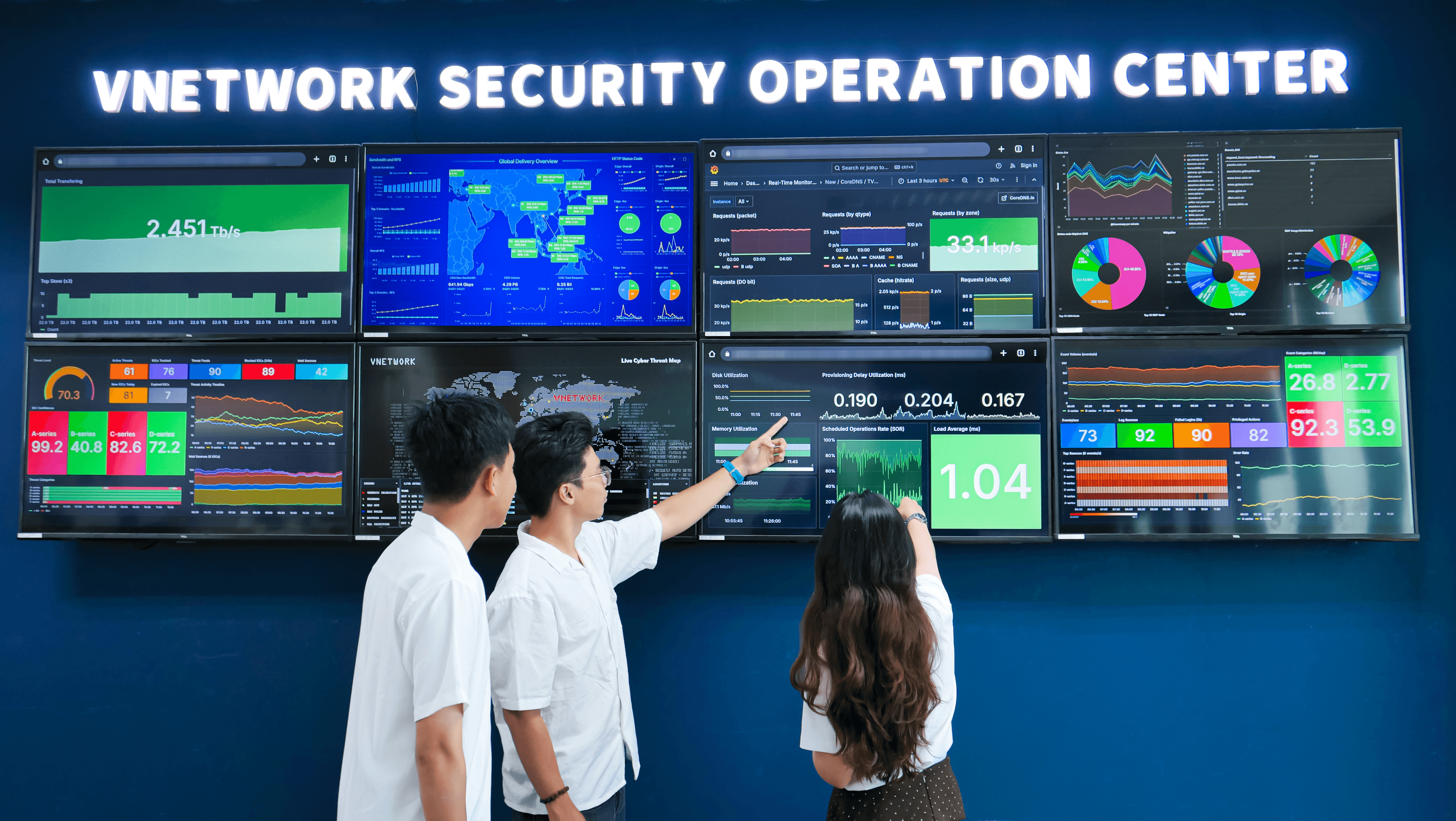
The constantly evolving threat landscape requires vendors to commit to regular security rule updates, ideally automated and in real time. Round-the-clock technical support and a dedicated Security Operations Center (SOC) team are critical factors, especially for organizations that do not yet have a strong internal security team. Organizations should also prioritize solutions that integrate according to Defense in Depth principles to build multi-layered protection rather than relying on a single control point.
Once these criteria are clear, the next practical question for many organizations, particularly those running websites, web applications, or APIs, is how to find a solution that simultaneously protects the application layer and the infrastructure layer without requiring multiple separate and complex tools.
6. VNETWORK WAF: A comprehensive web application firewall solution
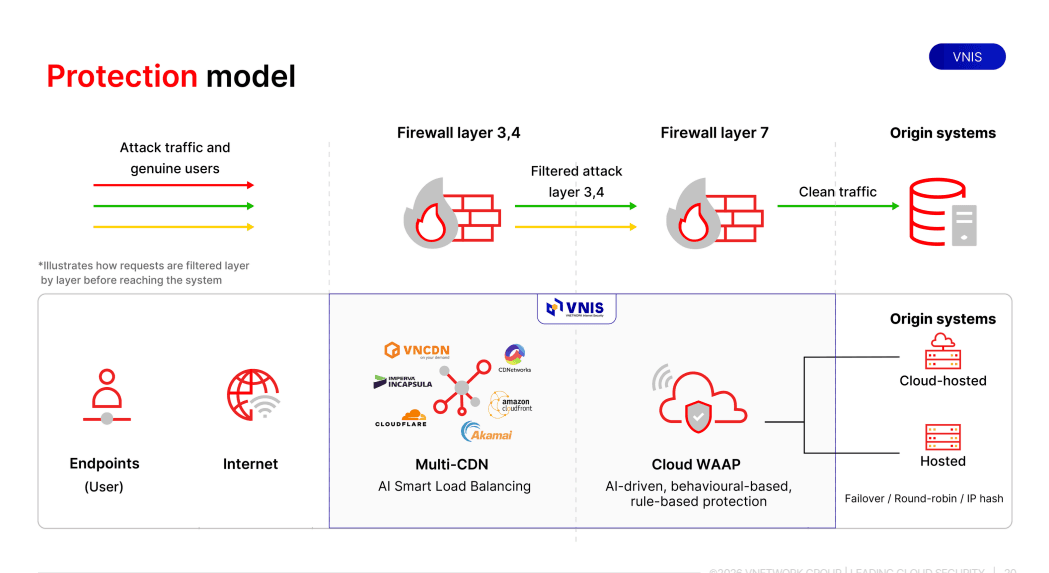
VNETWORK provides a WAF solution integrated within a comprehensive Web/App/API security and acceleration platform called VNIS (VNETWORK Internet Security). VNIS is not merely a standard AI WAF; it operates on a two-layer protection model that simultaneously addresses both infrastructure-layer and application-layer security challenges, issues that organizations would otherwise need multiple standalone tools to handle.
- The first layer of VNIS combines AI Smart Load Balancing and Multi-CDN to mitigate DDoS attacks at the network layer (Layer 3/4). The AI system automatically analyzes access behavior, distributes traffic intelligently, and eliminates abnormal traffic sources before they can overload the infrastructure.
- The second layer deploys an AI-powered WAAP to block Layer 7 DDoS attacks, malicious bots, OWASP Top 10 vulnerabilities, and zero-day exploits directly at the processing layer of web applications and APIs.
What sets the WAF within VNIS apart from conventional firewalls is its continuously updated security ruleset, a 24/7 SOC monitoring team, and the ability to protect hundreds of thousands of websites, applications, and APIs worldwide simultaneously. Organizations without a dedicated internal security team can access a fully managed security service from VNETWORK, encompassing monitoring, threat analysis, and incident response.
7. Conclusion
An enterprise firewall is not an optional choice but a mandatory component in the security architecture of any organization operating a digital infrastructure. From controlling network access and detecting threats to complying with international legal standards, enterprise firewalls ensure the continuity and safety of the entire system. Selecting the appropriate firewall type, whether packet filtering, NGFW, WAF, or WAAP, requires a careful assessment of the organization's scale, infrastructure architecture, and compliance requirements. If your organization is looking for a comprehensive solution to protect web applications and APIs, contact VNETWORK for consulting and deployment of the most suitable WAF solution.
FAQ: Frequently asked questions about enterprise firewalls
1. Do small businesses need an enterprise firewall?
Yes. Even small and medium-sized enterprises (SMEs) need an enterprise firewall if they operate a website, web application, or handle customer data online. Cyberattacks do not discriminate by company size, and many serious security incidents specifically target smaller organizations due to their weaker protection layers. Many firewall solutions today offer flexible pricing models suitable for SMB budgets.
2. Can NGFW and WAF replace each other?
No, NGFW and WAF serve different purposes and are typically deployed as complementary solutions. An NGFW protects the entire network infrastructure from the network layer through the application layer, while a WAF specializes in protecting web applications and APIs from in-depth HTTP/HTTPS attacks such as SQL Injection and XSS. Organizations running e-commerce sites or business-critical APIs should deploy both for comprehensive layered protection.
3. Can an enterprise firewall defend against DDoS attacks?
Enterprise firewalls, especially NGFWs and WAFs with integrated Anti-DDoS capabilities, can mitigate many types of application-layer (Layer 7) DDoS attacks. However, for large-scale network-layer (Layer 3/4) DDoS attacks, organizations typically need a dedicated anti-DDoS solution combined with CDN infrastructure and scrubbing centers to absorb and filter attack traffic before it reaches the infrastructure.
4. How often should firewall rules be updated?
An enterprise firewall's security ruleset should be updated continuously, ideally automatically in real time or at least daily, to reflect newly emerging threats. Additionally, organizations should periodically review and optimize firewall policies (typically every three to six months) to remove outdated rules and ensure the configuration does not introduce unintended vulnerabilities.
5. Is a cloud firewall suitable for organizations undergoing digital transformation?
Yes, cloud firewalls (Firewall-as-a-Service) are particularly well-suited for organizations in the midst of digital transformation because they require no upfront hardware investment, can scale flexibly with demand, and support protection of applications across multiple cloud environments simultaneously. However, organizations must carefully evaluate latency, data residency requirements, and the legal compliance of the solution before deployment.