
1. What does an OTT platform need from a VOD solution?
VOD (Video on Demand) is a content distribution model that allows users to watch pre-processed and stored video at any time of their choosing, rather than following a fixed broadcast schedule.
Unlike live streaming, VOD content is processed, encoded, and stored before distribution. This creates distinct technical requirements: the system must handle large volumes of video files, support multiple formats, and ensure consistent playback speeds regardless of the viewer's geographic location.
For media businesses building or expanding an OTT platform, a VOD solution must address three core needs: high-speed content delivery with minimal latency, digital rights management, and the ability to scale flexibly during peak-hour traffic spikes.

2. Benefits of VOD for media businesses
VOD does not only solve the content distribution challenge but also opens up significant growth opportunities for media businesses. Below are the core benefits of deploying VOD on an OTT platform.
2.1. Reaching viewers anytime, anywhere
VOD content is not constrained by broadcast schedules. Users can watch or rewatch programs, films, or exclusive content at any time that suits their lifestyle. With the growing prevalence of smartphones and smart TVs, OTT platforms that implement VOD correctly can significantly expand their potential user base, including groups who do not follow linear television.
2.2. Optimizing revenue from digital content
VOD supports flexible digital content business models, including SVOD (subscription-based), AVOD (ad-supported free viewing), and TVOD (pay-per-content). The ability to combine these models within a single platform allows media businesses to diversify revenue streams, maximize user lifetime value, and segment content by customer tier.
2.3. Reducing infrastructure load compared to live streaming
VOD content is pre-processed and encoded, so the system does not need to handle real-time signal processing as live streaming does. This reduces pressure on server infrastructure, optimizes bandwidth costs, and allows content processing to be scheduled in batches rather than requiring continuous resource availability.
2.4. Personalizing the user experience
VOD enables integration of content recommendation systems based on viewing history, behavioral analytics, and preference profiling. When combined with analytics data from the CDN and player, media businesses can personalize interfaces, surface relevant content suggestions, and increase average viewing time on the OTT platform.
3. Key features of a VOD solution
An effective VOD solution goes far beyond simply storing and playing back video. Below are the core features that OTT platforms should carefully evaluate before making a selection.
3.1. Transcoding and multi-format video processing
Transcoding is the process of converting a source video file into multiple formats and resolutions (H.264, H.265, VP9...) to ensure compatibility across diverse end-user devices. A professional VOD solution must support automatic transcoding, parallel processing, and short conversion times so content is ready for playback promptly after upload.
3.2. Adaptive Bitrate (ABR) and content protection
Adaptive Bitrate allows the player to automatically adjust video quality to match the user's available bandwidth, reducing buffering and interruptions. Alongside this, content protection through DRM and token authentication is a mandatory requirement for OTT platforms distributing licensed content, helping prevent unauthorized access and content copying.
Law No. 131/2025/QH15 (effective from April 1, 2026) and Decree 174/2026/ND-CP (effective from July 1, 2026) not only increase penalties for violators but also require digital platform operators to proactively implement technical copyright protection measures. A VOD solution with multi-standard DRM and token authentication helps OTT businesses meet these requirements while establishing a solid legal basis for content takedown requests and protecting the integrity of their licensed content library.
3.3. Multi-device support and CDN-based distribution
A VOD solution must deliver a consistent experience across all devices: web browsers, iOS, Android, smart TVs, and set-top boxes. CDN infrastructure plays a critical role in distributing content from PoP (Point of Presence) nodes closest to the user, reducing latency and improving video load speeds.
3.4. Analytics and performance measurement
Analytics is an indispensable component of a modern VOD solution. Data on buffer rates, drop-off rates, average watch time, and user geographic distribution helps media businesses optimize delivery quality, improve content, and make infrastructure investment decisions based on real data.
Comparison of VOD features and their impact on user experience:
| Feature | Description | Impact on UX |
| Multi-format transcoding | Automatically converts video to H.264, H.265, VP9... | Very high |
| Adaptive Bitrate (ABR) | Automatically adjusts video quality based on available bandwidth | Very high |
| DRM content protection | Encrypts content and prevents unauthorized copying | High |
| Token authentication | Controls access permissions per video stream | High |
| CDN distribution | Delivers content via a globally distributed network of nodes | Very high |
| Real-time analytics | Tracks views, buffer rate, and drop-off per session | Medium |
4. Criteria for selecting a VOD solution for OTT platforms
With many deployment options available on the market, media businesses should carefully evaluate the following criteria before making a decision:
- Bandwidth and scalability: The solution must handle sudden traffic spikes during peak hours without compromising playback quality.
- Uptime and stability: An SLA uptime of 99.9% or higher is the minimum standard for a professional content distribution platform.
- Multi-protocol delivery support: Compatibility with FTP, S3, and CDN for flexible integration with existing infrastructure.
- Operational cost: The ability to leverage cloud CPU/GPU helps optimize transcoding costs instead of investing in fixed hardware.
- Integration capability: Open API support for connecting with the OTT platform's CMS, payment systems, and player.
Comparison of VOD deployment models:
| Criterion | Self-hosted | Cloud-based | CDN-powered (VMS) |
| Initial investment cost | High | Low | Low |
| Scalability | Limited | Good | Excellent |
| Data control | Full control | Dependent on provider | Flexible |
| Deployment time | Long (3-6 months) | Fast (a few days) | Fast (a few days) |
| DRM content protection | Self-integrated | Depends on plan | Built-in |
| Best suited for | Large enterprises, self-managed | New OTT startups | Broadcasters, fast-growing OTT |
5. VOD solutions from VNETWORK's VNCDN ecosystem
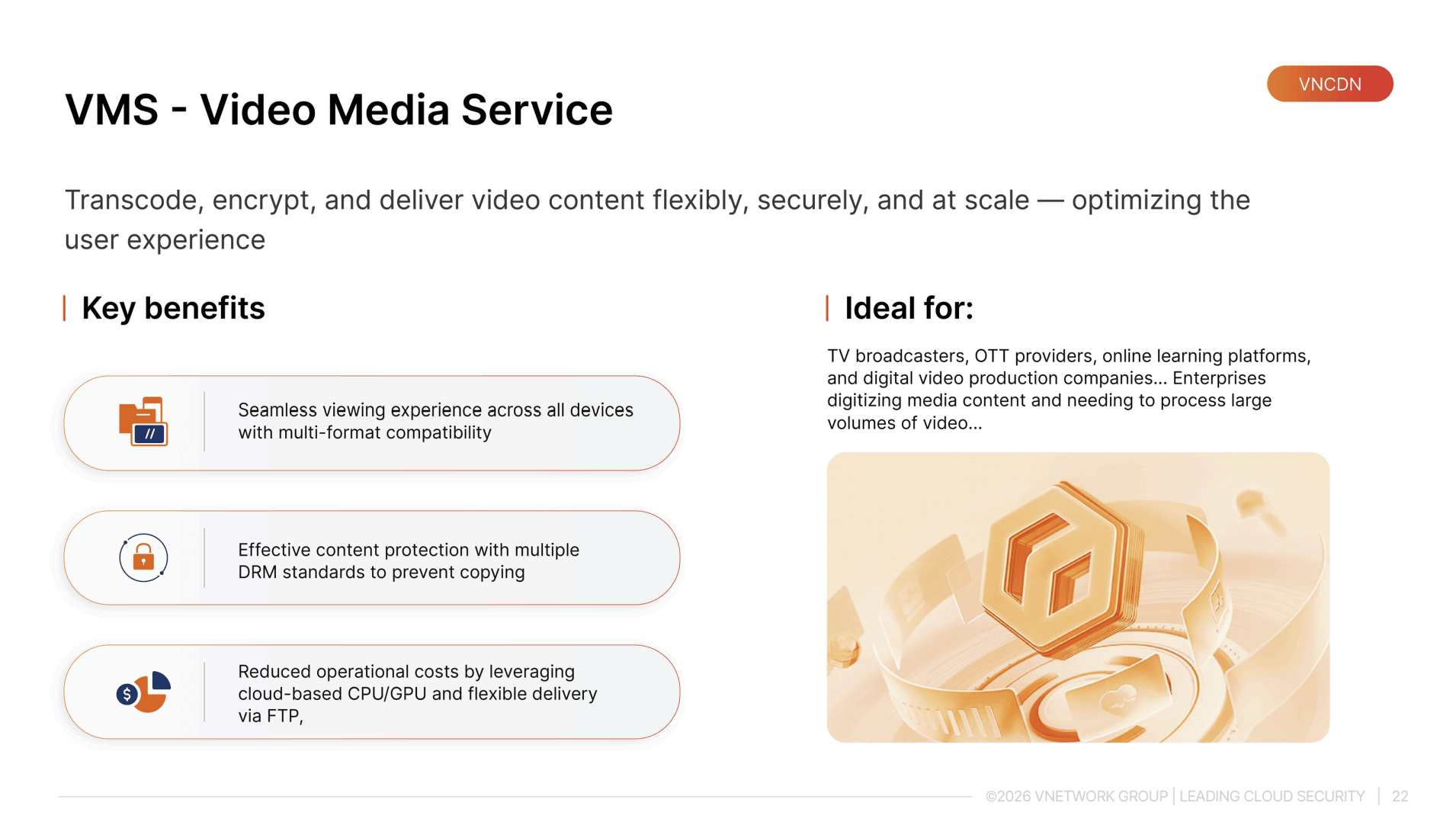
To implement VOD effectively, media businesses need a powerful infrastructure platform that integrates all components from transcoding to distribution and content protection. The VMS (Video Media Service) solution within VNCDN's ecosystem by VNETWORK meets all of these requirements. It is specifically designed for broadcasters, OTT publishers, and businesses digitizing large-scale media archives.
5.1. Key highlights of VMS
- Video conversion, encoding, and distribution: VMS supports the entire workflow from automatic transcoding to content delivery, ensuring videos reach users quickly and reliably.
- Multi-format, multi-device support: Users can watch seamlessly on web, iOS, Android, and smart TV without worrying about format compatibility.
- Comprehensive content protection: VMS integrates multiple DRM standards for copy protection, safeguarding digital copyright for producers and publishers.
- Optimized operational costs: Leveraging cloud CPU/GPU and flexible delivery via FTP, S3, and CDN reduces infrastructure costs compared to traditional self-hosted models.
- Scalability based on real-time traffic: VNCDN's distributed CDN infrastructure ensures VMS can handle sudden traffic spikes without affecting playback quality.
5.2. VMS deployment workflow
VMS is designed to let businesses get video content onto the system and distributed to users quickly, without requiring complex technical steps. The entire workflow consists of just two core steps:
- Step 1: POST video to the system. The business submits the video file URL via API. VMS automatically receives the data, processes the content, and prepares it for playback without requiring manual intervention.
- Step 2: Stream video to users. Once the playback ID is added to the system, VMS automatically generates video versions suited for each device and bandwidth level, ensuring smooth playback and optimized delivery costs.
This streamlined workflow helps media businesses shorten the time from content upload to user delivery, while reducing the technical team's workload in day-to-day operations.
6. Case study: VTV GO and the challenge of national-scale VOD distribution
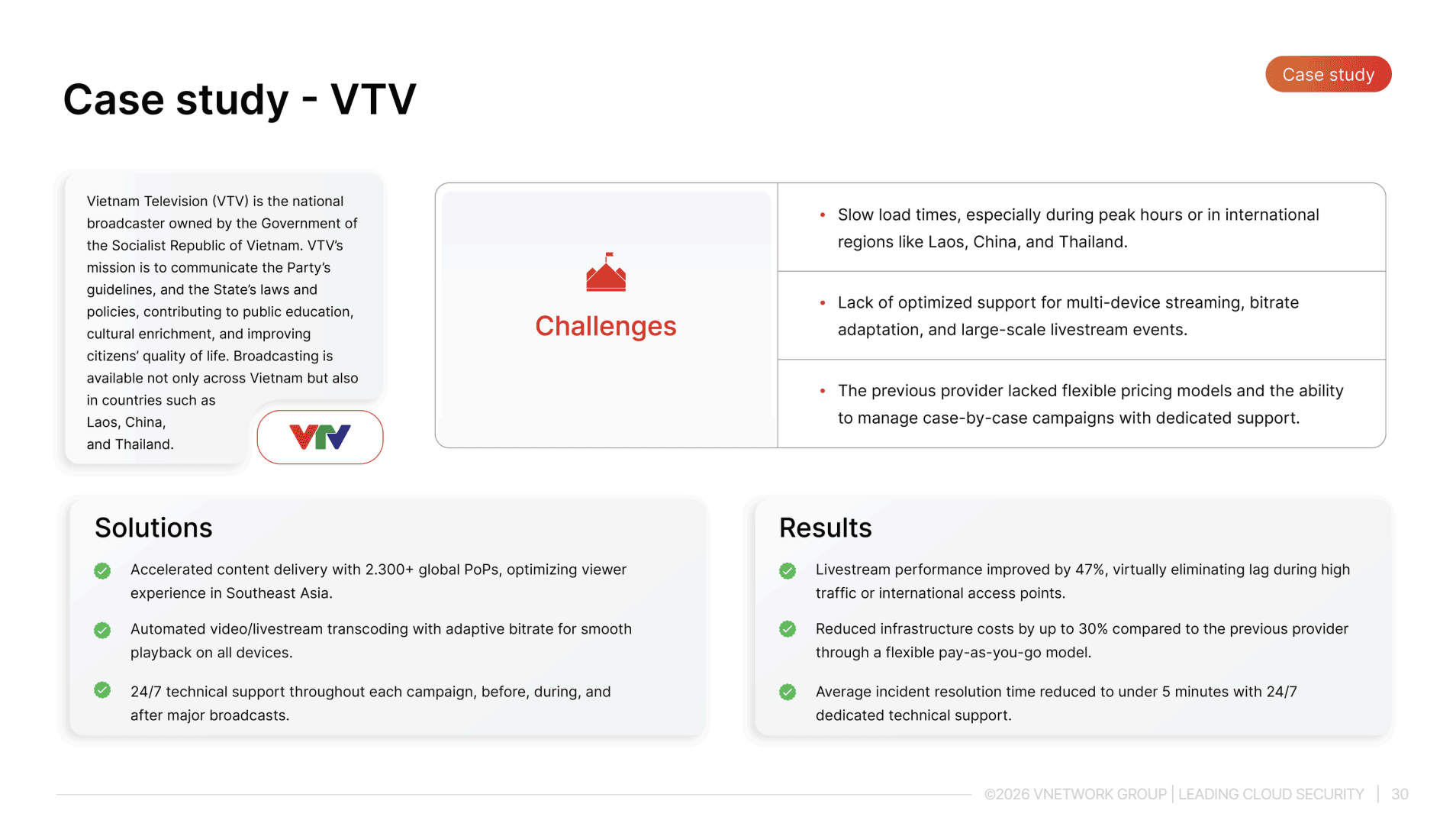
Vietnam Television is the country's broadest-reach broadcaster. When VTV decided to bring its entire content library onto an OTT platform under the VTV GO brand, the challenge was not simply storing video but distributing it simultaneously to millions of users across diverse devices, with consistent quality from urban centers to remote areas.
The greatest challenge emerged during peak hours, when live events combined with surging VOD viewership. Self-operated infrastructure struggled to handle the wide traffic fluctuations without degrading the user experience or inflating operational costs.
VNETWORK partnered with VTV GO to deploy a video content distribution solution based on VNCDN infrastructure. The outcomes achieved included:
- VOD content distributed via a distributed CDN network, reducing video load latency for users nationwide.
- The system automatically scaled with real-time traffic, ensuring stable playback quality even during peak broadcast hours for major events.
- Consistent smooth viewing experience maintained across diverse devices, from smartphones to smart TVs and web browsers.
The VTV GO story demonstrates that for a large-scale OTT platform, content distribution infrastructure cannot be an afterthought. Learn more at the VTV GO case study.
7. Conclusion
A VOD solution for an OTT platform is not simply a video storage problem; it is an integrated system spanning transcoding, CDN distribution, content protection, and analytics. Media businesses should prioritize criteria such as scalability, uptime, copyright protection, and operational costs when selecting the right solution.
Contact VNETWORK for consulting and deployment of a VOD solution tailored to your OTT platform:
- Hotline: 028 7306 8789
- Email: contact@vnetwork.vn
FAQ
1. How does VOD differ from live streaming on an OTT platform?
VOD (Video on Demand) allows users to watch pre-processed and stored content at any time, whereas live streaming broadcasts content in real time. Technically, VOD uses pre-transcoded content and is therefore less resource-intensive, while live streaming requires continuous signal processing and lower latency. Many OTT platforms today deploy both simultaneously to optimize the user experience.
2. Does a small OTT platform need a dedicated CDN for VOD?
Even for small-scale OTT platforms, a CDN still delivers clear benefits in terms of load speed and stability, particularly when users are distributed across multiple geographic regions. CDN-powered solutions like VMS allow usage based on actual demand without requiring fixed infrastructure investment, making them suitable for both early-stage and growing platforms.
3. What video formats does VMS support?
VMS supports common video formats, including H.264 and H.265 compression standards, and is compatible with HLS and DASH distribution protocols. After transcoding, content can be delivered via FTP, S3, or directly through CDN, ensuring compatibility with a wide range of end-user devices from web browsers to smart TVs.
4. How is the cost of deploying VOD with VMS calculated?
VMS deployment costs depend on content library size, distribution traffic, and the content protection features required. A usage-based pricing model helps businesses manage costs flexibly, which is especially useful during periods of uneven traffic. Contact VNETWORK for a detailed quote based on your specific requirements.
5. How can VOD content be protected from unauthorized copying?
Protecting VOD content requires a multi-layered approach: DRM (Digital Rights Management) encrypts content and controls playback rights; token authentication restricts access by session and device; and watermarking enables source tracing in the event of a leak. VMS has built-in support for leading DRM standards, allowing media businesses to comprehensively protect their digital content rights without needing to integrate additional third-party solutions.