
1. What is a cloud computing model?
A cloud computing model is a framework for classifying and organizing cloud computing services according to two criteria: how far up the stack the provider is responsible for managing, and where the infrastructure is deployed. A clear understanding of cloud computing models helps businesses select the right type of service for their actual needs, avoiding wasted spending or selecting the wrong infrastructure from the outset.
Cloud computing operates on centralized provider infrastructure delivered to users over the Internet. Businesses do not need to know where servers are located or who maintains the physical hardware; a stable network connection is all that is required to access the necessary resources from anywhere. Instead of large upfront capital investment in physical servers, companies pay only for what they actually consume and scale resources up or down flexibly at each stage of growth.
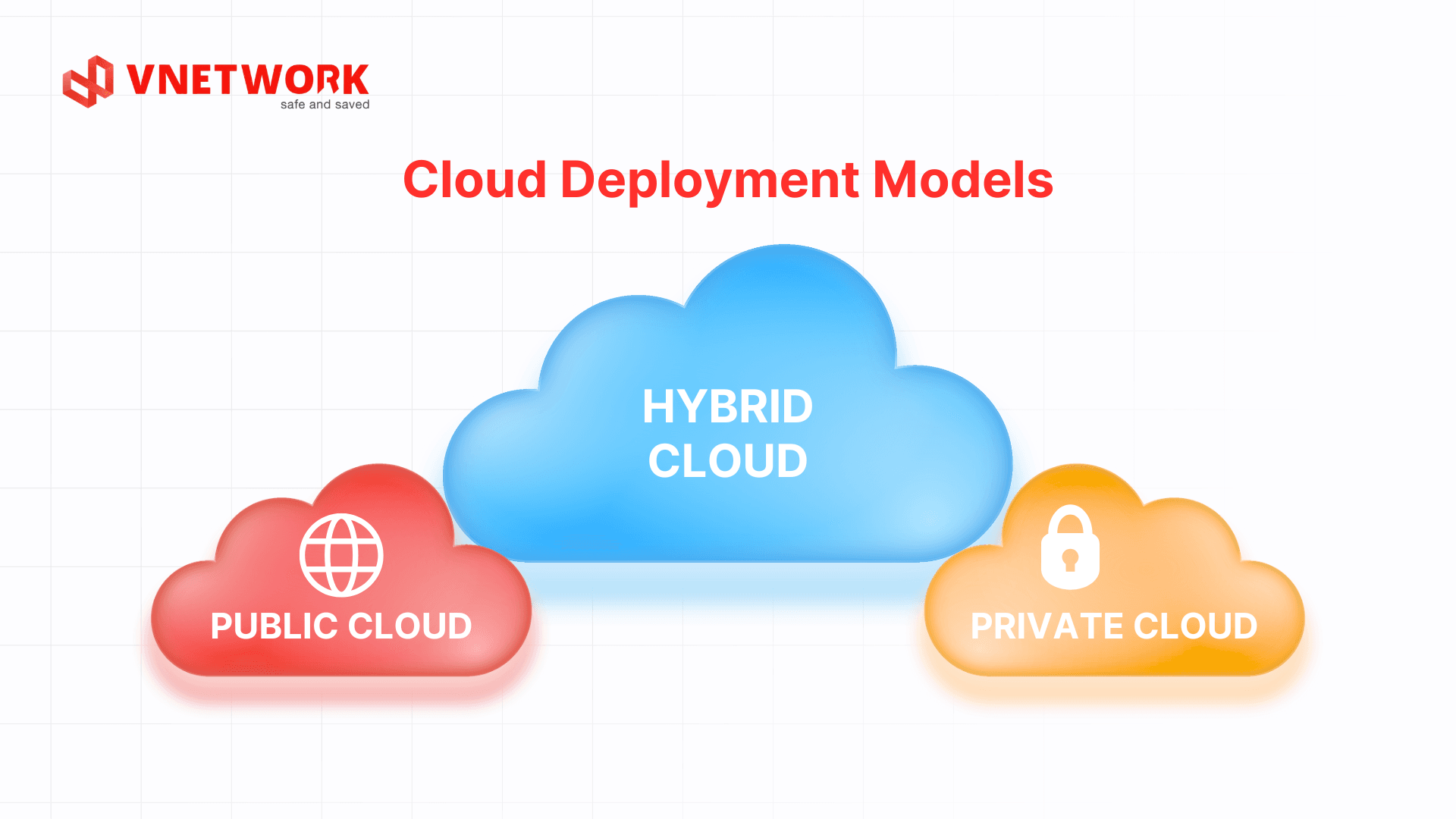
Cloud computing models fall into two main groups. Service models (IaaS, PaaS, SaaS) define how far up the stack the provider takes responsibility. Deployment models (Public, Private, Hybrid) define where the infrastructure resides and who has access to it. The two groups are complementary, and businesses can freely combine them based on their specific requirements.

2. Common cloud service models
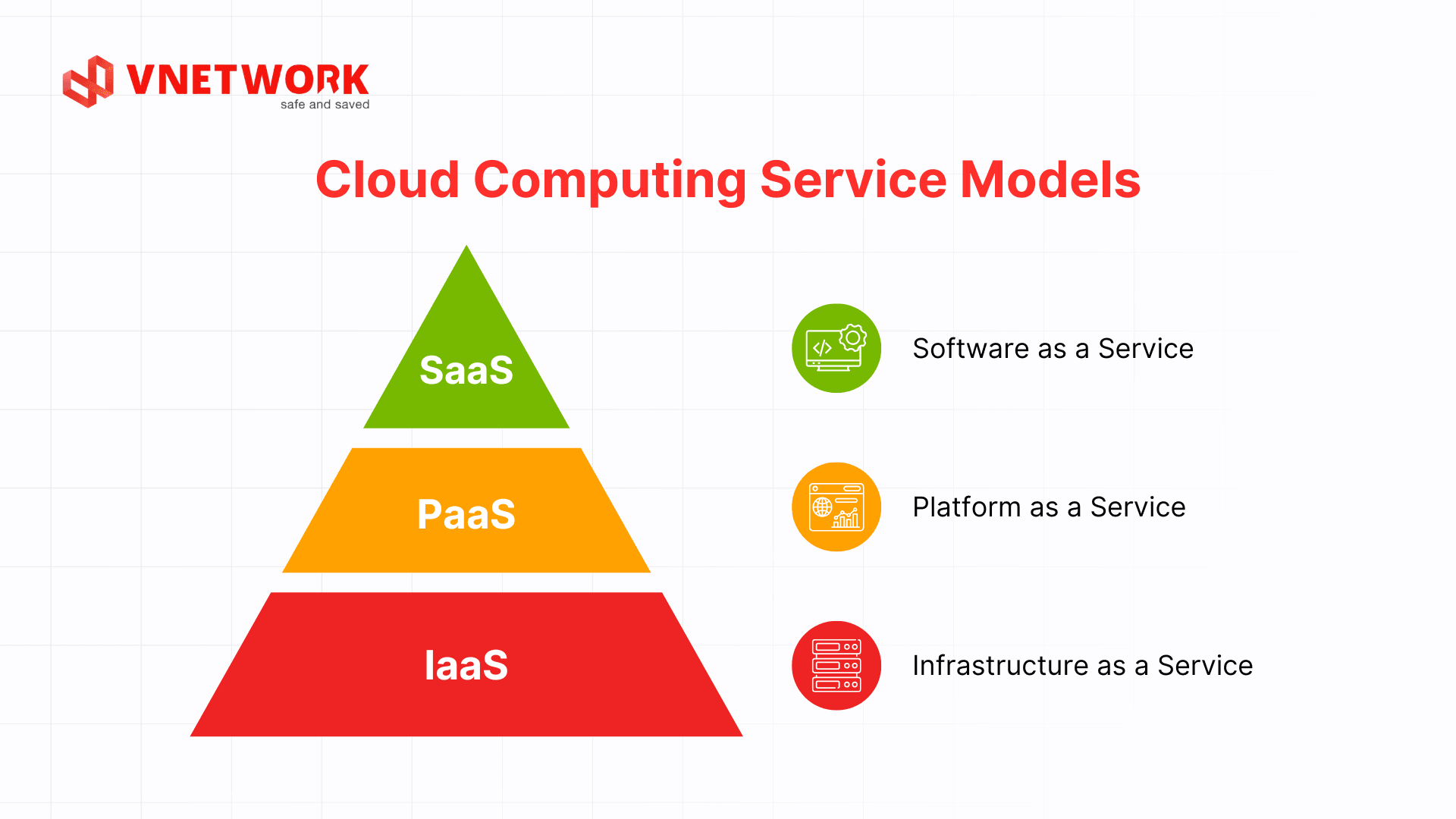
2.1. IaaS (Infrastructure as a Service)
IaaS is the cloud service model that provides raw infrastructure: virtual servers, storage, networking, and firewall. Businesses retain full control from the operating system upward, while the provider manages only the physical hardware and network connections.
IaaS suits IT teams with system administration expertise who need deep, flexible infrastructure customization. Businesses commonly choose IaaS to run VPS or bare metal servers, build staging environments, store periodic backups, or deploy internal systems to custom specifications.
In Vietnam, IaaS is widely used across a range of contexts. E-commerce companies rent IaaS to run order-processing systems and configure servers to handle actual load during each promotional campaign. Fintech firms use IaaS to maintain full control over their security environment, meeting audit requirements from the State Bank of Vietnam. DevOps teams use IaaS to build dedicated CI/CD pipelines with clearly separated dev, staging, and production environments.
- Advantages: complete control, the most flexible of the three service models, costs billed by actual hours of use.
- Disadvantages: requires an IT team with strong administration skills; small businesses without dedicated technical staff will struggle to operate it effectively.
2.2. PaaS (Platform as a Service)
PaaS is the cloud service model that provides a ready-made environment for developing and deploying applications, including the operating system, runtime, database, and CI/CD tools. Developers write code and deploy; they do not need to touch the underlying infrastructure.
Compared to IaaS, PaaS is a better fit when a business wants to focus resources on product development rather than system administration. If IaaS is like renting an empty plot of land to build your own house, PaaS is like renting a fully fitted apartment where the utilities are already set up. Kubernetes is often used alongside PaaS to manage containers and automate application deployments, allowing the dev team to focus entirely on features rather than infrastructure operations.
PaaS is particularly well suited to three scenarios: small dev teams without a dedicated sysadmin, projects that need to ship quickly without spending time configuring servers, and applications that have no special infrastructure customization requirements. As the need for infrastructure control grows with scale, businesses can consider gradually migrating to IaaS.
- Advantages: shorter development cycles, built-in CI/CD pipeline, no infrastructure administration required.
- Disadvantages: less flexible than IaaS for deep customization, dependent on the provider's platform.
2.3. SaaS (Software as a Service)
SaaS is the cloud service model that delivers fully functional software through a browser or application. Users sign in and get started immediately, with no installation and no need to manage any technical component. All infrastructure, security, and updates are handled by the provider.
SaaS is the most popular model for SME businesses because it requires no dedicated IT team, charges on a monthly subscription, and is ready to use immediately after sign-up. A 50-person company can run its entire business operations using SaaS tools alone, without a single line of code or a single server. In Vietnam, popular SaaS tools include Google Workspace and Microsoft 365 for email and collaboration, MISA and Fast Accounting Online for financial accounting, HubSpot and Salesforce for customer relationship management, and Zoom and Google Meet for online meetings.
One important consideration when using SaaS is that business data is stored on the provider's systems. Companies should carefully evaluate security terms, data ownership policies, and data export capabilities before signing a contract, particularly in heavily regulated industries such as finance and healthcare.
- Advantages: ready to use with no technical expertise required, low and predictable costs, provider handles all updates and security patches.
- Disadvantages: limited customization options; data stored on the provider's systems, so security terms and data ownership policies need thorough review.
Comparison of IaaS, PaaS, and SaaS across core criteria:
| Criteria | IaaS | PaaS | SaaS |
| Managed by business | OS, app, data | App and data only | Nothing to manage |
| Managed by provider | Hardware, network, storage | Infrastructure and runtime platform | Entire system |
| Best suited for | IT Admin, DevOps, sysadmin | Dev teams, developers | End users, SMEs |
| Flexibility | Highest | Medium | Lowest |
| Typical examples | Virtual servers, VPS, backup | CI/CD environment, managed DB | Email, CRM, accounting |
For a detailed breakdown, see: IaaS vs PaaS vs SaaS explained
3. Cloud deployment models
3.1. Public Cloud
Public Cloud is a deployment model in which cloud infrastructure is operated by a provider and shared across multiple organizations. Businesses rent resources over the Internet and pay based on actual consumption, with no hardware investment or management required.
Public Cloud is well suited to startups, SMEs, and web applications with seasonally variable traffic. Load balancing is commonly combined with Public Cloud to distribute traffic and maintain stable performance during peak periods.
- Advantages: lowest upfront cost, highly elastic scaling, no hardware management required.
- Disadvantages: shared environment means less control over security; data sovereignty requirements may limit usage for regulated industries.
3.2. Private Cloud
Private Cloud is a cloud deployment model dedicated to a single organization. Infrastructure may reside in an internal data center or be operated by a provider in a completely isolated environment. No other organization shares resources with the Private Cloud user.
Private Cloud is a mandatory choice for banks, insurance companies, hospitals, and government agencies in Vietnam. Organizations in these sectors should consult the Data Law 2024 and the Personal Data Protection Law to identify their compliance obligations before selecting a deployment model.
- Advantages: highest security, complete control, compliance with domestic data storage regulations.
- Disadvantages: significantly higher deployment and operating costs than Public Cloud; requires an IT team with deep administration expertise.
3.3. Hybrid Cloud
Hybrid Cloud is a deployment model that combines Public Cloud and Private Cloud, allowing data and applications to move flexibly between the two environments based on sensitivity and performance requirements.
A business might keep customer data and financial transactions in a Private Cloud while pushing its website and marketing applications to Public Cloud to reduce costs and improve response speed. Hybrid Cloud is an increasingly popular approach among mid-sized Vietnamese businesses in the midst of deeper digital transformation.
Comparison of Public Cloud, Private Cloud, and Hybrid Cloud:
| Criteria | Public Cloud | Private Cloud | Hybrid Cloud |
| Security | Medium | Highest | High, flexible |
| Upfront cost | Low | High | Medium |
| Scalability | Very high (elastic) | Limited by internal infrastructure | High |
| Operational complexity | Low | High | Medium to high |
| Best suited for | Startups, SMEs, variable web/app traffic | Banks, healthcare, government | Businesses balancing security and cost |
Further reading: Public Cloud vs Private Cloud vs Hybrid Cloud
4. Cloud computing applications by industry
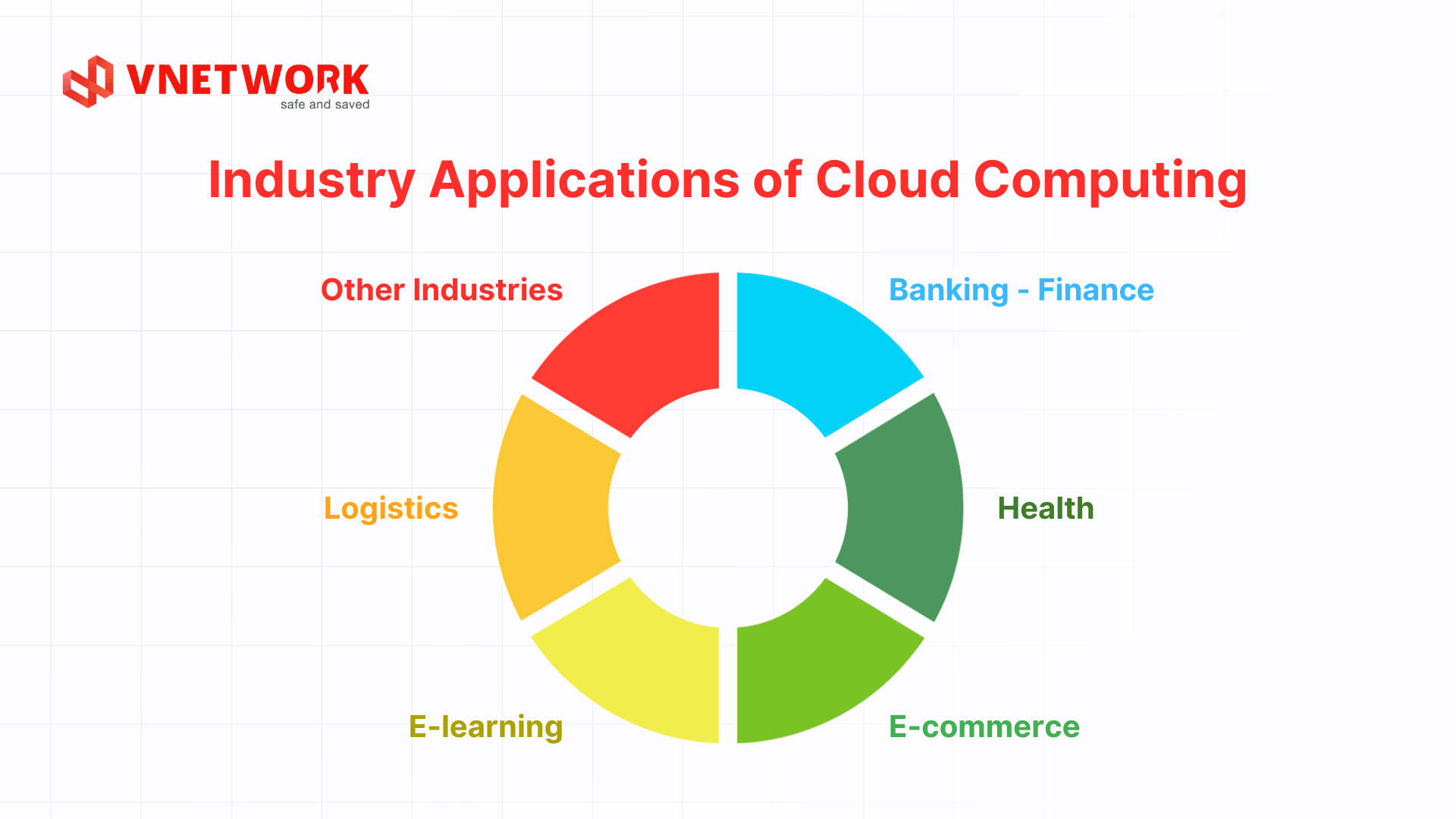
Cloud computing is widely applied across almost all economic sectors in Vietnam. Each industry has different needs and levels of data sensitivity, resulting in different approaches to leveraging the cloud.
4.1. Finance and banking
The financial sector primarily adopts cloud computing through Private Cloud or Hybrid Cloud to maintain absolute control over transaction data and comply with regulatory requirements. Cloud computing in finance enables banks to analyze risk in real time, deploy high-speed payment systems, and automate credit approval workflows without large physical infrastructure investments.
4.2. Healthcare
Hospitals and healthcare facilities use cloud computing to centralize patient record storage, connect systems across multiple care sites, and support remote diagnosis. Cloud computing in healthcare enables physicians to access a patient's medical history from anywhere while ensuring health data is protected in accordance with applicable regulations.
4.3. E-commerce
E-commerce platforms and online retailers leverage Public Cloud to handle sudden traffic spikes during major promotional events without maintaining fixed infrastructure year-round. Cloud computing keeps payment, order management, and warehouse systems running smoothly even at peak times, and automatically scales resources back down after each campaign to reduce costs.
4.4. Online education
E-learning platforms use cloud computing to stream high-quality lecture videos to thousands of simultaneous learners, track learning progress, and personalize learning paths for each user. Cloud computing in education helps educational organizations scale quickly without investing in dedicated server infrastructure.
4.5. Logistics
Logistics companies apply cloud computing to track shipments in real time, optimize delivery routes, and connect warehouse systems with partners across the supply chain. Cloud computing in logistics helps reduce operating costs, speed up order processing, and improve the end-customer experience.
5. How to choose the right cloud computing model
There is no single best cloud computing model for every situation. The right choice depends on three specific factors unique to each business.
5.1. By company size
Startups and early-stage SMEs should begin with SaaS or Public Cloud: fast to deploy, low cost, and no need for a large IT team. Mid-sized businesses with established operational processes can consider PaaS or Hybrid Cloud when tighter data control becomes necessary. Large enterprises or organizations with high security requirements should prioritize Private Cloud or Hybrid Cloud from the outset to avoid costly infrastructure migrations later.
5.2. By industry and security requirements
Finance, healthcare, and government agencies face strict data storage regulations, making Private Cloud or Hybrid Cloud essential to keep sensitive data out of multi-tenant environments. E-commerce, online education, and media companies can take full advantage of Public Cloud thanks to its elastic scaling during traffic spikes.
5.3. By in-house IT team capability
IaaS and Private Cloud require an IT team with hands-on system administration experience. Businesses without dedicated IT specialists should start with SaaS. PaaS is a middle-ground option when the company has a dev team but wants to avoid the burden of infrastructure administration. Beyond model selection, a clear understanding of what cloud storage is and how to organize data also helps businesses optimize long-term storage costs.
6. VCLOUD: flexible cloud infrastructure for Vietnamese businesses
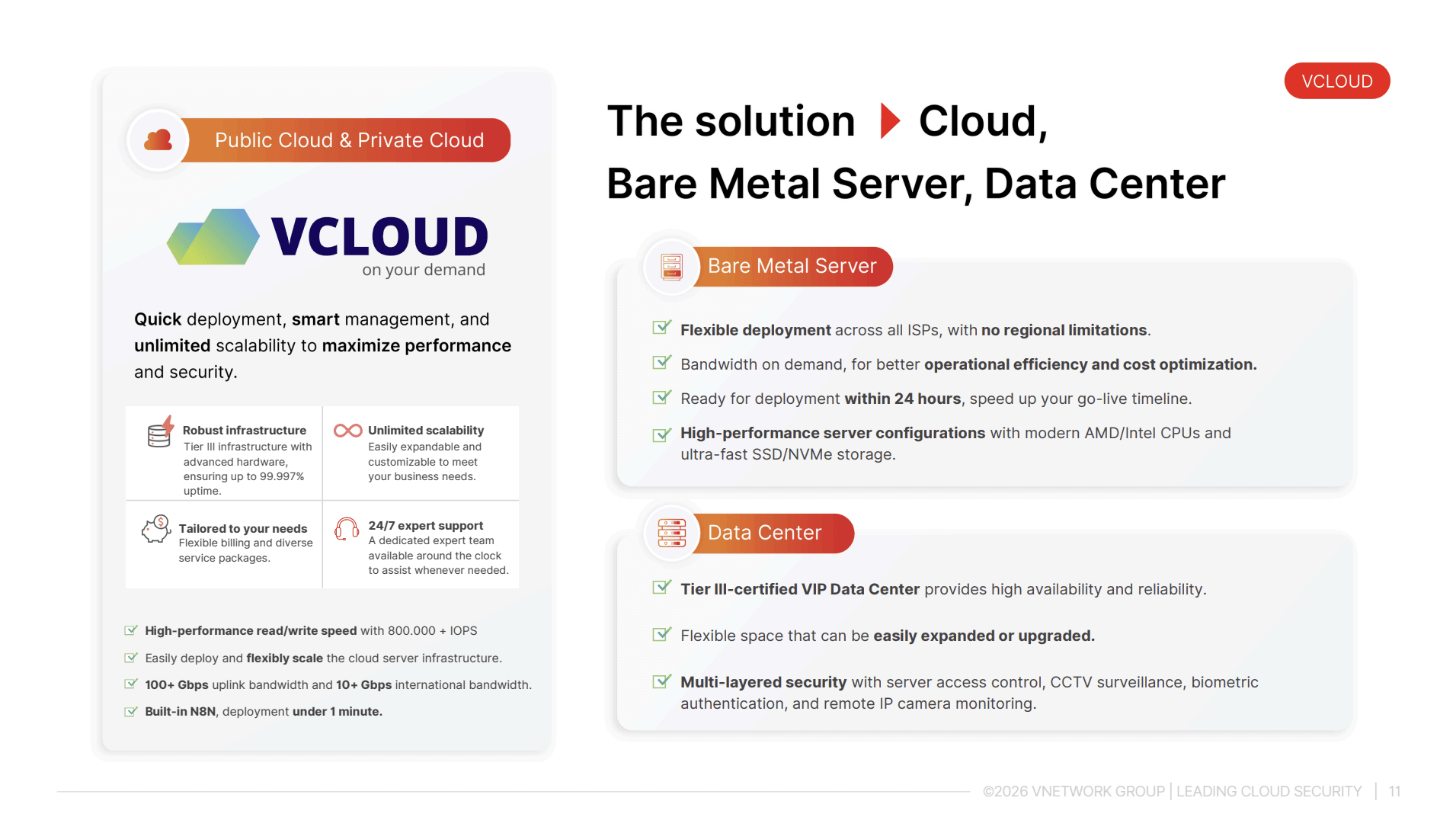
VNETWORK offers VCLOUD, a cloud computing platform developed specifically for the Vietnamese market, supporting all three deployment models (Public Cloud, Private Cloud, and Hybrid Cloud) within a single unified management system.
VCLOUD operates on Tier III-certified data centers located entirely within Vietnam, meeting domestic data storage requirements under current regulations. VCLOUD is suitable for SMEs undergoing digital transformation for the first time as well as large organizations requiring strict data control and regulatory compliance.
Key features of VCLOUD:
- Tier III-certified infrastructure with high uptime, minimizing the risk of service disruption.
- Multi-layer security with integrated Firewall, Security Group, 2FA authentication, and SSH Key Pair, compliant with ISO 27001 standards.
- Instant resource scaling: increase or decrease CPU, RAM, and storage in response to actual load without system interruption.
- Supports AI systems, Big Data workloads, and high-performance cloud storage, suited to businesses processing large data volumes in real time.
- VNETWORK technical team available 24/7/365, from model selection consulting and deployment through ongoing operations.
7. Conclusion
The six cloud computing models (IaaS, PaaS, SaaS, Public Cloud, Private Cloud, and Hybrid Cloud) each serve a distinct role in a business's digital infrastructure strategy. There is no universally best model, only the most appropriate one for a given company's size, industry, and current IT capabilities. Businesses should carefully assess all three factors before committing to a long-term cloud architecture.
FAQ: Frequently asked questions about cloud computing models
1. What types of cloud computing models are there?
Cloud computing models are divided into two main groups. The service model group consists of IaaS, PaaS, and SaaS, which define the level of management the provider takes on. The deployment model group consists of Public Cloud, Private Cloud, and Hybrid Cloud, which define where the infrastructure is located and who owns it. Businesses can combine both groups freely based on actual needs; for example, running SaaS on a Hybrid Cloud foundation or deploying IaaS within a Private Cloud environment.
2. Which cloud model should an SME start with?
SMEs without a dedicated IT team should begin with SaaS for core business functions such as email, CRM, and accounting. As the organization grows and needs more infrastructure flexibility, the transition to PaaS or IaaS on Public Cloud becomes a natural next step. Hybrid Cloud is the logical progression when the organization develops additional data security requirements.
3. Is Hybrid Cloud complex to operate?
Hybrid Cloud requires managing two simultaneous environments, making it more complex than standalone Public or Private Cloud. However, with an experienced provider and centralized management tools, businesses can operate Hybrid Cloud effectively without an oversized IT team.
4. Which cloud model should finance and healthcare organizations in Vietnam choose?
Private Cloud or Hybrid Cloud is the most appropriate choice: sensitive data remains in a fully controlled private environment that meets domestic data storage regulations, while less sensitive applications can run on Public Cloud to optimize costs.
5. Which deployment models does VCLOUD support?
VCLOUD supports Public Cloud, Private Cloud, and Hybrid Cloud on a single platform, with infrastructure located in Vietnam meeting Tier III standards, ISO 27001 security certification, and 24/7/365 technical support from the VNETWORK team.