
1. What is a next generation firewall?
Next generation firewall (NGFW) is a new-generation firewall that integrates traditional packet filtering with application identification, intrusion prevention, and deep traffic analysis in a single security platform.
Unlike older firewalls that only control ports and IP addresses, a next generation firewall understands the content and context of network traffic. NGFW can identify specific applications, users, and threats hidden within packets, enabling more accurate allow-or-block decisions across multiple layers.
To fully understand the next generation firewall, it helps to consider NGFW in relation to a traditional firewall. Traditional firewalls operate primarily at the network and transport layers, relying on port and IP address rules. The next generation firewall extends control up to the application layer, where the majority of modern threats are concentrated.
The next generation firewall reads and analyzes traffic across multiple layers of the OSI model. As a result, NGFW not only knows where a packet is going but also identifies which application generated it and whether it shows any anomalous indicators. This is the fundamental difference that sets new-generation firewalls apart from their predecessors.

2. Core components of a next generation firewall
A complete next generation firewall is composed of multiple components working in coordination. Each component plays a distinct role, yet they all work toward the same goal: deeper traffic analysis and earlier threat prevention compared to traditional firewalls.
Some components work directly at Layer 7, the application layer, where most web vulnerability attacks occur. This is also the layer where the next generation firewall demonstrates its clearest advantage over simple packet-filtering devices.
- Deep packet inspection (DPI): inspects the full content of packets rather than just reading headers, allowing the next generation firewall to detect malicious data hidden within legitimate traffic streams.
- Intrusion prevention system (IPS): real-time intrusion prevention that identifies and blocks known attack patterns before they reach the target system.
- Application awareness: the ability to identify applications, enabling the next generation firewall to distinguish and control individual applications even when they share the same port. This allows NGFW to block attacks such as SQL injection and XSS targeting web applications.
- Threat intelligence: continuously updated threat intelligence data that helps the next generation firewall recognize newly emerging IP addresses, domains, and attack patterns from around the world.
- SSL inspection: decrypts and inspects encrypted traffic to ensure the next generation firewall does not miss threats hidden within encrypted HTTPS connections.
3. How does a next generation firewall work?
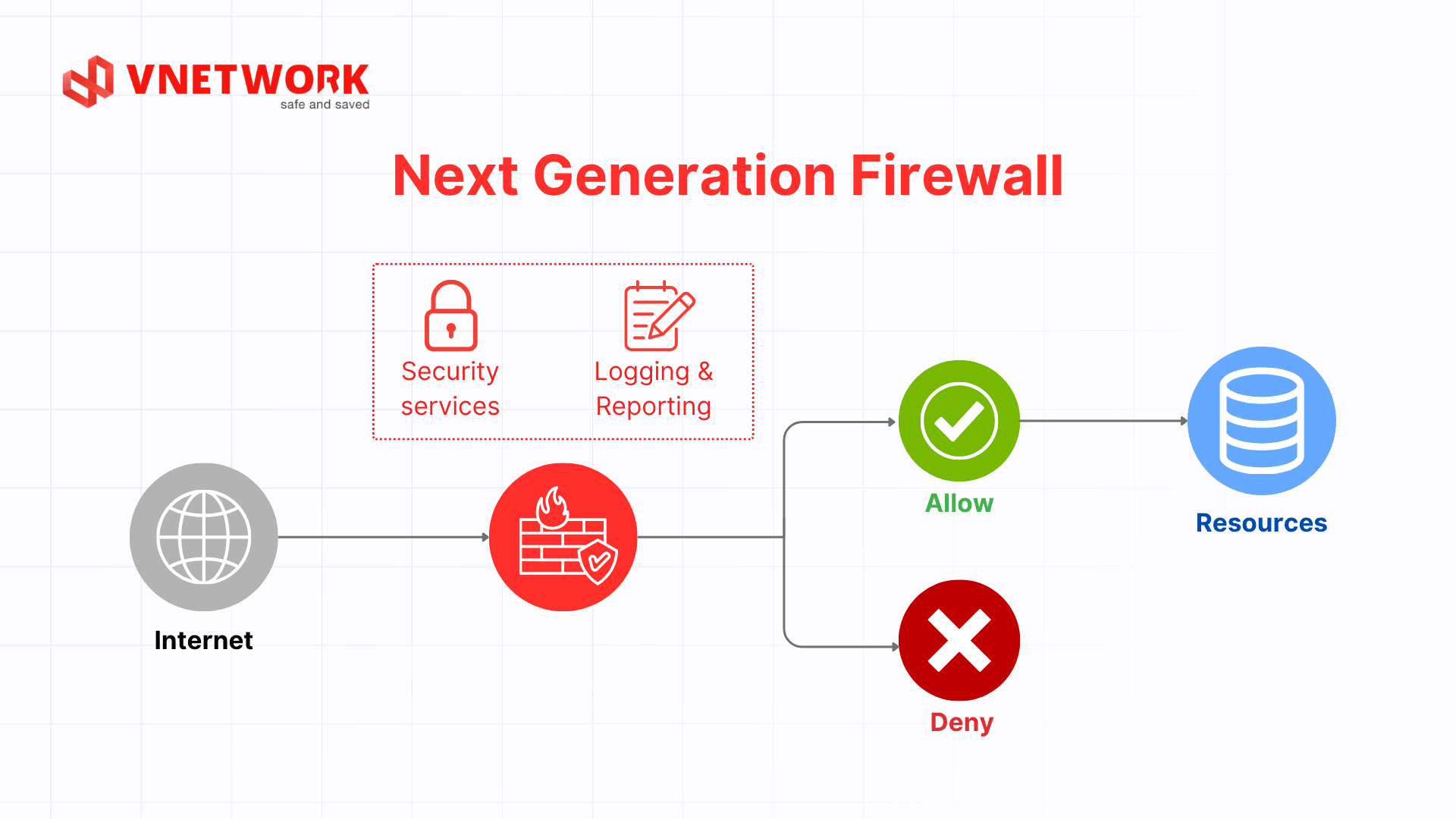
A next generation firewall works by performing deep packet analysis, identifying applications and users, cross-referencing threat intelligence, and then making context-aware decisions to allow or block traffic.
When a packet passes through the next generation firewall, the system does not merely read source and destination addresses; it also analyzes the packet's content. NGFW determines which application generated the traffic, checks for signs of malware, and cross-references a threat database before making a decision.
For threats without a known signature, such as zero-day vulnerabilities, the next generation firewall relies on behavioral analysis and sandboxing. NGFW monitors unusual behavior in traffic flows, isolates suspicious files in a virtual environment, and blocks them immediately upon detecting warning signs, rather than waiting for a known signature match.
This entire process runs continuously and near-instantaneously. The next generation firewall simultaneously controls inbound and outbound traffic while logging events for the security team to analyze, forming a more proactive defense cycle compared to traditional firewalls.
4. How does a next generation firewall differ from a traditional firewall?
The core difference between a next generation firewall and a traditional firewall lies in the layer of control. Traditional firewalls filter based on ports and IPs, whereas NGFW performs deep analysis down to the application layer and integrates multiple security mechanisms.
Traditional firewalls are well suited for network segmentation and basic connection control. The next generation firewall inherits those capabilities while adding application identification, intrusion prevention, threat intelligence, and encrypted traffic inspection to counter attacks targeting the application layer.
| Criteria | Traditional firewall | Next generation firewall |
|---|---|---|
| Layer of control | Network and transport layers | Up to the application layer |
| Filtering basis | Ports and IP addresses | Applications, users, and packet content |
| Application identification | Not available | Has application awareness |
| Intrusion prevention | Not integrated | Integrated real-time IPS |
| Encrypted traffic | Difficult to inspect | Supports SSL inspection |
| Zero-day protection | Limited | Enhanced via threat intelligence and sandbox |
5. Benefits of a next generation firewall for organizations
A next generation firewall delivers significant practical benefits for organizations of all sizes, especially those with web systems, applications, and customer data connected to the internet. The following benefits explain why NGFW has become a central component in modern security architectures.
- Multi-layer prevention: the next generation firewall combines packet filtering, intrusion prevention, and application identification to create multiple defensive layers rather than a single perimeter.
- Reduced zero-day risk: by leveraging behavioral analysis and threat intelligence, the next generation firewall can detect emerging attack patterns without a known signature.
- Application control: organizations can define which applications are permitted, reducing the attack surface and the risk of data leakage through uncontrolled applications.
- Zero trust architecture support: the next generation firewall aligns with the zero trust model, where every access request is authenticated and inspected rather than implicitly trusted.
When deployed alongside other protective layers, the next generation firewall becomes one link in a defense in depth strategy. This multi-layer defensive approach allows organizations to remain secure even when one protective layer is breached.
6. Criteria for selecting a security solution aligned with the next generation firewall approach
When evaluating a security solution aligned with the next generation firewall approach, organizations should apply clear criteria to ensure the solution meets both current needs and future scalability requirements.
6.1. Multi-layer protection integration capability
A solution in line with the next generation firewall approach must integrate multiple protective layers within a single platform, from packet filtering and intrusion prevention to application identification and encrypted traffic inspection. This integration helps organizations reduce the number of disparate devices and simplifies security operations.
6.2. Performance and scalability
Performance is a critical criterion because the next generation firewall must analyze traffic in depth in real time. Organizations should verify actual throughput when all security features are fully enabled and assess scalability as traffic grows over time or during peak periods.
6.3. Technical support and continuous monitoring
An effective security solution must come with technical support and continuous monitoring. A real-time monitoring team helps detect and respond to incidents rapidly, which is particularly important for organizations that lack a dedicated security team large enough to operate a next generation firewall around the clock.
7. VNIS - A complementary solution for the next generation firewall at the application layer
VNIS is VNETWORK's Web, App, and API security and acceleration platform. VNIS is not a next generation firewall in the sense of a network appliance; rather, it is a complementary protection layer for NGFW at the application layer. While the next generation firewall controls traffic at the system perimeter, VNIS focuses on directly protecting Web, App, and API assets, where many modern attacks are aimed. The two solutions work together within the same multi-layer defense architecture, built on the same principles of layered protection, AI application, and application-aware identification.
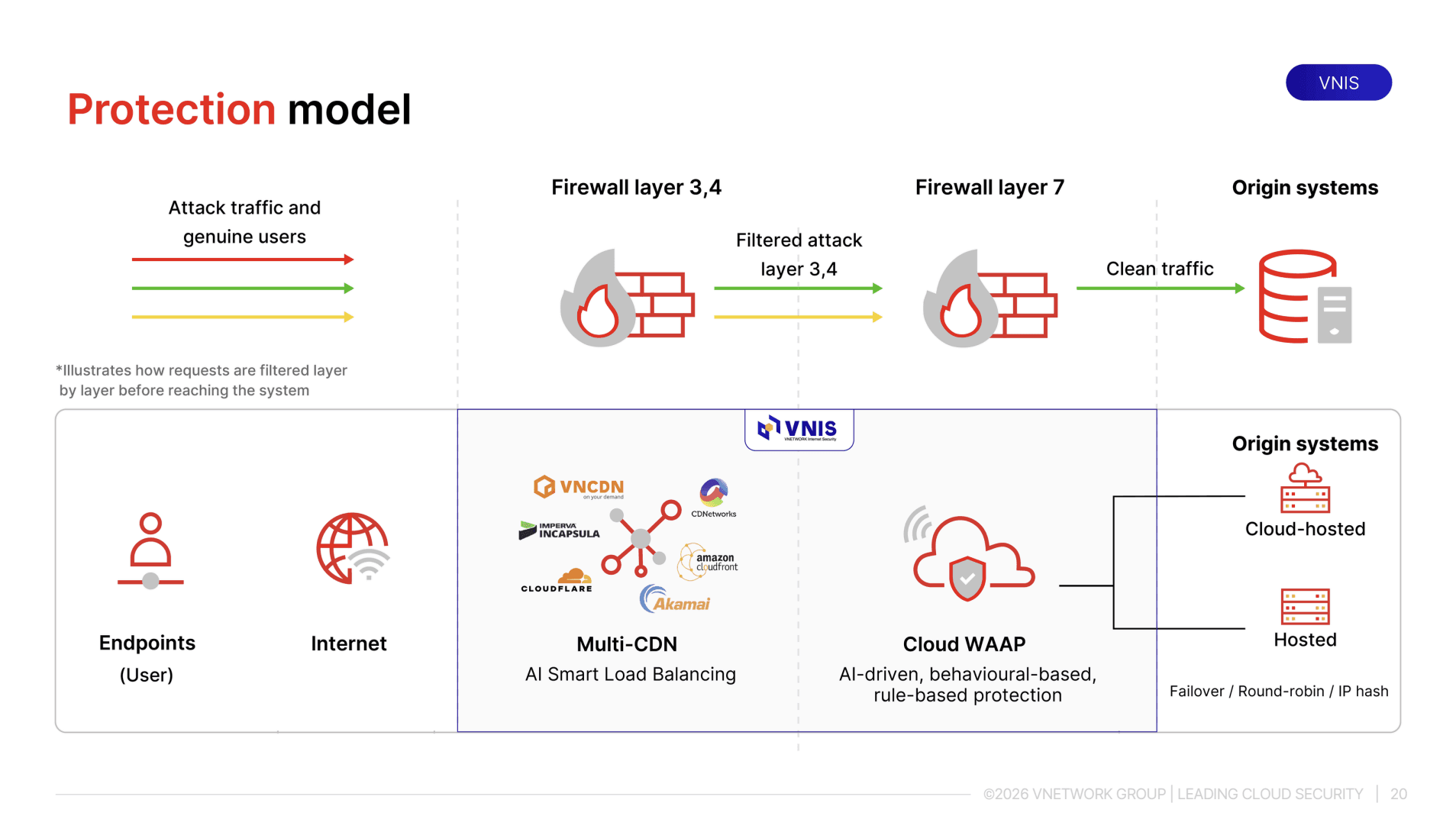
VNIS deploys a two-layer protection model:
- Layer 1: VNIS combines AI Smart Load Balancing and Multi-CDN to analyze access behavior, distribute traffic intelligently, and eliminate abnormal traffic sources before they overload the system.
- Layer 2: VNIS uses WAAP (Web Application and API Protection), applying AI to block application-layer DDoS attacks, malicious bots, and common vulnerabilities listed in the OWASP Top 10. This layer goes deep into the processing logic of Web, App, and API assets, an area where hardware-based next generation firewalls are typically less specialized.
Because it operates at the application layer, VNIS is well suited for organizations with high traffic volumes that rely heavily on Web, App, and API systems, such as e-commerce, finance, media, and online information portals. For these organizations, VNIS complements the next generation firewall to complete a multi-layer protection strategy while maintaining the availability and data security of their applications.
8. Conclusion
The next generation firewall represents an inevitable evolution of the firewall in an era where cyberattacks increasingly focus on the application layer. By combining packet filtering, intrusion prevention, application identification, and threat intelligence, NGFW enables organizations to pursue a more proactive and multi-layered defense posture. For organizations that need to protect the application layer following the same principles of multi-layer defense and AI application, VNIS from VNETWORK is a solution worth considering.
FAQ - Frequently asked questions
1. Does a next generation firewall completely replace a traditional firewall?
The next generation firewall does not eliminate the traditional firewall; rather, it inherits and extends its capabilities. NGFW still filters packets based on ports and IP addresses as a traditional firewall does, while adding application identification, intrusion prevention, and encrypted traffic analysis. The next generation firewall therefore serves as a more comprehensive protective layer rather than a separate replacement device.
2. Do SME organizations need to invest in NGFW?
SME organizations may need a next generation firewall if they have web systems, applications, or customer data connected to the internet. NGFW helps SMEs control applications, block malware, and reduce attack risk without requiring multiple standalone devices. For SMEs without a dedicated security team, a service-based NGFW or a cloud-based WAAP platform is often a more cost-effective and operationally practical choice.
3. Can a next generation firewall defend against zero-day attacks?
A next generation firewall helps reduce the risk from zero-day attacks by combining threat intelligence, behavioral analysis, and sandboxing. Rather than relying solely on known signatures, NGFW monitors unusual behavior to detect threats without a known identifier. However, no solution can guarantee complete zero-day prevention, so the next generation firewall should be combined with a multi-layer defense strategy.
4. Is VNIS a next generation firewall?
VNIS is not a next generation firewall in the traditional network hardware definition. VNIS is a WAAP platform that protects and accelerates Web, App, and API assets operating at the application layer. However, VNIS shares the same core principles as NGFW, including multi-layer protection, AI-driven anomaly detection, and application-aware traffic identification. VNIS concentrates on the application layer, where many modern attacks are directed.
5. Does deploying NGFW affect system performance?
A next generation firewall can impact performance if it must perform deep traffic analysis and SSL decryption with a suboptimal configuration. Modern solutions mitigate this impact through dedicated hardware, distributed processing, and scalable cloud-based architectures. When evaluating NGFW, organizations should verify actual throughput under conditions where all security features are fully enabled.