1. What is OWASP?
OWASP (Open Worldwide Application Security Project) is a global non-profit organization dedicated to improving the security of web applications, mobile applications, and API services. OWASP operates on an open community model, where thousands of security professionals, developers, and researchers collaborate to build free standards, tools, and guidance documents for the entire industry.
OWASP does not independently test or certify the security products of any organization. Instead, it focuses on creating reference standards that the global security community universally recognizes. Its most prominent project is OWASP Top 10, which lists the 10 most critical security risks in web applications and is updated periodically based on real-world data from millions of applications tested worldwide.
Beyond OWASP Top 10, the organization maintains several other important projects: OWASP Web Security Testing Guide (a security testing guide for web applications), OWASP ASVS (Application Security Verification Standard, a collection of security verification requirements for applications and APIs), OWASP ZAP (Zed Attack Proxy, an open-source penetration testing tool), and OWASP Cheat Sheet Series (concise practical guidance for each specific vulnerability type). Together, these projects form a comprehensive security knowledge ecosystem suitable for everyone from developers to CISOs.
2. The OWASP Top 10 vulnerability list
OWASP Top 10 is a list of the 10 most critical security risks in web applications, built from real-world testing data across millions of applications globally. This is not academic theory. It is a compilation of the vulnerabilities attackers are actively exploiting most often today. The table below summarizes all 10 categories, and the next section explains each vulnerability in detail.
| # | Risk Category | Description |
|---|---|---|
| A01 | Broken Access Control | Users access data or functionality outside their authorization scope |
| A02 | Security Misconfiguration | System deployed with insecure defaults, leaking information externally |
| A03 | Software Supply Chain Failures | Libraries or development tools compromised by attackers, spreading to the application |
| A04 | Cryptographic Failures | Sensitive data exposed due to weak or absent encryption |
| A05 | Injection | Attacker embeds malicious commands in input data, causing the system to execute them |
| A06 | Insecure Design | Feature design creates vulnerabilities from the outset, not a coding error |
| A07 | Authentication Failures | Weak authentication mechanisms allow attackers to log in without valid credentials |
| A08 | Software or Data Integrity Failures | Application runs external code or data without verifying integrity |
| A09 | Security Logging & Alerting Failures | No logging or alerting, allowing attackers to persist undetected |
| A10 | Mishandling of Exceptional Conditions | Improper error handling causes the application to skip security checks during failures |
3. Detailed breakdown of the 10 vulnerabilities in OWASP Top 10
OWASP Top 10 2025 is built from real-world testing data across millions of global applications. This is not academic theory. It is a compilation of the vulnerabilities attackers are actively exploiting most today. Below is each specific risk that anyone operating a web application needs to understand.
A01 - Broken Access Control
Broken Access Control occurs when an application fails to properly verify whether a user has permission to perform an action or access a specific resource. As a result, regular users may be able to view other people's data, modify information outside their scope, or even execute functionality reserved for administrators.
A straightforward example: a logged-in user sees a URL structured as /invoice/1001 and tries changing it to /invoice/1002. If the application does not check whether invoice 1002 belongs to that user, the entire invoice record of another customer is exposed. This is why Broken Access Control has consistently topped the OWASP Top 10 for many years in a row and remains the most frequently occurring vulnerability in practice.
A02 - Security Misconfiguration
Security Misconfiguration occurs when a system is deployed with insecure settings, even though the software itself has no flaw. This can include admin accounts still using default passwords, error pages that display full stack traces to the public internet, S3 buckets set to public access, or unnecessary ports and services left open.
This error is particularly common in cloud and container environments because each service comes with dozens of configuration options. A single oversight in a config file can expose an entire database to the outside world without the operations team being aware.
A03 - Software Supply Chain Failures
Software Supply Chain Failures occur when attackers do not target your application directly, but instead target the libraries, packages, or tools your application depends on to build and run. Open-source libraries, npm packages, container images, and even CI/CD pipelines can all become entry points. Simply put: instead of breaking down your front door, the attacker compromises the company that manufactured the lock you installed.
A real-world scenario: a third-party library used by thousands of applications has malicious code injected into a new update. Every project that automatically updates its dependencies gets infected without the attacker needing to target each application individually. This risk is closely related to zero-day vulnerabilities in widely used components.
A04 - Cryptographic Failures
Cryptographic Failures are a group of errors that cause sensitive data to be exposed due to improper or absent encryption. This includes storing passwords in plain text or using MD5 without salt, transmitting credit card data over HTTP instead of HTTPS, using broken encryption algorithms such as DES or RC4, or exposing encryption keys in source code.
The consequences are often severe because when data is exposed in unencrypted or weakly encrypted form, attackers can read it immediately without needing to crack anything. This is the root cause of most large-scale customer data breaches.
A05 - Injection
Injection occurs when an application receives user input and passes it directly to another system for processing without filtering or validating it first. Attackers exploit this by embedding malicious commands into the data, causing the system to execute those commands as if they were legitimate.
The most common form is SQL Injection: an attacker inputs a SQL string into a search field, the application concatenates it into a database query and executes it, resulting in the entire dataset being extracted or wiped. XSS (Cross-Site Scripting) works similarly but injects malicious JavaScript into a web page. That code runs in other users' browsers and can steal cookies, session tokens, or login credentials. Injection is a vulnerability that can be entirely prevented through proper input handling, yet it continues to appear in practice because developers often use string concatenation instead of parameterized queries.
A06 - Insecure Design
Insecure Design is a security vulnerability that originates from how a feature was designed, not a coding error. The developer writes perfectly correct code, but the processing flow itself was inherently insecure from the moment it was conceived. This means that even with no bugs, even with a stable application, the system can still be exploited because of logic gaps built into the design.
Example: a payment page that lets users enter the transaction amount into a form and submit it to the server. An attacker simply opens a browser, changes that number to 1 and clicks confirm. The server receives a perfectly valid request and processes it normally because nothing is technically wrong. The transaction amount should be calculated and fully controlled server-side, never submitted by the user.
A07 - Authentication Failures
Authentication Failures are a group of errors that allow attackers to impersonate legitimate users or take over accounts. Common signs include: no limit on failed login attempts (enabling brute force attacks), no mandatory MFA for admin accounts, session tokens that do not expire after logout, or session IDs stored in URLs instead of secure cookies.
When this vulnerability is exploited, attackers gain access to the system under a real user's identity, allowing them to access data, execute fraudulent transactions, or escalate privileges to administrative accounts.
A08 - Software or Data Integrity Failures
Software or Data Integrity Failures occur when an application trusts and executes code or data from external sources without verifying whether it has been tampered with. The application assumes everything it receives is safe, while in reality an attacker has already modified it beforehand.
Concrete examples: an application loads a plugin from an external CDN and runs it directly without verifying its digital signature; a CI/CD pipeline automatically deploys from any branch without requiring approval; or the application deserializes data from a cookie without verification, allowing attackers to craft malicious objects to execute commands on the server.
A09 - Security Logging & Alerting Failures
Security Logging & Alerting Failures are the reason many organizations only discover they were attacked after the damage is already done. Without adequate logs, without timely alerts, no one knows when the attacker entered the system or what they did during that time.
Specific signs: no logging of failed login attempts, no alerts when an unfamiliar IP tries logging in thousands of times per minute, logs that get overwritten or deleted without backups, or no one reviewing security logs on a regular basis. This type of vulnerability does not help attackers get in, but it allows them to stay longer, move deeper, and cause significantly more damage before being detected.
A10 - Mishandling of Exceptional Conditions
Mishandling of Exceptional Conditions occurs when an application encounters a situation outside the normal flow and responds in a way that compromises security. Developers typically write and test the happy path, but when the system faces connection errors, timeouts, unresponsive dependencies, or unusual input, the application may not know how to handle it and inadvertently opens a vulnerability.
Example: a login system relies on an external authentication service. When that service fails and returns no result, the application receives no rejection signal, so it defaults to letting the user in to avoid wrongful blocking. The entire authentication mechanism is disabled for the duration of the incident without anyone realizing. Or more simply: when a database reports an error, the application prints the raw SQL query to the screen, exposing the full database structure to anyone watching.
Is your website or web application currently exposed to any of the vulnerabilities above? Block them instantly with WAF Free from VNETWORK, built on OWASP-standard security rules, free of charge and with no dedicated security team required.
4. Why does OWASP matter in security?
Before OWASP existed, there were few common standards for measuring how secure a system was. Each security team defined risk in its own way, each testing tool had different criteria, and management had no shared language to discuss security with technical teams. OWASP solved that problem by creating a reference framework that the entire industry recognizes. Specifically, OWASP plays an important role for the following reasons:
- Common standard for the entire industry: OWASP Top 10 is a shared language between developers, security teams, and management. When a vulnerability is labeled "A01 Broken Access Control," everyone in the organization understands what it is and how serious it is, with no need for re-explanation.
- Foundation for focused security prioritization: Rather than trying to patch every possible vulnerability, technical teams can start from the 10 most critical risks and know with confidence they are addressing the right issues first.
- Basis for compliance and auditing: PCI DSS requires web applications to be tested according to OWASP Top 10. ISO 27001 references OWASP Top 10 as part of web application risk controls in Annex A. For Fintech, e-commerce, and healthcare organizations, compliance with OWASP Top 10 is often a mandatory requirement when working with enterprise partners and clients.
- Ecosystem of free tools and documentation: Beyond OWASP Top 10, the organization provides OWASP ZAP for penetration testing, OWASP ASVS for defining security requirements per application type, and OWASP Cheat Sheet Series for developers to look up how to handle each specific vulnerability type. All of these are freely available.
- Updated based on real-world data: OWASP Top 10 is built from real-world testing data across millions of applications, not theory. Each update accurately reflects what attackers are most actively exploiting at that point in time.
5. OWASP Top 10 2025 vs 2021: Key changes to know
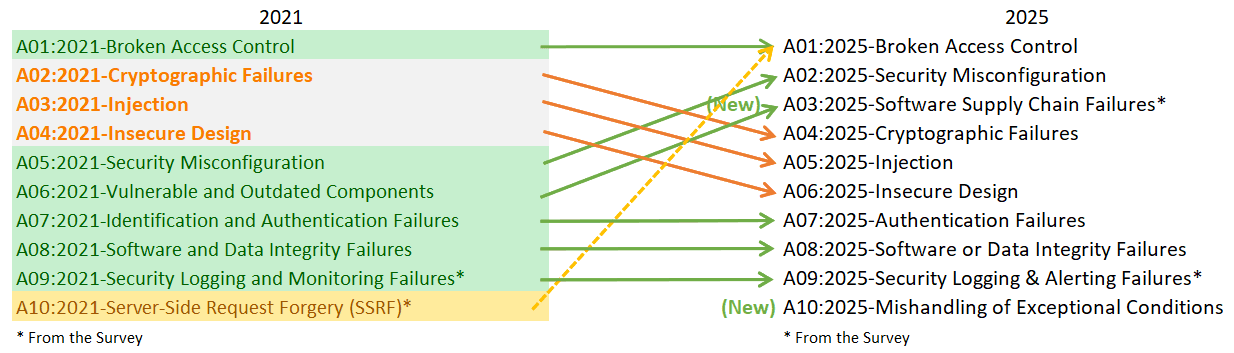
If your organization is using a security checklist or WAF configuration based on the OWASP Top 10 2021 edition, there are several points that need immediate updating. OWASP Top 10 2025 is not simply a reshuffling of rankings. It reflects genuine changes in how attackers are currently targeting systems, with two entirely new categories and several notable positional shifts. Here are the core differences:
- Security Misconfiguration jumped significantly from #5 to #2: reflecting the explosion of cloud-native and container deployments, where the number of configuration points has grown substantially and configuration errors have become harder to control.
- Software Supply Chain Failures (A03) replaces "Vulnerable and Outdated Components": expanding the scope from just patching outdated libraries to securing the entire software supply chain, including build pipelines and distribution infrastructure.
- SSRF is no longer a standalone category: Server-Side Request Forgery, which was A10 in the 2021 edition, has been merged into A01 Broken Access Control, because the nature of SSRF typically originates from access control failures at the server level.
- Mishandling of Exceptional Conditions (A10) is entirely new: reflecting the reality that distributed applications, microservices, and complex systems increasingly encounter exceptional conditions which, if handled incorrectly, can open serious security vulnerabilities.
- Injection dropped from #3 to #5: this does not mean Injection is less dangerous. It reflects that modern frameworks have built in stronger Injection prevention mechanisms, reducing its frequency in testing data.
While your team works on building out a full DevSecOps pipeline, WAF Free lets you start defending right away, blocking the most common vulnerabilities in the OWASP Top 10 in just minutes.
6. How organizations apply OWASP Top 10 in practice
OWASP Top 10 is not just a list to read. It is an operational tool for three distinct groups within an organization: technical teams, security departments, and management.
6.1 Pentest and security auditing
Penetration testers and security auditors use OWASP Top 10 2025 as a minimum checklist when assessing web applications. Each category in OWASP Top 10 maps to multiple specific attack scenarios, helping security testing teams ensure they do not overlook the most common attack vectors. It also provides a basis for comparing results across different audit cycles and measuring improvement over time.
With OWASP ASVS (Application Security Verification Standard), organizations can go a step deeper: instead of only checking the 10 risk categories, ASVS provides hundreds of detailed verification requirements organized into three levels (Level 1, 2, 3) corresponding to the sensitivity of the application.
6.2 Compliance and risk governance
OWASP Top 10 is a reference standard recognized by many major compliance frameworks. PCI DSS (Payment Card Industry Data Security Standard) requires web applications handling card data to be tested against OWASP Top 10. ISO 27001 uses OWASP Top 10 as part of web application risk controls in Annex A. For Fintech, e-commerce, and healthcare organizations, compliance with OWASP Top 10 is typically a mandatory condition when working with enterprise partners and clients.
6.3 DevSecOps pipeline
Technical teams apply OWASP Top 10 within DevSecOps by integrating automated security testing directly into the development process. SAST (Static Application Security Testing) scans source code to detect Injection, Cryptographic Failures, and Insecure Design early. DAST (Dynamic Application Security Testing) simulates real-world attacks to test Broken Access Control and Authentication Failures on running applications.
For Software Supply Chain Failures (A03), organizations need to additionally implement SCA (Software Composition Analysis) to scan libraries and components for vulnerabilities across the entire dependency tree, not just updating package versions.
7. VNIS - Web/App/API security solution aligned with OWASP Top 10
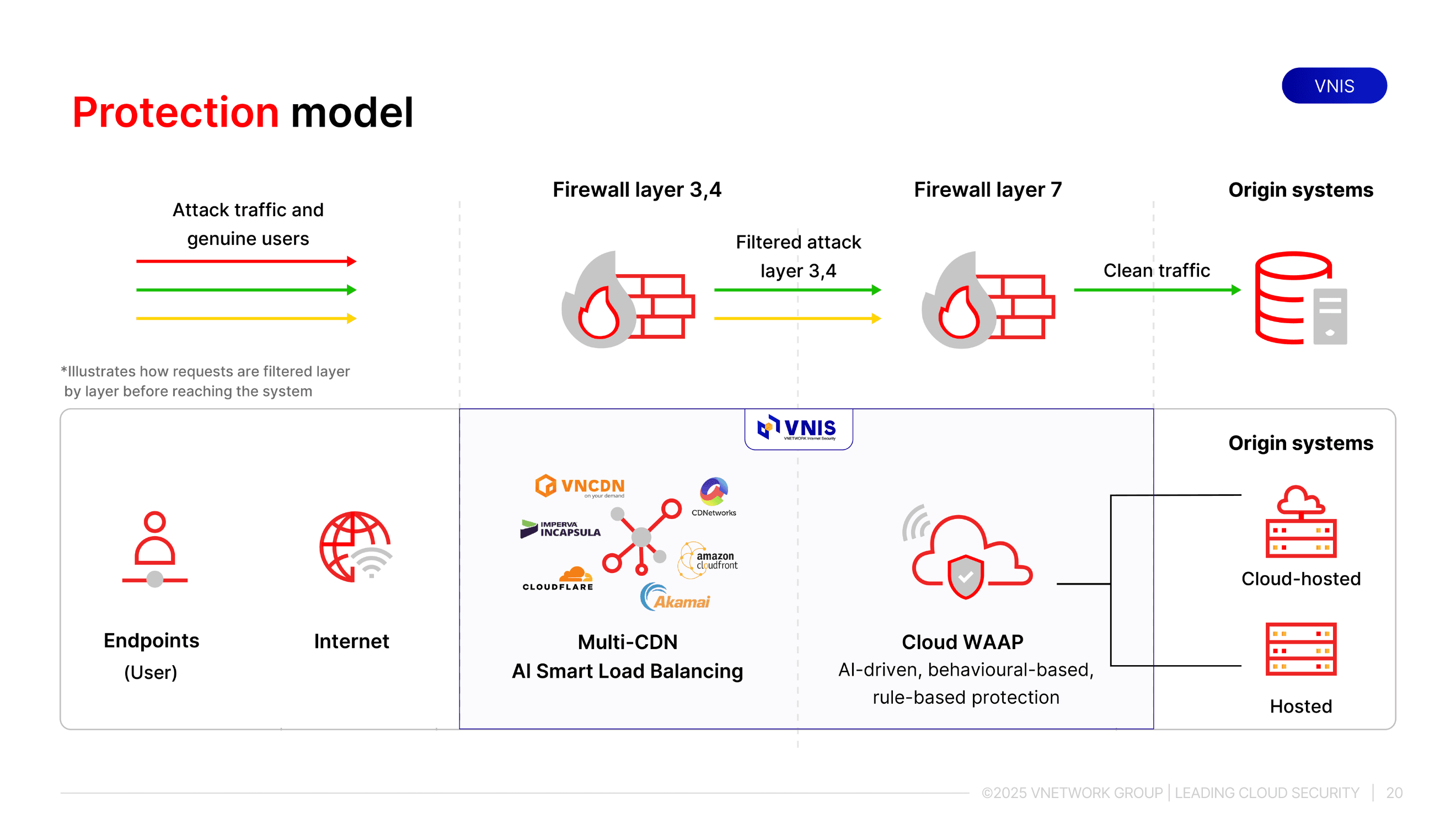
VNIS is VNETWORK's security and performance acceleration platform for Web/App/API, providing real-time protection against threats including multi-layer DDoS attacks, malicious bots, and OWASP Top 10 vulnerabilities such as SQL Injection, XSS, and zero-day exploits. VNIS operates on a two-layer protection model:
- Layer 1: Combines AI Smart Load Balancing and Multi-CDN to handle DDoS attacks at the network layer (Layer 3/4). AI automatically analyzes access behavior, distributes traffic intelligently, and filters out abnormal traffic sources before they cause system overload, ensuring service availability even during an active attack.
- Layer 2: Deploys WAAP (Web Application and API Protection) powered by AI to block Layer 7 DDoS, malicious bots, and OWASP Top 10 vulnerabilities. This layer directly protects the processing logic of web applications and APIs, which are the most deeply exploited and hardest to detect areas. With integrated rate limiting, VNIS also blocks brute force and credential stuffing attacks targeting authentication mechanisms.
8. Conclusion
OWASP Top 10 2025 is an update that accurately reflects the current attack landscape, with emerging risks such as Software Supply Chain Failures and Mishandling of Exceptional Conditions growing increasingly common in cloud and microservices environments. Understanding these 10 vulnerabilities is the first step, but understanding without a corresponding technical protection layer is not enough.
There's no need to wait for a large budget. Businesses can get started right away with the WAF Free package within the VNIS ecosystem, free of charge, easy to integrate, and ready to scale up to more comprehensive protection plans as traffic grows.
VNIS from VNETWORK is built to fill exactly that gap. With a two-layer protection architecture, AI-powered WAAP, and a SOC team monitoring 24/7, VNIS helps businesses proactively defend against OWASP Top 10 risks without needing to build an in-house security team. Contact VNETWORK for a consultation and a free trial of VNIS.
FAQ: Frequently asked questions about OWASP Top 10
1. What is new in OWASP Top 10 2025 compared to the 2021 edition?
OWASP Top 10 2025 introduces two new categories: Software Supply Chain Failures (A03), which expands from "Vulnerable and Outdated Components" to cover the entire software supply chain, and Mishandling of Exceptional Conditions (A10), focused on incorrect error handling and fail-open behavior. Security Misconfiguration climbed from #5 to #2. SSRF, which was A10:2021, was merged into A01 Broken Access Control. Broken Access Control retains its position at number one.
2. How does OWASP Top 10 differ from OWASP API Security Top 10?
OWASP Top 10 (Web Application) focuses on security risks in traditional web applications and SaaS. OWASP API Security Top 10 is a separate list covering 10 risks specific to REST APIs, GraphQL, and microservices, including Broken Object Level Authorization (BOLA) and Excessive Data Exposure. Organizations running both a web application and APIs should reference both lists.
3. Can a WAF protect against all of OWASP Top 10?
A WAF effectively handles risks at the HTTP layer such as Injection (A05), portions of Broken Access Control (A01), and Security Misconfiguration (A02). However, a WAF cannot replace secure coding practices: Insecure Design (A06) must be addressed at the architecture stage, and Software Supply Chain Failures (A03) require SCA within the CI/CD pipeline. A comprehensive solution combines WAF with DevSecOps practices and regular security testing.
4. Do SME organizations need to comply with OWASP Top 10?
Yes. SMEs running e-commerce websites, order management applications, or customer portals are real-world attack targets. Broken Access Control and Injection are among the most common vulnerabilities and can be exploited automatically at scale, regardless of company size. OWASP Top 10 provides a minimum priority list that allows SMEs to start from the most critical points without requiring large security resources.
5. How often is OWASP Top 10 updated?
OWASP Top 10 does not follow a fixed update schedule. In practice, updates occur roughly every three to four years depending on shifts in the security landscape. Recent editions were published in 2017, 2021, and most recently 2025. Each version is built from testing data across millions of global applications, combined with surveys of the security expert community to incorporate newly emerging risks into the list.