
1. What is private cloud?
Private cloud is a cloud computing infrastructure built and operated exclusively for a single organization, without sharing resources with any other party.
Private cloud is a cloud computing environment in which all hardware, software, and network infrastructure resources are dedicated to a single organization. Unlike public cloud, where multiple customers share the same physical infrastructure, private cloud ensures complete isolation, giving businesses tight control over data, performance, and security policies.
Private cloud can be deployed at the enterprise's own data center (on-premises) or operated by a service provider at their facilities (hosted/managed). The core characteristic is exclusivity: all resources belong to and serve only that one organization. This is why private cloud has become the preferred choice for organizations handling sensitive data, financial records, medical records, or legally regulated information.
Technically, private cloud uses virtualization technology to create flexible compute, storage, and network resources, similar to public cloud, but the entire management and orchestration layer remains under the enterprise's control. Internal users can request and consume resources through a self-service portal, while the IT team retains full oversight and governance authority.

2. Core components of a private cloud system
A complete private cloud system is composed of multiple technology layers that work in close coordination. Understanding each component helps businesses plan deployments and operations more effectively.
| Component | Primary function | Technology examples |
| Server and storage infrastructure | Provide computing capacity and physical storage | Server rack, SAN, NAS |
| Virtualization layer (hypervisor) | Partition physical resources into multiple virtual machines | KVM, VMware ESXi |
| Management and automation software | Orchestrate resources, provide self-service portal | OpenStack, vSphere |
| Security and access control layer | Protect data, manage identity and access | IAM, firewall, VPN, encryption |
2.1. Server and storage infrastructure
The physical infrastructure is the foundation of the entire private cloud system. This layer includes physical servers (bare metal servers), SAN (Storage Area Network) or NAS (Network-Attached Storage) systems, and a high-speed internal network. Businesses must carefully calculate compute capacity, storage volume, and network bandwidth based on actual workloads to avoid shortfalls or wasted resources.
2.2. Virtualization layer (hypervisor)
The virtualization layer is the technology that allows a single physical server to run multiple independent virtual machines simultaneously. The hypervisor allocates CPU, RAM, and storage to each virtual machine on demand, creating flexibility similar to public cloud but on the enterprise's own infrastructure. The virtualization layer is the determining factor for performance and resource utilization density across the entire private cloud system.
2.3. Management and automation software
Cloud management platform software is the central orchestration layer, providing a self-service interface for internal users and a monitoring dashboard for the IT team. Through this software, businesses can automate resource provisioning, track performance, manage virtual machine lifecycles, and control operating costs per department or project. Orchestration platforms such as Kubernetes are also commonly integrated to manage containers in modern private cloud environments.
2.4. Security and access control layer
Security in private cloud is deployed in a multilayer model, including network firewalls, intrusion detection and prevention systems (IDS/IPS), data encryption at rest and in transit, and an identity and access management system (IAM). The enterprise defines its own security policies, determines who can access which resources, and logs all activity for audit purposes.
3. Common private cloud deployment models
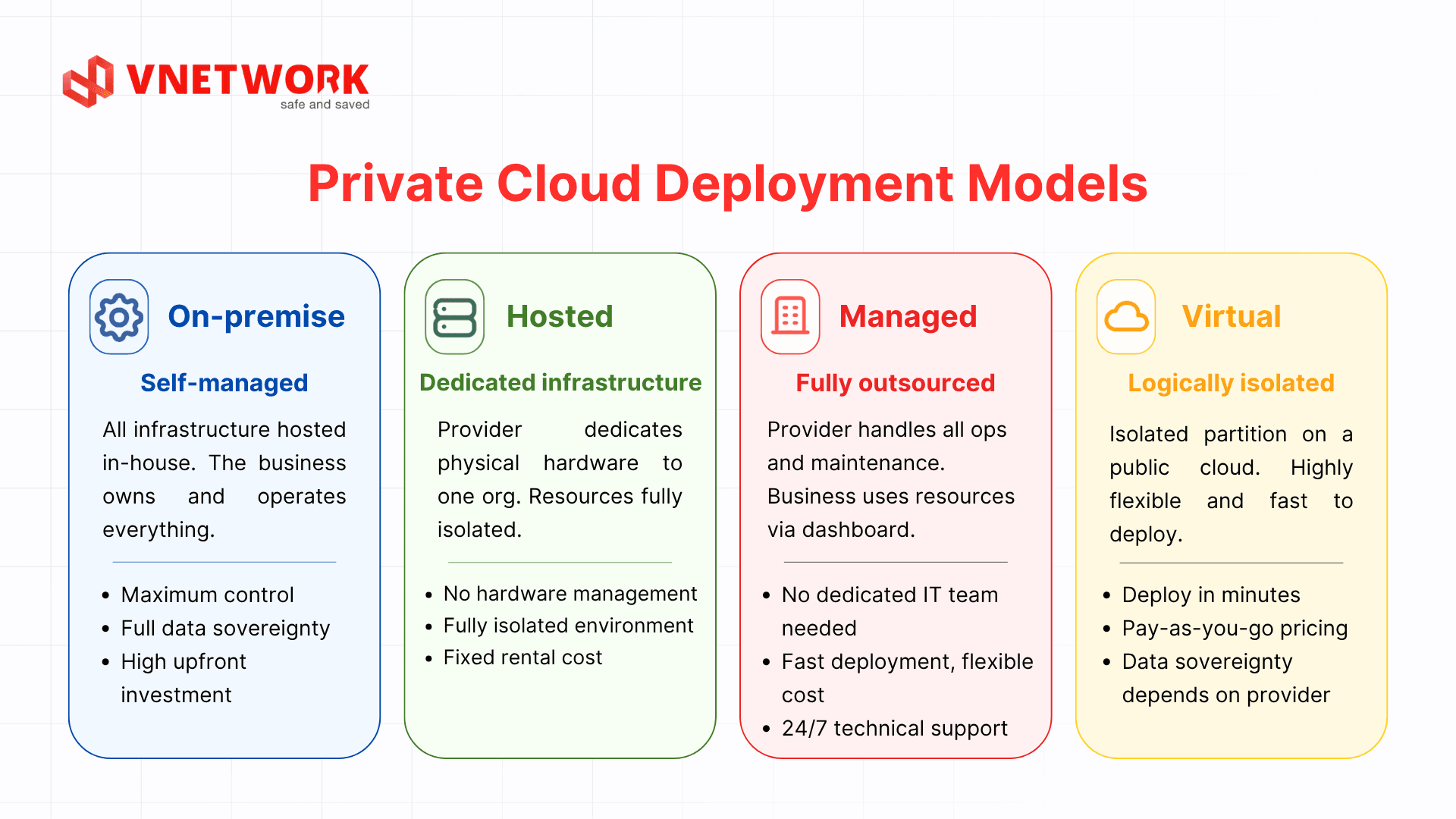
Private cloud is not limited to a single deployment approach. Depending on internal resources, control requirements, and budget, businesses can choose from four primary models. Unlike VPS or shared hosting solutions, private cloud ensures all resources are dedicated exclusively to a single organization.
3.1. On-premises private cloud
On-premises private cloud is the model in which an enterprise builds and operates its entire infrastructure at its own data center. The enterprise owns the hardware, installs management software itself, and is fully responsible for operations, maintenance, and upgrades. This model provides the highest level of control but requires significant upfront investment and a deeply skilled IT team.
3.2. Hosted private cloud
Hosted private cloud is the model where a service provider dedicates a portion of the physical infrastructure at their data center exclusively to a tenant enterprise. Resources remain fully isolated and are not shared with other customers, but the enterprise does not need to manage the physical hardware itself. This is a suitable option for organizations that want the isolation of private cloud without investing in their own infrastructure.
3.3. Managed private cloud
Managed private cloud is the model where a service provider takes full responsibility for managing, operating, and maintaining the private cloud infrastructure on behalf of the enterprise. The enterprise only needs to consume resources through a management interface, while the provider handles complex technical work such as system updates, performance monitoring, and incident response. This model allows businesses to focus on digital transformation and core business activities.
3.4. Virtual private cloud
Virtual private cloud is the model where an enterprise uses a logically isolated partition (not physical isolation) within a public cloud provider's infrastructure. Resources are protected by network policies, VPNs, and dedicated access controls, creating an operating environment similar to private cloud but on a shared platform. VPC suits businesses that need the flexibility of public cloud combined with a higher level of isolation than standard public cloud, but do not yet require absolute data sovereignty as with on-premises or hosted deployments.
3.5. Comparison of 4 private cloud deployment models
| Criteria | On-premises | Hosted | Managed | Virtual |
| Control level | Highest | High | Medium | Lower |
| Initial investment | Very high | Medium | Low | Very low |
| Operating cost | High (IT staff) | Medium | Low (provider managed) | Usage-based |
| IT team requirement | Deep expertise | Medium | Minimal | Minimal |
| Deployment speed | Slow (3-6 months) | Medium | Fast | Very fast |
| Best for | Large enterprise, government | Mid-size businesses | SMEs, digital transformation | Startups, flexible workloads |
4. Benefits of private cloud for enterprises with data compliance requirements
In the increasingly tightening legal environment in Vietnam, private cloud delivers practical benefits that other infrastructure models struggle to fully provide. Understanding these benefits helps businesses make sound investment decisions on their digital journey.
4.1. Full control over data and storage location
Private cloud allows enterprises to specify exactly where data is stored, who can access it, and under what conditions. This is a critical factor when organizations need to demonstrate to regulators that Vietnamese users' data is stored within Vietnam's territory. No infrastructure model provides better data location transparency than on-premises or hosted private cloud at a domestic data center. This is also a core requirement of the Personal Data Protection Law and its implementing decrees.
4.2. Compliance with Decree 356/2025/ND-CP and Vietnam's Cybersecurity Law
Decree 356/2025/ND-CP (effective January 1, 2026) provides detailed guidance for implementing the Personal Data Protection Law, requiring organizations that process sensitive personal data to have appropriate technical and organizational measures in place. The Cybersecurity Law of 2018 requires certain categories of data to be stored within Vietnam. Private cloud helps businesses meet both requirements: absolute technical control and full data sovereignty within the organization's own hands.
4.3. Consistent performance and high customizability
Because resources are not shared with any other entity, private cloud completely eliminates the "noisy neighbor" effect common in public cloud, where performance degrades when other customers over-consume shared resources. Businesses can customize network configurations, storage policies, and technical parameters to match the specifics of each application, something public cloud does not permit.
4.4. Multi-layered security for sensitive data
Private cloud allows businesses to apply a cloud security strategy customized per data segment, integrating with existing internal security systems and controlling the entire data access chain. All activity is logged in detail, supporting internal audits and regulatory requirements. For financial data, medical records, or personally identifiable information, this level of security is non-negotiable.
5. How does private cloud differ from public cloud and hybrid cloud?
The three mainstream cloud models are private, public, and hybrid cloud, each with different levels of control, cost, and legal compliance. You can read more about Public Cloud, Private Cloud, and Hybrid Cloud to understand each model in detail before making a decision.
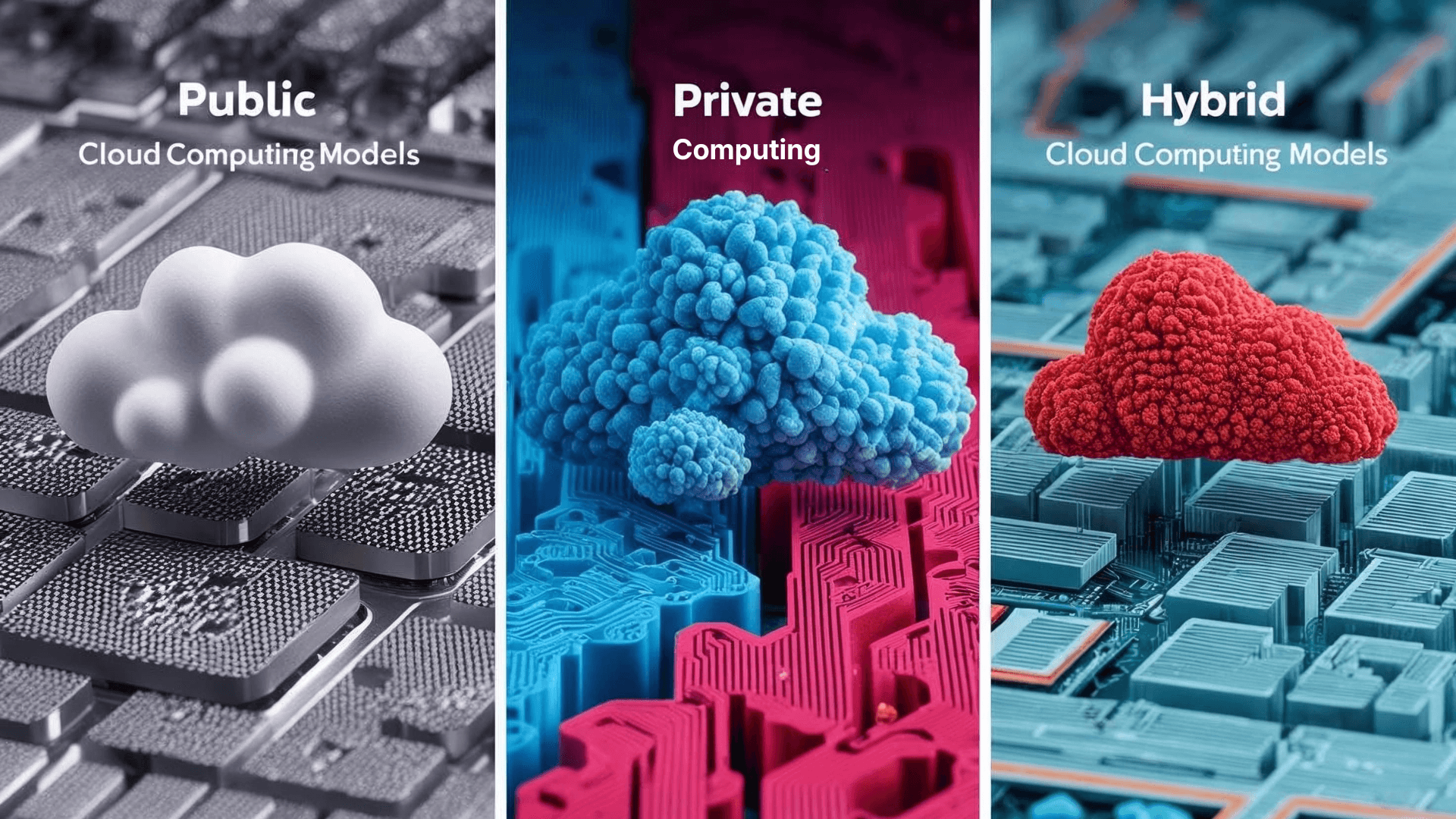
Private cloud dedicates all infrastructure to one organization, public cloud shares resources among multiple customers on the same physical infrastructure, and hybrid cloud combines both to leverage the advantages of each. Which model a business chooses depends on the level of data control required, budget, and legal compliance needs. To better understand cloud service tiers, see also IaaS, PaaS, SaaS.
| Criteria | Private Cloud | Public Cloud | Hybrid Cloud |
| Data control | Full | Limited | Partial |
| Security | Highest | Medium | High (configuration-dependent) |
| Initial cost | High | Low | Medium |
| Operating cost | Fixed | Usage-based | Mixed |
| Vietnam compliance | Easiest to comply | Provider-dependent | Compliant if properly configured |
| Scalability | Infrastructure-limited | Near unlimited | Flexible |
| Best for | High-compliance organizations | Startups, variable-load apps | Enterprises needing both |
| Data location | Enterprise-controlled | Provider-determined | Sensitive on private, rest on public |
For Vietnamese enterprises with data residency requirements, on-premises or hosted private cloud at a domestic data center is the safest option from a legal standpoint. Hybrid cloud is a popular approach when businesses want to keep sensitive data on private cloud while using public cloud for lower-risk applications.
6. Which industries is private cloud best suited for?
6.1. Finance, banking, and insurance
The financial sector has the highest demand for private cloud in Vietnam. Banks, securities firms, and insurance companies process large volumes of transaction data, account information, and customer records that require a high level of security. The State Bank of Vietnam and the Ministry of Finance impose strict requirements on storing transaction data within Vietnam, controlling access, and maintaining auditability. Private cloud helps financial institutions meet standards such as PCI DSS, ensures data integrity, and maintains high uptime for online transaction systems.
6.2. Healthcare and medical services
Electronic medical records, laboratory results, medical imaging, and patient identification information are extremely sensitive data. The Ministry of Health of Vietnam is promoting cloud adoption in healthcare alongside requirements to ensure information security for electronic health record systems. Private cloud allows hospitals and healthcare facilities to maintain full control over patient data, integrate with HIS (Hospital Information System) and PACS (Picture Archiving and Communication System) without the risk of data leaving the internal infrastructure.
6.3. Government agencies and public organizations
Government agencies, administrative units, and public organizations have specific requirements around national information security and citizen data. Under current regulations, government information systems must ensure data sovereignty and may not store national information on foreign infrastructure. On-premises or nationally certified hosted private cloud is the most appropriate solution for this group, combined with requirements for multi-factor authentication, role-based access control, and comprehensive audit logging.
6.4. E-commerce and large-scale retail
E-commerce platforms and large retail chains process millions of transactions daily, storing payment information, delivery addresses, and shopping behavior data of Vietnamese users. For deeper insight into the role of cloud infrastructure in this industry, see cloud for retail. Decree 356/2025/ND-CP classifies much of this data as personal data, requiring appropriate technical and organizational protection measures under the Personal Data Protection Law. Private cloud enables e-commerce organizations to control customer data, customize infrastructure for peak loads, and maintain legal compliance.
6.5. FDI enterprises with Vietnam data residency requirements
Foreign direct investment (FDI) enterprises operating in Vietnam are increasingly facing data localization requirements. The Cybersecurity Law and its implementing decrees stipulate that certain categories of data collected from Vietnamese users must be stored within Vietnam. Rather than synchronizing all data to the parent company's systems abroad, FDI enterprises can deploy private cloud in Vietnam to store and process domestic data, then transfer only permitted data to central systems.
7. VCLOUD - Private cloud solution from VNETWORK
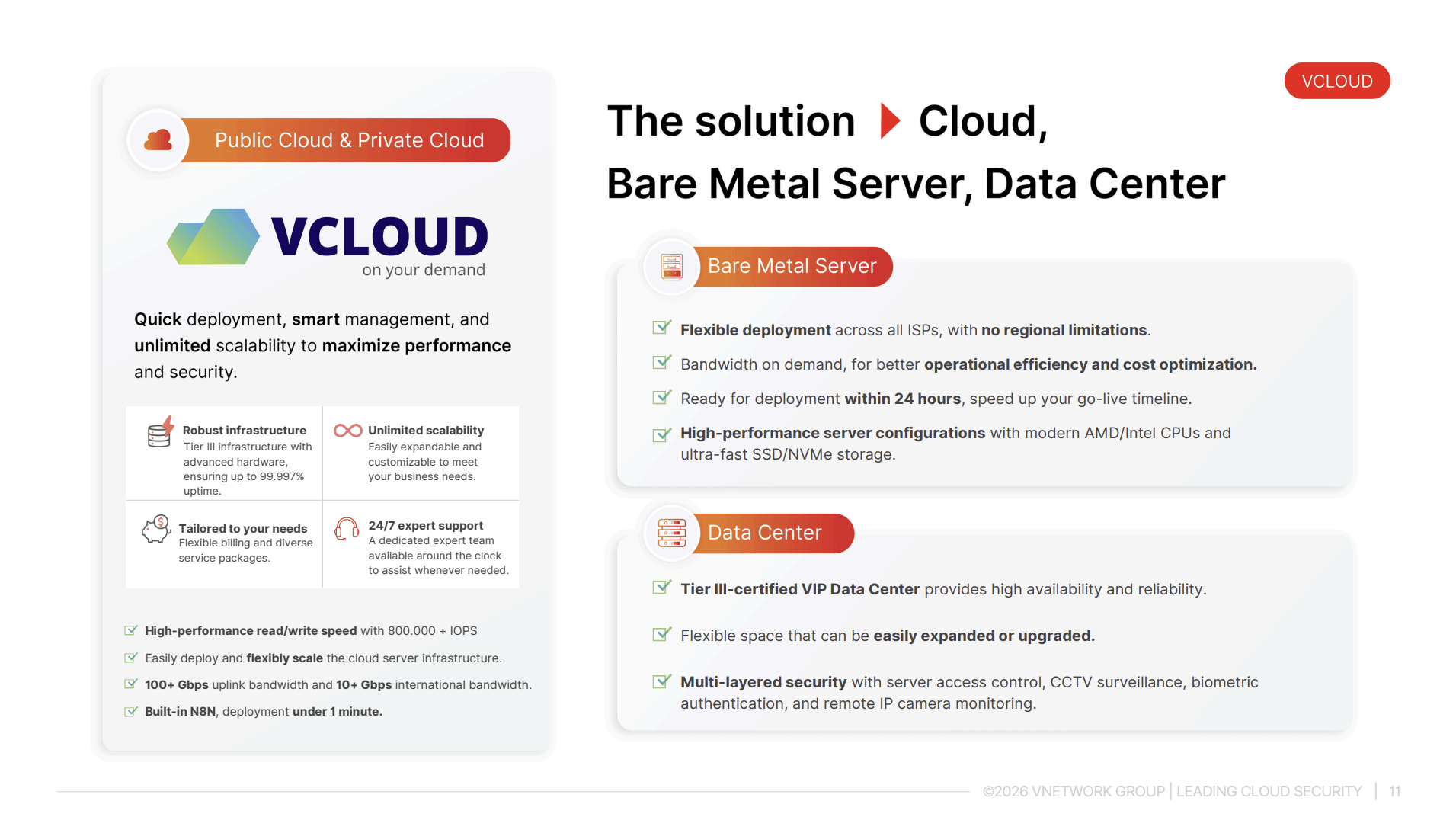
VNETWORK has developed VCLOUD, a cloud computing platform built specifically for the Vietnamese market and operated on Tier III-certified data center infrastructure. Unlike international cloud platforms, VCLOUD provides full virtualized resources (CPU, RAM, storage, network) through a flexible model, with all data stored within Vietnamese territory, directly meeting data sovereignty requirements under Decree 356/2025/ND-CP and the Cybersecurity Law.
The most significant differentiator of VCLOUD compared to international cloud platforms is direct technical support in Vietnamese, available 24/7 without tickets or automated chatbots. Rather than waiting for a response, businesses can contact VNETWORK's specialists directly for real-time consultation, incident resolution, and technical support.
Key features of VCLOUD:
VCLOUD is designed to comprehensively address enterprise digital infrastructure needs, with the following core strengths:
- Performance up to 99.997%: Tier 3 Data Center-certified infrastructure delivering 99.997% uptime and extreme read/write speeds of 800,000 IOPS, suitable for high-continuity systems such as e-commerce, finance, and AI applications.
- Cost efficiency: Flexible payment model aligned with project milestones and actual usage, with no fixed costs when resources are idle. Service packages are tailored to specific needs, suitable for both SMEs and large enterprises in the midst of digital transformation.
- Unlimited growth: Built-in essential services including Load Balancer, Snapshot, Backup, and unlimited resource scaling, supporting continuous business growth without requiring architectural changes. Full Kubernetes support and modern container deployment.
- Tailored to requirements: A flexible system that easily accommodates any custom requirement, from hardware configuration to operating environment setup. Manage the entire infrastructure intuitively through a dashboard or API, with budget alerts and real-time resource monitoring.
- Comprehensive international-standard security: Full compliance with ISO 27001, 2FA authentication, SSH Key Pairs, Security Groups, and Firewall Rules, ensuring enterprise data is protected at multiple independent layers. VCLOUD also integrates seamlessly with advanced cloud security solutions from the VNETWORK ecosystem.
8. Conclusion
Private cloud is no longer a solution reserved for large corporations. In the context of the Personal Data Protection Law and Decree 356/2025/ND-CP being enforced with increasing rigor, any business that processes personal data of Vietnamese users needs to take data sovereignty and its infrastructure model seriously. Private cloud delivers the control, security, and regulatory compliance capability that no other model can match.
FAQ - Frequently asked questions about private cloud
1. Is private cloud a mandatory solution for complying with Decree 356/2025/ND-CP?
Decree 356/2025/ND-CP (effective January 1, 2026, fully replacing Decree 13/2023/ND-CP) does not require businesses to use private cloud, but does require organizations that process personal data to have appropriate technical and organizational measures in place under the Personal Data Protection Law. Private cloud is one of the best solutions for meeting this requirement, as it allows full control over the data storage and processing environment. Businesses may also use public cloud or hybrid cloud if configured to provide equivalent protection measures, but demonstrating compliance will be more complex.
2. Is the cost of deploying private cloud higher than public cloud?
The initial investment for private cloud, especially the on-premises model, is generally significantly higher than public cloud because businesses must purchase or lease physical infrastructure. However, long-term operating costs can be lower when usage volume is large and stable, as there are no usage-based fees as with public cloud. With the managed private cloud model, upfront costs are much lower and businesses pay through a monthly service contract, suitable for forecastable budgets.
3. Should SMEs use private cloud?
SMEs can absolutely use private cloud through hosted or managed models, without needing to invest in their own infrastructure. The decision should be based on the type of data the business processes: if it handles financial data, medical information, or sensitive personal data of Vietnamese customers, private cloud is a necessary investment for legal compliance and reputation protection. If the data is not sensitive and the volume is small, public cloud or hybrid cloud may be a more cost-effective choice.
4. Is private cloud different from an internal data center?
An internal data center (traditional data center) is the physical infrastructure where an enterprise houses servers and networking equipment. Private cloud is the virtualization and automation technology layer built on top of that infrastructure, creating a flexible and self-service environment. In other words, the data center is where the hardware resides, while private cloud is how resources from that hardware are organized and operated. An internal data center that has not been virtualized and automated is not yet a private cloud.
5. What is managed private cloud and who is it best for?
Managed private cloud is the model in which a service provider operates and manages the entire private cloud infrastructure on behalf of the enterprise, including maintenance, updates, monitoring, and incident response. The enterprise only needs to consume resources through a management interface. This model is suitable for organizations that do not have a large enough dedicated IT team to operate complex infrastructure independently, or those that want to focus their resources on core business activities rather than managing infrastructure.