1. What is the Shellshock vulnerability?
Shellshock, also known as Bashdoor, is a critical security vulnerability identified under CVE-2014-6271, along with several related CVEs published in the days that followed. The vulnerability resides in Bash (Bourne Again Shell), the default command interpreter on most Unix and Linux systems, and affected all versions from 1.03 (released in 1989) through 4.3. It was publicly disclosed on September 25, 2014, and immediately received a CVSS score of 9.8, rated CRITICAL by NIST.
At its core, Shellshock exploits the way Bash processes environment variables. Bash supports a mechanism that allows function definitions to be passed from a parent process to a child process through environment variables. Due to a parsing flaw, however, Bash does not stop after importing the function. It continues executing any commands appended after the closing brace of that function definition within the same environment variable. Attackers leverage this behavior to inject arbitrary commands, turning a routine environment variable import into a gateway for Remote Code Execution (RCE) without any authentication required. This makes Shellshock significantly more dangerous than typical application-layer vulnerabilities.
What sets Shellshock apart from conventional Arbitrary Code Execution (ACE) vulnerabilities is the exceptionally low technical barrier to exploitation. Traditional ACE flaws typically require deep knowledge of memory architecture, stack layout, and assembly code. Shellshock requires none of that. A single specially crafted string embedded in an HTTP header is sufficient to trigger the exploit. This ease of exploitation places it in the same category as some of the most severe zero-day vulnerabilities ever recorded.
2. The technical mechanics of Shellshock
2.1 How Bash processes environment variables
Bash supports a mechanism for exporting function definitions through environment variables so that child processes can inherit functions defined by a parent. When Bash starts, it reads all environment variables and, if it detects a variable whose value begins with a function definition syntax, it imports that function into the current session. The Shellshock flaw arises because Bash does not validate the boundary at the end of the function. Instead, it continues executing all commands that appear after the closing brace within the same environment variable.
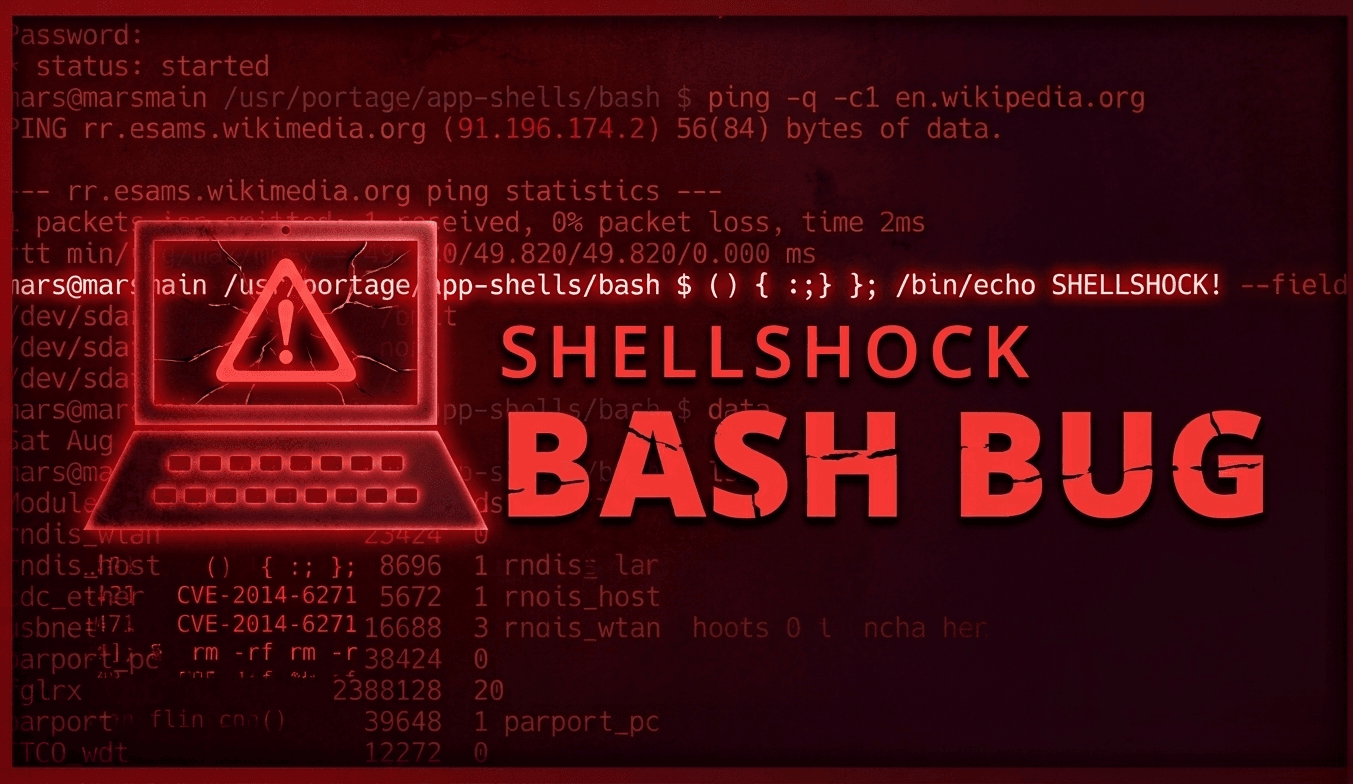
The structure of a Shellshock exploit payload follows the pattern: a valid function definition () { :; }; followed by the arbitrary command to execute. When a child Bash process receives an environment variable containing this string, it imports the empty function and immediately executes the trailing command with the privileges of the running process. This entire sequence occurs during Bash initialization, before any script has been invoked.
2.2 The attack flow via CGI and web servers
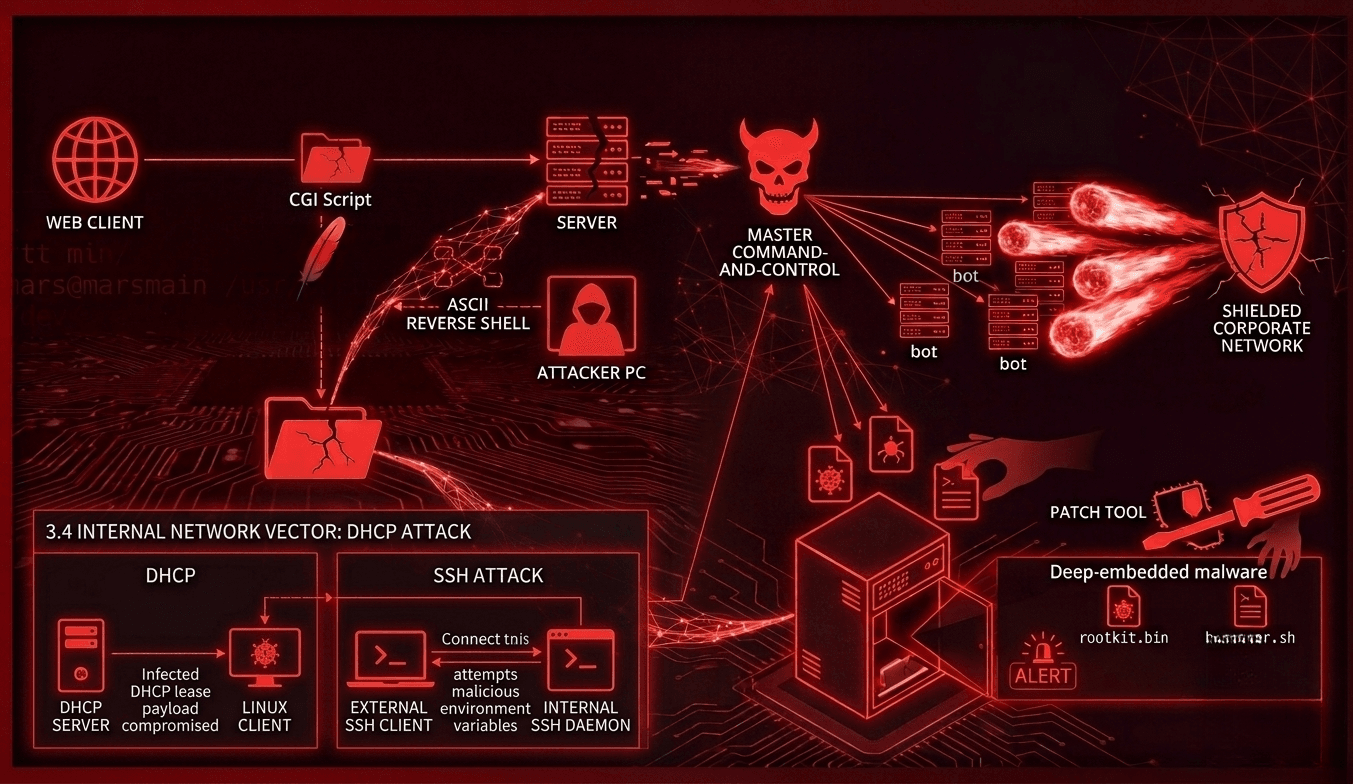
The most widely exploited vector for Shellshock is through CGI (Common Gateway Interface). CGI is a mechanism that allows web servers to execute external scripts and return the output to the client. When a web server receives an HTTP request, it converts request components such as URL parameters and headers including User-Agent, Referer, and Cookie into environment variables, then passes them to a CGI script running inside a Bash environment. An attacker embeds a Shellshock payload in any HTTP header. When the CGI script is invoked, Bash executes the malicious command with the privileges of the web server process. Traditional firewalls have no capability to inspect payload content at this layer and therefore cannot detect or block Shellshock attacks.
From an architectural perspective, the risk exists at any layer of the OSI model where data from an external source is passed into a Bash environment. This means the attack surface extends well beyond web servers to include DHCP clients, SSH daemons, IoT devices, routers, and any networked service running on Linux or Unix that interacts with Bash.
3. Real-world attack vectors for Shellshock
3.1 Web server attacks via CGI scripts
This is the most dangerous vector for organizations running web applications. An attacker does not need to know anything about the target system's internals. Sending an HTTP request with a Shellshock payload embedded in the User-Agent or Referer header to any endpoint that invokes a CGI script is sufficient. If the web server is vulnerable, Bash executes the command with the privileges of the Apache or web server process. The attacker can read system configuration files such as /etc/passwd, enumerate sensitive information, or establish a reverse shell to gain persistent remote control of the server.
3.2 Botnet construction and DDoS attacks
Within hours of the Shellshock disclosure, botnets began forming from large numbers of compromised servers. These botnets were deployed to launch DDoS attacks against other targets, scan for additional vulnerable systems at scale, and expand the scope of attacker control. A particularly serious consequence is that a compromised server does not only become a victim. It is actively weaponized against others, creating significant legal and reputational exposure for the organization that owns it.
3.3 Malware installation, rootkits, and persistent backdoors
Once an initial foothold is established, attackers use Shellshock to download and install malware or rootkits on the compromised system, or to create backdoors and reverse shells that maintain control even after the vulnerability has been patched. This is precisely why patching Bash alone is not sufficient. Organizations must conduct a thorough forensic investigation of all affected systems, including a full review of logs to determine whether any intrusion occurred before the patch was applied.
3.4 Exploitation via DHCP client and SSH daemon
Internal network environments are not automatically protected from Shellshock. An attacker who controls a DHCP server can inject Shellshock payloads into DHCP options, triggering the vulnerability on any Linux DHCP client that receives a lease from that server. Similarly, SSH daemons can become a vector if their configuration allows environment variables to be passed from a client into an SSH session. These vectors are particularly concerning in internal infrastructure that is typically assumed to be safe behind a perimeter firewall but lacks application-layer inspection controls.
4. The impact of Shellshock on enterprise environments
Shellshock is not merely a technical vulnerability. It represents a serious operational risk with a uniquely wide blast radius, owing to the fact that Bash is the default interpreter on virtually all Unix and Linux systems, from large-scale web servers to embedded devices and IoT hardware. When an attacker successfully exploits Shellshock, the consequences can unfold simultaneously across multiple dimensions:
- Reading and exfiltrating sensitive data from the file system and organizational databases.
- Privilege escalation to gain full administrative control over the system, giving the attacker complete authority over the infrastructure.
- Disruption of services by consuming system resources, leading to denial-of-service conditions.
- Turning compromised servers into components of a botnet used to conduct DDoS attacks against other targets.
- Creating persistent backdoors that maintain long-term access even after the vulnerability has been patched.
- Exposing the organization to a critical risk window: automated exploitation begins almost immediately after a vulnerability is disclosed, while enterprise patch cycles are far slower. The gap between these two timelines is when organizations are most exposed.
- Highlighting software supply chain risk: a widely trusted open-source component contained a flaw that went undetected for decades, underscoring the importance of security auditing for both internally developed code and third-party libraries.
5. How to effectively defend against Shellshock
5.1 Short-term measures: patching and system review
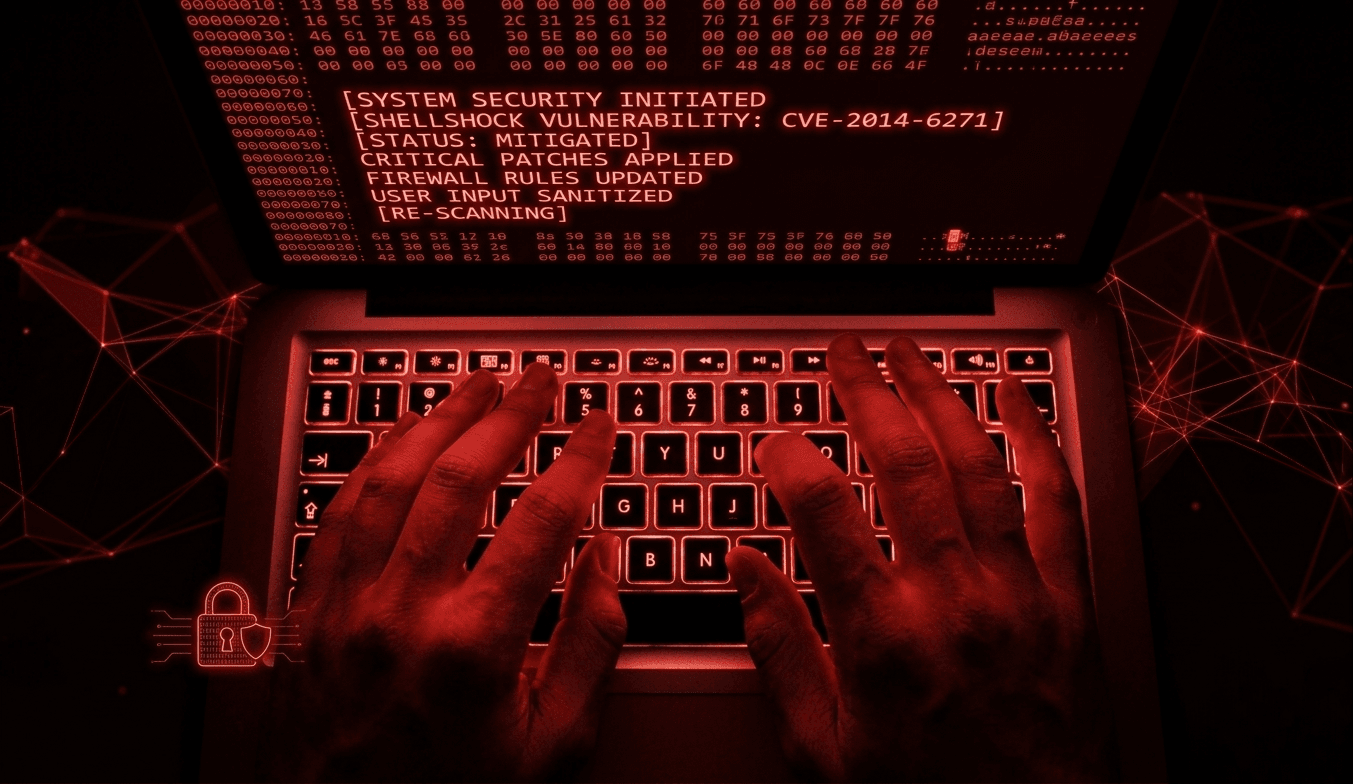
The immediate and mandatory first step is upgrading Bash to a patched version (4.3 patch 25 or later). However, patching Bash is a necessary condition, not a sufficient one, particularly if the system may already have been compromised before the patch was applied. Organizations should simultaneously carry out the following:
- Audit and update Bash across all systems: web servers, embedded devices, routers, and IoT hardware.
- Review web server logs for any signs of Shellshock payloads that may have been sent to the system prior to patching.
- Inspect all CGI scripts on web servers and assess their exposure.
- Perform a full system scan for indicators of malware, backdoors, or unauthorized accounts.
5.2 Long-term strategy: layered security architecture
For the long term, the Defense in Depth principle is foundational. No single control is sufficient to fully protect against Shellshock and similar vulnerabilities. Organizations need to build multiple coordinated layers of protection:
- Deploy a WAF to detect and block Shellshock payloads at the HTTP layer before requests reach the web server.
- Minimize the use of CGI scripts, and prioritize modern web application architectures that do not pass raw HTTP data into a shell.
- Apply the principle of least privilege: run web server processes with only the minimum permissions required, limiting the damage if an exploit succeeds.
- Upgrade to WAAP for comprehensive protection of both web applications and APIs against sophisticated multi-layer attacks.
- Adopt a Zero Trust strategy to reduce the risk from internal threats and enforce strict access controls.
- Implement a structured patch management process with prioritization based on vulnerability severity.
6. VNIS: proactive protection against vulnerabilities like Shellshock
Founded in 2013, VNETWORK is a leading provider of cybersecurity and digital infrastructure services in Vietnam, with over 13 years of hands-on operational experience. Holding ISO/IEC 27001 international certification, VNETWORK is a trusted strategic partner for major enterprises, financial institutions, and large-scale organizations in the domestic market, including VTV, VnExpress, Tiki, Sendo, Momo, and VNG. With a deep understanding of enterprise operational realities and the specific security pressures organizations face, VNETWORK delivers the VNIS platform to help organizations build the most comprehensive defense against critical vulnerabilities such as Shellshock.
How VNIS works:
VNIS is an integrated Web/App/API security and acceleration platform, purpose-built to protect applications against the real-world threats analyzed in this article: multi-layer DDoS, operating system vulnerability exploitation, and Remote Code Execution (RCE) attacks. The entire architecture and operational framework of VNIS is built to ISO 27001 standards, enabling organizations to integrate VNIS directly into their existing information security management systems without introducing any compliance gaps.
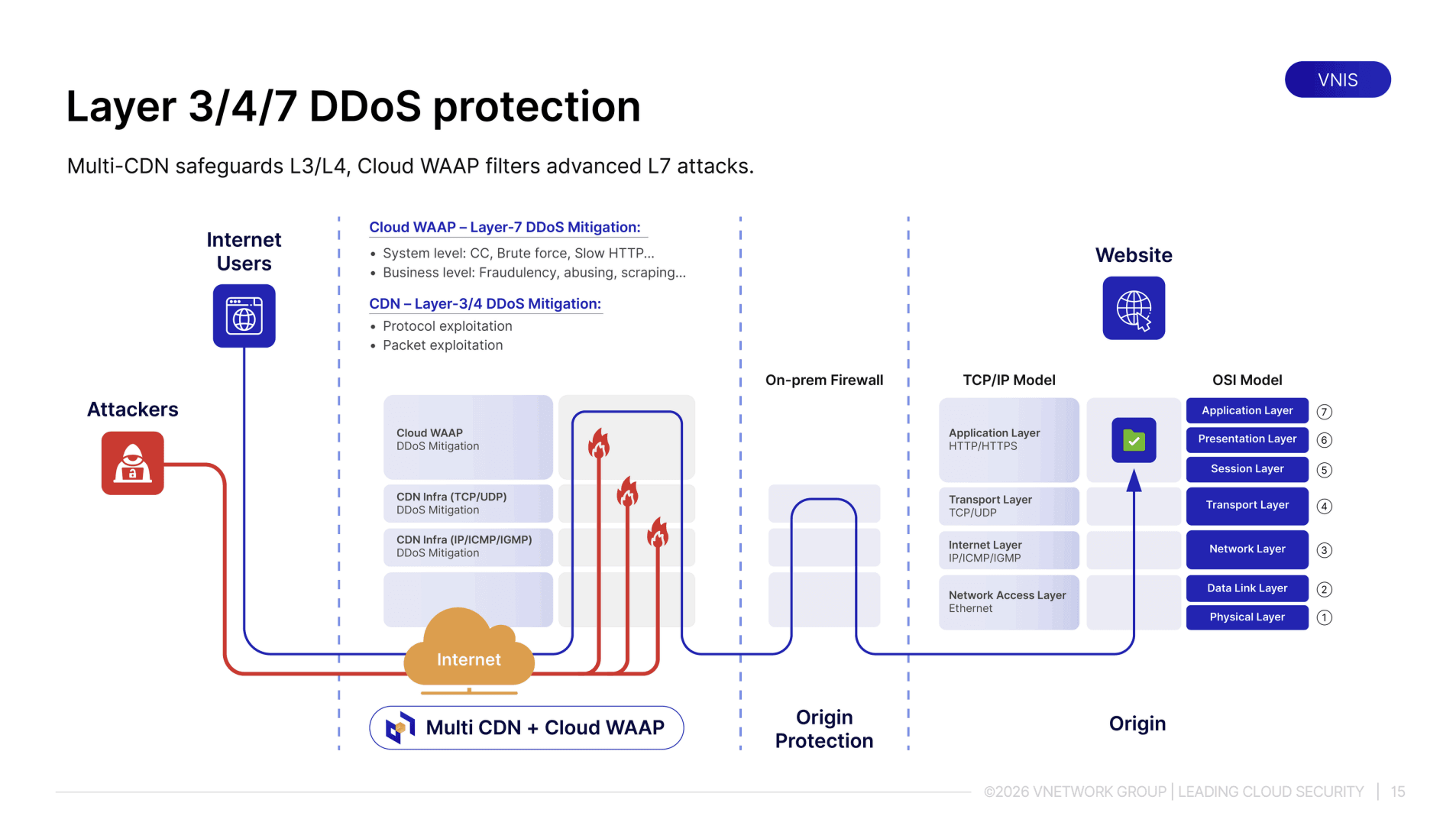
Modern applications cannot be effectively protected by a single-layer solution. As attack traffic grows increasingly sophisticated, malicious HTTP requests carrying Shellshock payloads can silently exploit system logic the moment a request reaches the server. To address this comprehensively, VNIS deploys a two-layer protection model:
- Infrastructure-layer threat mitigation: The AI Smart Load Balancing mechanism, combined with a global Multi-CDN network, absorbs and distributes DDoS traffic at Layers 3 and 4 before it can reach the infrastructure. AI continuously analyzes traffic behavior, automatically routing legitimate traffic and eliminating anomalous sources without manual intervention, ensuring service continuity even under heavy attack pressure.
- Application and API protection layer: VNIS deploys AI-powered WAAP to analyze every request in real time, identify malicious payload strings such as Shellshock, and block Layer 7 DDoS attacks before they consume application server resources. Intelligent rate limiting based on behavioral analysis enables precise distinction between legitimate users and malicious bots, aligned with Zero Trust principles. Security rulesets are continuously updated against the OWASP Top 10, protecting infrastructure against sophisticated attack techniques even when system patches have not yet been fully deployed.
When an incident occurs, VNETWORK's SOC (Security Operations Center) team works directly alongside the customer's technical team to isolate the attack, analyze root causes, and restore operations as quickly as possible.
7. Conclusion
Shellshock stands as the clearest evidence that the most severe security vulnerabilities do not always originate from new technology. A foundational component trusted for decades can harbor serious, undiscovered risks. For CTOs, CISOs, and technology leaders, the lesson from Shellshock is not limited to patching Bash. It is about building a security posture with genuine depth: combining proactive patch management, continuous behavioral monitoring, and application-layer protection that is fast enough to respond in the window between when a vulnerability is disclosed and when every system in the environment has been updated. Contact VNETWORK for expert guidance on web application security solutions tailored to your infrastructure and security requirements.
FAQ — Frequently asked questions about the Shellshock vulnerability
1. Is the Shellshock vulnerability still dangerous in 2026?
Yes. Although patches were released in 2014, a significant number of legacy systems, embedded devices, IoT hardware, and routers continue to run unpatched versions of Bash. Automated scanners continuously probe the internet for vulnerable servers, meaning the risk remains active for any system that has not been fully patched.
2. How can I check whether my system is vulnerable to Shellshock?
Organizations can run the following quick test: env x='() { :;}; echo vulnerable' bash -c 'echo test'. If the system prints 'vulnerable' before the output of echo test, the installed Bash version is susceptible. A thorough assessment, however, requires auditing all CGI-enabled services, SSH configurations, DHCP clients, and network devices across the infrastructure.
3. Can a WAF block Shellshock attacks?
Yes. A WAF with a properly maintained ruleset can detect and block Shellshock payloads at the HTTP layer before requests reach the web server. WAF plays a particularly critical role during the period when an organization has not yet completed patching across its entire infrastructure, providing effective interim protection during the transition window.
4. How does Shellshock differ from SQL Injection or XSS?
SQL Injection and XSS target the web application layer, attacking the database and the user's browser respectively. Shellshock targets the operating system layer through the shell interpreter, enabling the execution of arbitrary system commands with the privileges of the web server process. The level of control an attacker achieves through Shellshock is deeper and more dangerous than what is possible through typical application-layer vulnerabilities.
5. Do organizations that do not use CGI still need to patch Shellshock?
Yes. Shellshock can be exploited through multiple vectors beyond CGI, including DHCP clients, SSH daemons, and other network services running on Linux or Unix. Any system that uses Bash and receives input from an external environment is at risk, regardless of whether CGI is deployed.