1. Why are DDoS attacks dangerous for businesses?
1.1 Immediate service disruption and financial losses
When a system comes under a DDoS attack, the immediate consequence is service outage. Websites fail to load, APIs stop responding, and applications freeze. For e-commerce businesses during peak seasons or financial platforms during trading hours, every minute of downtime translates directly into measurable revenue loss. Beyond lost sales, businesses also face the added burden of incident response costs, emergency specialist fees, and infrastructure recovery expenses.
1.2 Long-term reputational damage and erosion of customer trust
The damage that lingers longest and is hardest to quantify is reputational. When customers repeatedly encounter errors, they do not wait; they turn to competitors. For industries where trust is paramount, such as banking, fintech, and healthcare, a public DDoS incident can undermine confidence that took years to build. News of the incident spreads quickly across social media, generating media pressure that is difficult to contain.
1.3 DDoS as a smokescreen for a secondary attack
One of the most dangerous tactics that security teams tend to overlook: a DDoS attack is often not the final objective. Attackers use DDoS to create noise and force the IT team to focus all their efforts on managing the flood of traffic, while a separate group quietly exploits vulnerabilities to steal data, deploy ransomware, or seize control of the system. This is why DDoS prevention cannot be separated from a business's overall security strategy.
1.4 DDoS attacks are growing more sophisticated and harder to stop
Modern DDoS attacks no longer consist of simple floods of raw traffic from a basic botnet. Attackers increasingly leverage AI to simulate legitimate user behavior, automatically rotate attack vectors, and coordinate multi-channel attacks simultaneously. Attacks targeting Layer 7 of the application stack are becoming more prevalent because they consume less bandwidth yet can cripple a server by exploiting processing logic. This renders traditional defenses progressively less effective.

2. Recognizing the signs of a DDoS attack in progress
Early detection is the most important advantage in DDoS response. Here are some observable indicators that technical teams should watch for:
- Traffic spike with no clear cause: A sudden surge in traffic volume that cannot be attributed to any ongoing marketing campaign or event.
- Sudden increase in latency: Server response times stretch abnormally, and users continuously report slow loading or complete inaccessibility.
- Widespread 503/502 errors: Service Unavailable or Bad Gateway errors appear simultaneously across multiple endpoints with no changes made to the system.
- Requests concentrated from a single source: Server logs record a large volume of requests originating from the same IP range, the same country, or the same unusual user-agent string.
- Unexplained bandwidth saturation: Network throughput hits its limit even though no significant activity from legitimate users is occurring.
- CPU and RAM peaking for no reason: Server resources are pushed to their limits without a clear explanation from the application or any scheduled processing job.
Many of these indicators can also result from ordinary system errors. To confirm a DDoS attack, it is necessary to combine detailed server log analysis with real-time traffic monitoring tools, and compare findings against the system's normal traffic baseline.
3. DDoS prevention measures: from basic to advanced
3.1 Configuring connection limits and rate limiting on the server
This is the first step and requires no additional cost. On web servers such as Nginx or Apache, it is possible to configure limits on the number of simultaneous connections from a single IP, set shorter timeouts for incomplete connections, and enable rate limiting to control how many requests each IP can send within a given time window. These configurations cannot stop large-scale attacks, but they significantly reduce the impact of smaller ones and filter out junk traffic before it reaches the application.
3.2 Hiding the origin IP to prevent bypass
A common vulnerability that many businesses overlook: even when a CDN or protective proxy is in place, if the server's origin IP address is exposed, attackers can target it directly and bypass every layer of protection in front of it. It is essential to ensure the origin IP does not appear in public DNS records, email headers, or any response that a client can read.
3.3 Using a CDN to distribute traffic and absorb volumetric attacks
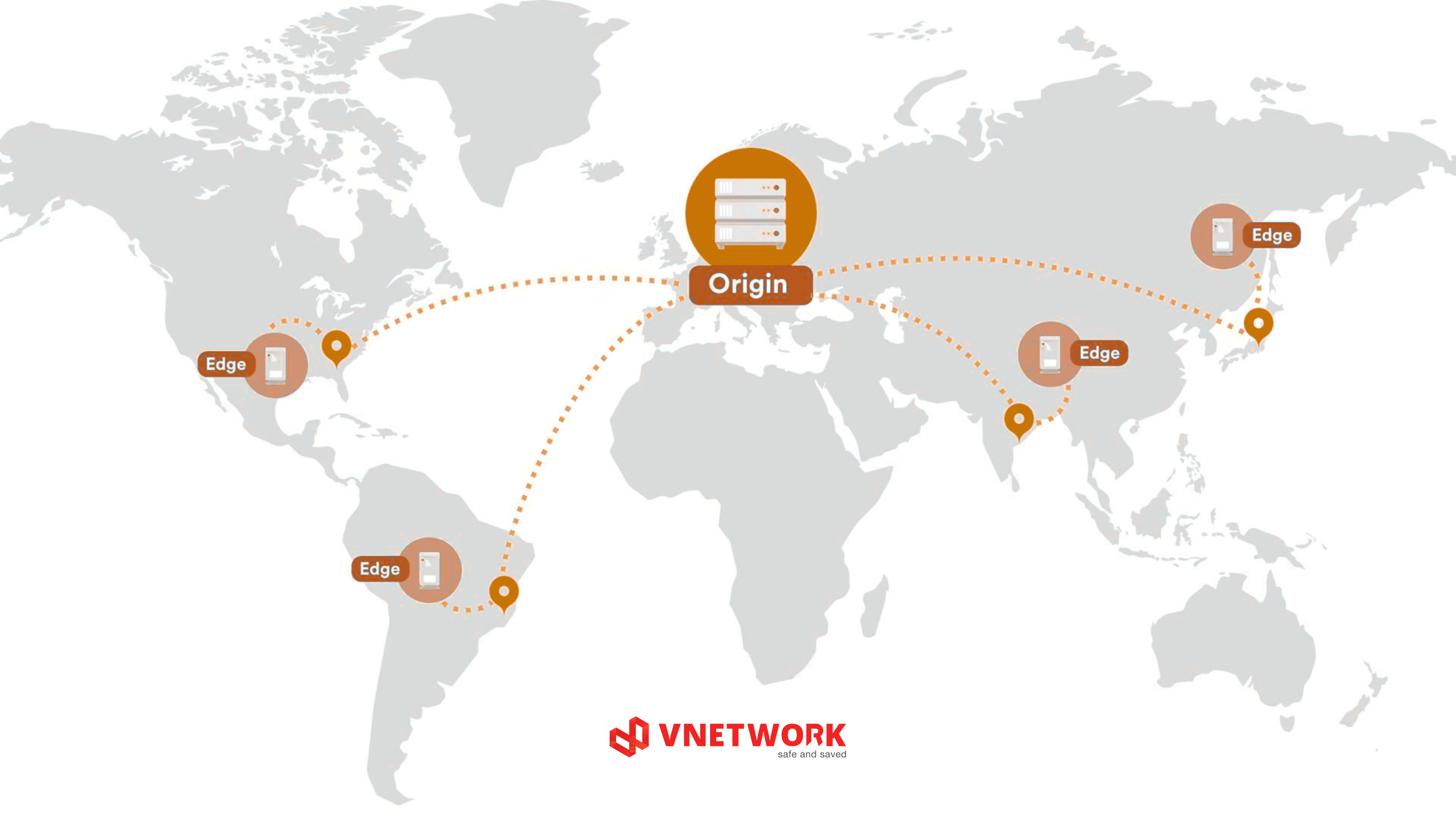
A content delivery network (CDN) is an effective layer of defense against volumetric attacks. Rather than routing all traffic to a single point, a CDN distributes it across hundreds of Points of Presence (PoPs) worldwide, preventing attackers from overwhelming the infrastructure at any single location. CDN infrastructure has the capacity to absorb far greater traffic volumes than the origin server of most businesses, enabling service continuity even during an active attack.
3.4 Deploying a WAF to filter malicious traffic at the application layer
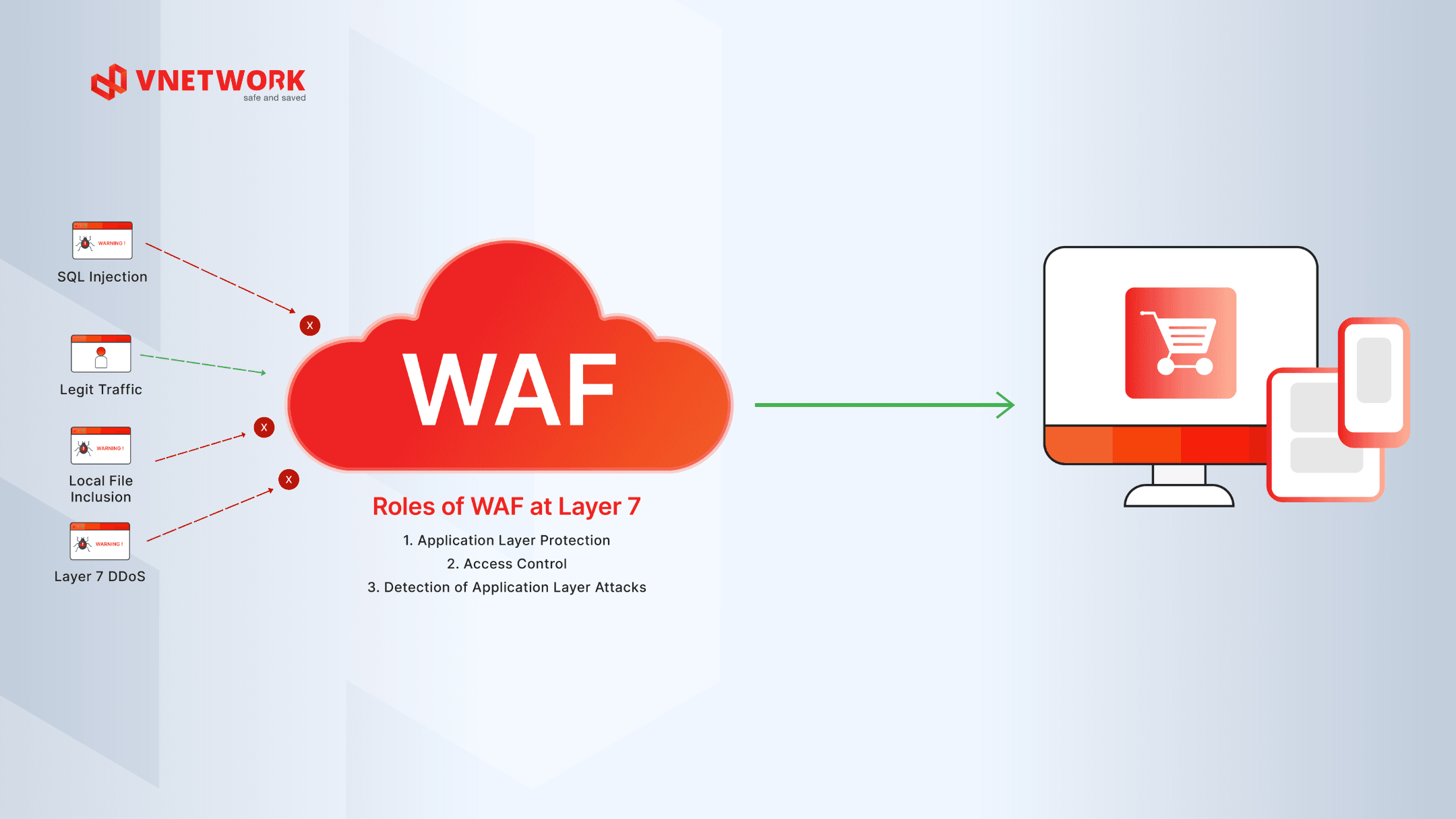
A Web Application Firewall (WAF) operates at the application layer, analyzing the content of each request to detect and block malicious traffic before it reaches the server. WAFs are especially effective against Layer 7 DDoS attacks such as HTTP Floods, because this type of attack simulates legitimate requests and cannot be stopped by IP filtering or bandwidth limiting alone. Next-generation WAFs integrate bot management capabilities, enabling them to distinguish between the behavior of attack bots, genuine users, and legitimate web crawlers.
3.5 Real-time traffic monitoring and early alert configuration
DDoS protection is not a one-time setup. Businesses need continuous monitoring systems to detect anomalies before they escalate into serious incidents. Set alert thresholds based on normal traffic baselines, configure automatic alerts when traffic spikes exceed those thresholds, and ensure the technical team receives immediate notifications through multiple channels. Real-time monitoring data also serves as critical evidence for post-incident analysis.
3.6 Building bandwidth contingency plans and failover procedures
Even with all layers of protection in place, businesses still need contingency plans for worst-case scenarios. These plans should include: bandwidth contingency arrangements with the Internet Service Provider (ISP) for rapid activation when needed, automatic load balancing to shift traffic to standby servers when the primary server is overloaded, and a clearly defined failover process that enables seamless system switchover without causing additional disruption to end users.
4. What to do when a DDoS attack occurs
4.1 Confirm the attack and activate the incident response plan
The first step is to confirm with certainty that this is a DDoS attack rather than a system error or a legitimate traffic spike. Review server logs, check real-time traffic monitoring, and compare against baseline. Once confirmed, immediately activate the incident response plan that was prepared in advance: notify the responsible parties, begin logging events, and switch to emergency response mode.
4.2 Coordinate with the ISP and upstream service providers
Contact the Internet Service Provider and the security solution provider immediately. The ISP can help filter traffic upstream before it enters the business's network, significantly reducing the load on internal infrastructure. If a dedicated anti-DDoS service is in use, activate enhanced protection mode and notify the provider's SOC team about the developing situation.
4.3 Communicate internally and with customers
While the technical team manages the incident, the communications team should proactively notify customers through channels that are still operational, such as email, social media, or a backup status page. Transparent and prompt communication with customers preserves far more trust than staying silent. Internally, ensure that relevant departments, including sales and customer support, are informed of the situation so they can coordinate their responses to incoming inquiries.
4.4 Collect evidence and conduct a post-incident review
Once the system has stabilized, gather and preserve all logs, packet captures, and monitoring data from the duration of the attack. This evidence is critical if the business intends to pursue legal action. Conduct a post-incident report to analyze root causes, evaluate the effectiveness of the response, and update the prevention plan for future incidents. For serious incidents, the business may consider filing a report with the relevant authorities pursuant to the Cybersecurity Law.
5. Criteria for selecting the right DDoS protection solution for your business
When evaluating and choosing a dedicated anti-DDoS solution, the following criteria warrant careful consideration:
- Bandwidth processing capacity: The solution's infrastructure must be large enough to absorb high-volume volumetric attacks without allowing traffic to overflow back to the origin server.
- Multi-layer protection: The solution must protect against both Layer 3/4 attacks (volumetric, protocol) and Layer 7 attacks (application layer), as real-world attacks typically combine multiple vectors simultaneously.
- Detection and response speed: The system must detect and begin blocking attacks in real time, not minutes later after damage has already occurred.
- Infrastructure located in Vietnam: In-country PoPs reduce latency and ensure that data is processed within Vietnamese territory, meeting local regulatory requirements.
- Compliance with domestic data storage regulations: The solution must meet the requirements of the Cybersecurity Law regarding storage and processing of data within Vietnamese territory, which is mandatory for financial, telecommunications, and healthcare sectors.
- Vietnamese-language support and local market expertise: When an incident occurs, a support team that speaks Vietnamese and understands Vietnam's network infrastructure significantly shortens coordination and resolution time.
- Clear SLA with defined compensation commitments: The provider must offer specific commitments regarding response times, uptime, and compensation in the event the SLA is not met.
- Flexible integration with existing infrastructure: The solution must be deployable on the cloud, on-premises, or hybrid environments the business already operates, without requiring a complete system overhaul.
6. VNIS - Comprehensive DDoS protection solution for businesses
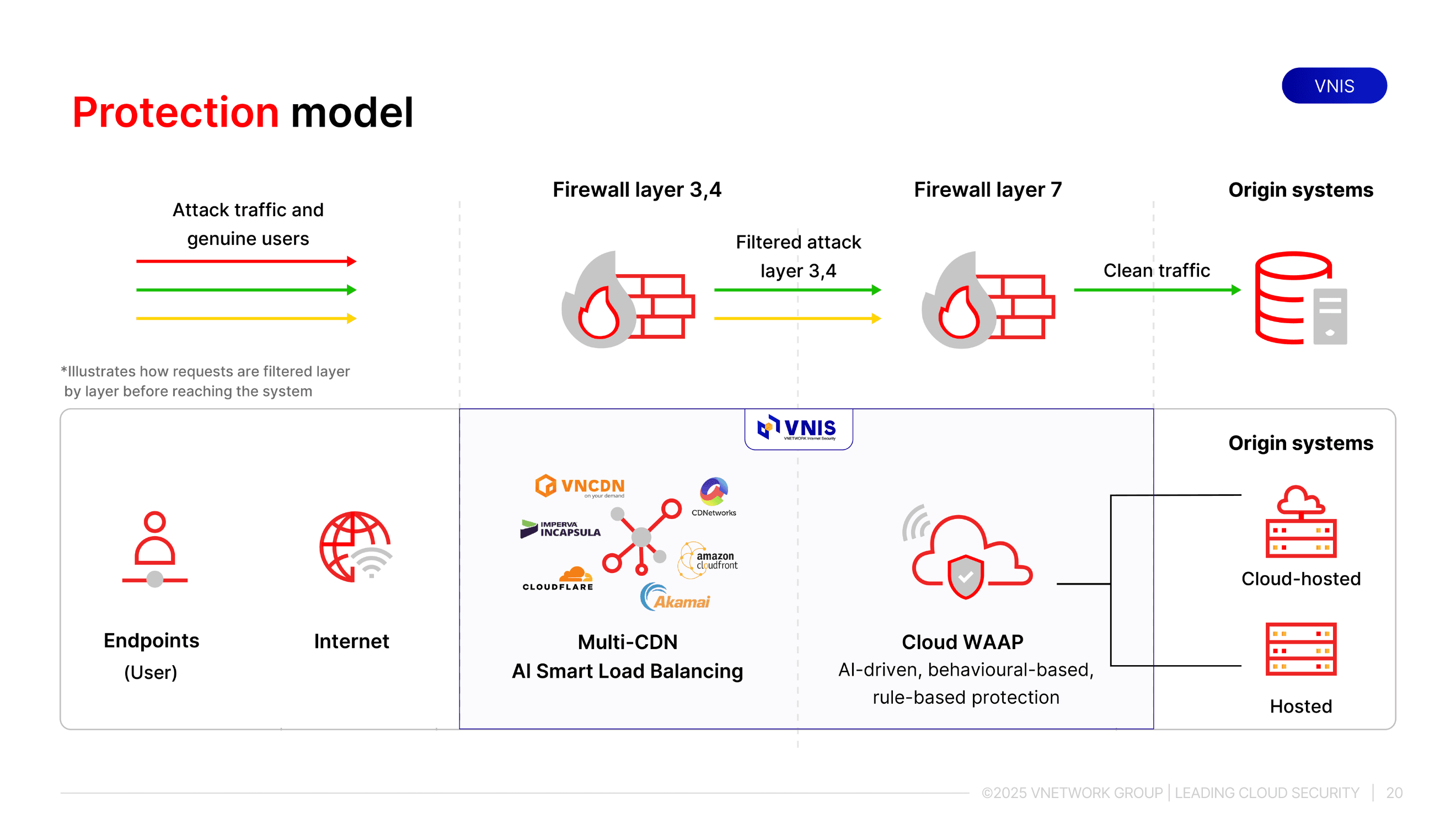
VNIS (VNETWORK Internet Security) is VNETWORK's Web/App/API security platform, developed by a company with over 13 years of experience in cybersecurity and network infrastructure in Vietnam. VNIS currently protects the systems of leading enterprises including MoMo, HSC, VPS, Vietcap, VieON, Coolmate, VOV, and thousands of other organizations. The platform provides real-time, multi-layer DDoS protection operating through a two-layer defense model:
- Layer 1: Multi-CDN with AI Smart Load Balancing: VNIS operates on a network of over 2,300 PoPs across more than 146 countries, with a total processing capacity of up to 2,600 Tbps. The system automatically absorbs and neutralizes volumetric DDoS attacks before malicious traffic reaches the origin server, while AI Smart Load Balancing continuously analyzes traffic behavior and routes it to the best-performing CDN node in real time.
- Layer 2: WAAP with integrated AI: Protects the application layer against Layer 7 DDoS, malicious bots, and vulnerabilities on the OWASP Top 10 list. The AI analyzes the behavior of each request, distinguishing legitimate traffic from attack requests even when they appear identical at the protocol level, which is a limitation that traditional filtering solutions cannot address.
Data is processed through PoPs located in Vietnam, ensuring low latency and compliance with domestic data storage requirements. VNETWORK's SOC team monitors systems 24/7, ready to coordinate incident response with Vietnamese-speaking engineers who understand the local market.
7. Conclusion
DDoS attack prevention is not a one-time task. It is an ongoing process that begins with basic server configuration, progresses to building layered infrastructure and application defenses, requires continuous monitoring, and demands a response plan prepared for worst-case scenarios. The more thoroughly a business prepares, the lower the damage when an incident occurs.
VNIS by VNETWORK helps businesses build a comprehensive DDoS protection framework, from the infrastructure layer to the application layer, backed by a 24/7 SOC monitoring team and infrastructure based in Vietnam. Contact VNETWORK for a DDoS protection consultation tailored to your system at vnetwork.vn/vnis.
FAQ: Frequently asked questions about DDoS attack prevention
1. Do small businesses need to worry about DDoS attacks?
Yes. Attackers do not exclusively target large corporations. Small and medium-sized businesses are often easier targets because their protective infrastructure is more limited. DDoS attacks against small businesses may stem from unfair competition, ransom demands, or simply technical experimentation. The cost of hiring a botnet to launch an attack is now very low, which has significantly lowered the barrier for potential attackers.
2. Is a regular firewall sufficient to defend against DDoS attacks?
Not sufficient for large-scale attacks. Traditional firewalls handle ordinary traffic well, but are easily overwhelmed by volumetric attacks running into hundreds of Gbps. Against Layer 7 DDoS attacks, a standard firewall cannot even distinguish malicious requests from legitimate ones because they appear identical at the protocol level. A combination of CDN, WAF, and real-time anomaly detection is required for effective protection.
3. How does Layer 7 DDoS differ from Layer 3/4 DDoS?
Layer 3/4 DDoS (volumetric) attacks by saturating bandwidth, sending massive volumes of traffic to congest network throughput. This type is easier to detect but requires substantial infrastructure to absorb. Layer 7 DDoS (application layer) targets the processing logic of the application, sending requests that appear legitimate but are designed to consume maximum server resources. This type uses less bandwidth but is far more difficult to differentiate and requires specialized behavioral analysis solutions such as AI WAF to block effectively.
4. Is DDoS protection legally required under Vietnamese regulations?
The Cybersecurity Law and its implementing decrees require businesses, particularly those in critical sectors such as finance, telecommunications, and energy, to implement measures to protect their information systems against cyber threats, including DDoS attacks. Additionally, the Personal Data Protection Law also sets requirements for protecting systems that process personal data from attacks that could result in data leakage or loss.
5. How can you check whether a system is currently under a DDoS attack?
A few basic checks: use server monitoring tools to observe CPU, RAM, and bandwidth in real time; review server access logs to detect high volumes of requests from the same IP range or the same user-agent string; use the netstat command to check the number of open connections; and monitor application response times via a monitoring tool. If multiple indicators appear abnormal simultaneously without a valid explanation, the situation warrants immediate investigation.
6. Should a business report a DDoS attack to the authorities?
For serious attacks that cause significant damage or target critical information systems, businesses should file a report with the Authority of Information Security (Ministry of Information and Communications) and the relevant authorities as required. Reporting helps agencies track attack trends, can facilitate investigation, and may support legal proceedings. Retaining all logs and evidence is a prerequisite for a report to carry any evidentiary value. Defense in depth is the recommended strategy for minimizing damage during and after an attack.