
1. VCLOUD
VNETWORK is the developer of VCLOUD, a cloud computing platform built specifically for the Vietnamese market, operating on a data center infrastructure certified to Tier III standards. VCLOUD delivers a full suite of virtualized resources (CPU, RAM, storage, network) on a flexible model, enabling businesses to deploy and operate IT infrastructure without investing in physical hardware.
VCLOUD's biggest differentiator from international cloud platforms is direct 24/7 Vietnamese-language technical support, without going through tickets or automated chatbots. Instead of waiting for responses as with overseas providers, businesses can immediately reach VNETWORK experts for real-time consultation, incident resolution, and technical assistance. This is a particularly important advantage for SMEs without a dedicated in-house IT team.
Key features of VCLOUD
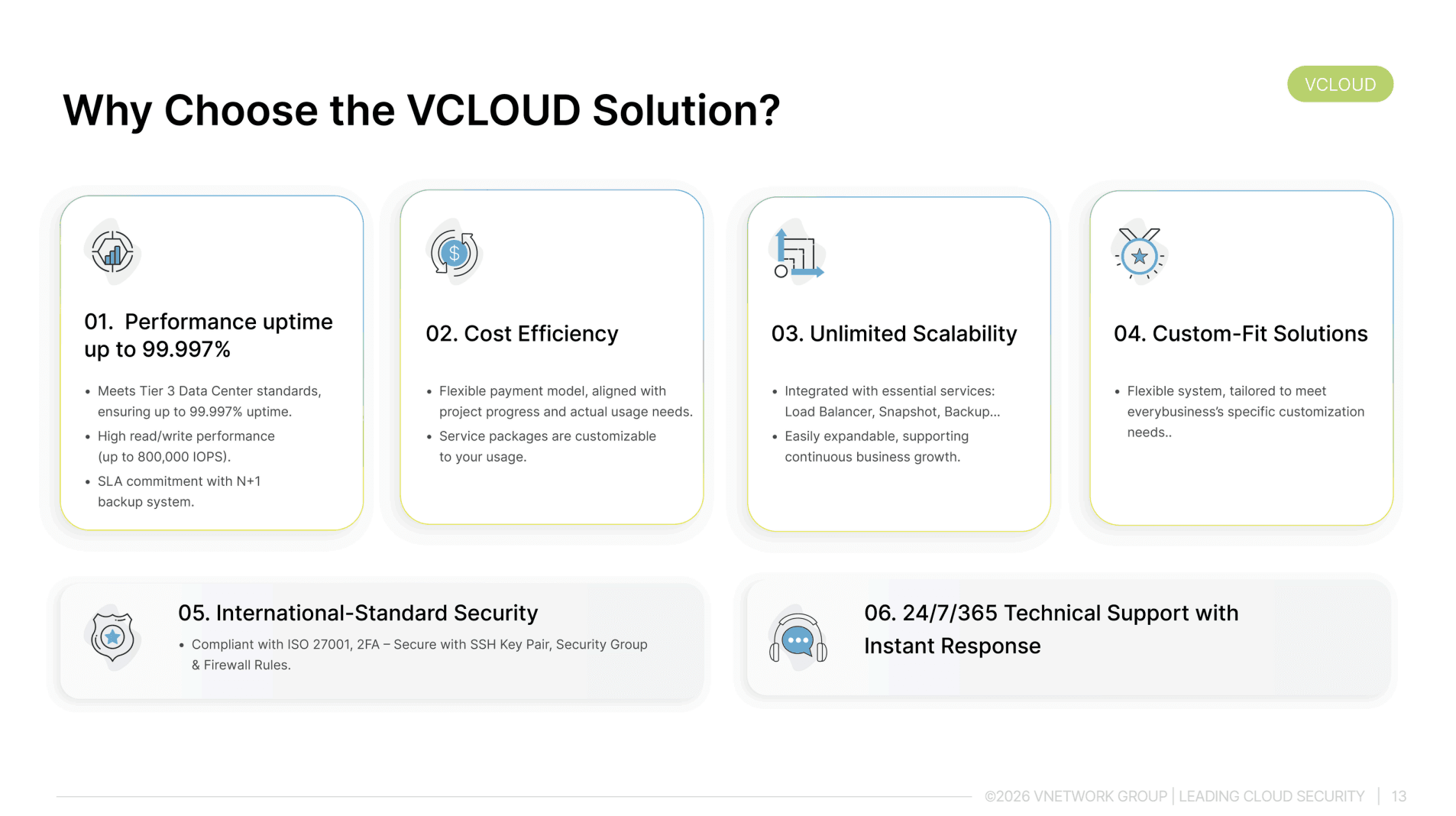
VCLOUD is designed to comprehensively meet the digital infrastructure needs of businesses, with 6 core strengths:
- Up to 99.997% performance: Tier III Data Center-certified infrastructure ensures 99.997% uptime and extremely high read/write speeds of 800,000 IOPS, suitable for systems requiring high continuity such as e-commerce, finance, and AI applications.
- Cost efficiency: A flexible payment model aligned with project progress and actual needs, with no fixed costs when resources are not in use. Service packages are tailored to specific requirements, suitable for both SMEs and large enterprises undergoing digital transformation.
- Unlimited scalability: Built-in essential services including Load Balancer, Snapshot, Backup, and unlimited resource expansion, supporting continuous business growth without architectural changes. Full Kubernetes support and modern container deployment are included.
- Tailored to your needs: A flexible system that easily accommodates any custom requirements for each business, from hardware configuration to operational environment setup. Manage all infrastructure intuitively via dashboard or API, with budget alerts and real-time resource monitoring.
- Comprehensive security to international standards: Full compliance with ISO 27001, 2FA, SSH Key Pair, Security Groups, and Firewall Rules ensure business data is protected across multiple independent layers. VCLOUD also integrates seamlessly with advanced cloud security solutions from the VNETWORK ecosystem.
- 24/7/365 technical support with instant response: A team of dedicated experts provides continuous, timely support via multiple channels including chat, hotline, and email, without going through tickets or automated chatbots as with international platforms. This is a particularly important advantage for businesses without a specialized IT team.
Domestic storage advantage and regulatory compliance
VCLOUD operates its entire infrastructure through data centers located within Vietnamese territory, ensuring that business data never leaves national borders. This allows VCLOUD to directly meet the requirements of the Personal Data Protection Law and increasingly stringent data localization regulations. Businesses have no need to worry about legal risks related to where user data is stored or processed, a factor that international cloud providers cannot fully guarantee when servers are located overseas.
Stable domestic cloud pricing amid international volatility
The global surge in AI demand is putting enormous pressure on hardware supply chains. RAM, SSD, GPU, and CPU prices have all risen as demand for AI data center construction skyrockets, driving up cloud rental costs from international providers. Meanwhile, VCLOUD maintains a stable pricing policy, helping Vietnamese businesses proactively control their operating budgets without being affected by exchange rate fluctuations or global hardware cost increases.
Best suited for: Businesses needing stable cloud infrastructure, reasonable costs, and 24/7 Vietnamese-language support; foreign companies with operations or user data in Vietnam that need to comply with local regulations; e-commerce systems, AI, and Big Data applications requiring rapid, continuous scaling.
2. Amazon Web Services (AWS)
Amazon Web Services is Amazon's cloud computing platform, offering over 200 cloud services covering all infrastructure needs from virtual computing, storage, databases, and networking to artificial intelligence and machine learning. AWS currently maintains infrastructure across multiple geographic regions worldwide, ensuring low latency for end users.
AWS's strength lies in its diverse service ecosystem and large support community. AWS is suitable for organizations that need to rapidly scale infrastructure, deploy microservices, or build complex AI applications at scale.
Note: AWS has a complex pricing structure and multiple service tiers, requiring businesses to have an experienced technical team to optimize costs and operate efficiently. Data is stored on international servers, so local regulatory compliance requirements in Vietnam should be reviewed.
3. Microsoft Azure
Microsoft Azure is Microsoft's cloud platform, deeply integrated with Office 365, Teams, Active Directory, and Dynamics 365. It is a natural choice for businesses already using the Microsoft ecosystem, enabling synchronized data and centralized access management.
Azure stands out for its hybrid cloud support, allowing businesses to run on-premises infrastructure and cloud workloads simultaneously. The platform also provides robust DevOps tools, security, and international compliance standards, suitable for large enterprises with high data control requirements.
Best suited for: Medium and large enterprises using Microsoft software; organizations needing to deploy hybrid cloud; technical teams familiar with the .NET and Windows Server environments.
4. Google Cloud Platform (GCP)
Google Cloud Platform is Google's cloud computing platform, built on global infrastructure that powers large services such as Search, Gmail, and YouTube. GCP excels in Big Data processing, advanced analytics, and AI model deployment through tools such as BigQuery, Vertex AI, and TensorFlow.
This platform is suitable for businesses that need real-time data analysis, machine learning model development, or serverless application building. GCP also provides high-speed network infrastructure through a network of submarine fiber optic cables and global PoP locations.
Note: GCP offers fewer traditional enterprise services than AWS and Azure, and its support community in Vietnam is still limited. Best suited for teams with expertise in data science and AI.
5. Alibaba Cloud
Alibaba Cloud is the cloud computing arm of the Alibaba Group, with strong presence in the Asian market, particularly in Southeast Asia and China. The platform offers a full range of services from virtual servers, object storage, and databases to AI solutions and security.
Alibaba Cloud is suitable for businesses that need to connect with the Chinese market or are looking for competitively priced cloud solutions in Asia. The platform provides basic Vietnamese-language support and has a Southeast Asia regional support team.
Best suited for: Import/export businesses trading with China; e-commerce platforms across Asia; startups needing flexible-cost cloud solutions with server regions close to Southeast Asia.
6. IBM Cloud Services
IBM Cloud provides cloud computing services with a focus on enterprise-grade security, regulatory compliance, and hybrid cloud support. IBM stands out with its Watson AI platform, which enables the integration of artificial intelligence into business operations, along with blockchain and data analytics solutions.
IBM Cloud is commonly chosen by financial institutions, banks, insurance companies, and government organizations because it meets strict compliance standards such as SOC 2, ISO 27001, and GDPR. IBM's hybrid cloud model allows businesses to keep sensitive data on private infrastructure while expanding to the public cloud when needed.
Best suited for: Financial institutions, banks, and insurance companies; businesses with strict regulatory compliance requirements; organizations that need AI/ML deeply integrated into internal operational workflows.
7. Tencent Cloud
Tencent Cloud is the cloud computing service of Tencent Group, built on infrastructure that serves billions of users across WeChat, QQ, and major gaming platforms. As a result, Tencent Cloud has a particular strength in handling high concurrent traffic, making it well-suited for gaming applications, online entertainment, and e-commerce.
Tencent Cloud offers a diverse range of services including CDN, security, databases, and AI, with coverage concentrated strongly in Asia. The platform supports multiple languages and offers competitive pricing compared to Western providers.
Best suited for: Game and entertainment businesses; live streaming and online video platforms; businesses needing to connect with the Chinese and Southeast Asian markets at competitive costs.
Comparison table: top 7 cloud computing services in 2026
The table below summarizes the key criteria to help businesses quickly identify the most suitable provider:
| Provider | Origin | Key strengths | Best suited for | Vietnamese support / VN legal compliance |
|---|---|---|---|---|
| VCLOUD | Vietnam | Tier III+, ISO 27001, 24/7 support | Enterprise, e-commerce, AI, Big Data | Full Vietnamese support, compliant with VN law |
| AWS | USA | 200+ services, broadest ecosystem | Enterprise, high-tech startups | Available, but servers located outside Vietnam |
| Microsoft Azure | USA | Hybrid cloud, Microsoft 365 integration | Businesses using Microsoft ecosystem | Regional support, servers outside Vietnam |
| Google Cloud | USA | Big Data, AI/ML, serverless | Data science teams, AI startups | Limited, servers outside Vietnam |
| Alibaba Cloud | China | Competitive pricing, strong in Asia | Businesses connected to Chinese market, e-commerce | Basic, SEA regional servers |
| IBM Cloud | USA | Enterprise security, Watson AI | Finance, banking, government | Limited, servers outside Vietnam |
| Tencent Cloud | China | Gaming, live streaming, high concurrency | Gaming, entertainment, businesses connecting to China | Basic, SEA regional servers |
What criteria help businesses choose the right cloud computing service?
No single cloud provider fits every business. Companies need to evaluate based on four key criteria below to make the most informed decision.
1. Pricing and payment models
Cloud computing services generally charge based on actual usage (pay-as-you-go), but each provider calculates costs differently. Businesses need to calculate the total cost of ownership (TCO), including resource fees, bandwidth fees, technical support costs, and workforce training expenses.
With international platforms, costs are typically quoted in USD and may fluctuate with exchange rates. Domestic solutions like VCLOUD typically publish prices in VND, making them more transparent and easier to manage for long-term budgeting.
2. Security and compliance standards
Cloud computing security is a factor that cannot be overlooked, especially when businesses store customer data, financial information, or sensitive operational data. Businesses should verify whether a provider complies with standards such as ISO 27001 and SOC 2, while also reviewing data encryption capabilities, access control, and 24/7 incident monitoring.
For businesses operating in Vietnam, particular attention should be paid to the Data Law 2024, which governs where data is stored and processed. Choosing a provider with servers located in Vietnam or one that fully complies with the domestic legal framework helps businesses avoid long-term legal risks.
3. Scalability and system integration
Cloud infrastructure needs to scale (scale up/scale out) flexibly to keep pace with business growth without causing disruption. Businesses need to evaluate maximum resource limits, the time required to scale, and the ability to automate this process.
Integration capabilities with existing systems such as ERP, CRM, and accounting software also need careful consideration. Platforms with full API support, clear documentation, and an active developer community make it easier for technical teams to deploy and operate.
4. Technical support and legal framework in Vietnam
Vietnamese-language technical support that is available 24/7 and accessible directly is an important factor for many small and medium-sized businesses. When incidents occur, response speed and support quality directly affect service continuity.
In addition, the SLA (Service Level Agreement) must include clear uptime commitments with compensation clauses for violations. Businesses should also check whether the provider has a representative office or authorized partner in Vietnam to ensure legal enforceability in the event of disputes.
Should businesses use domestic or international cloud?
The question of "domestic vs international cloud" has no absolute answer. The right decision depends on each business's scale, industry, level of regulatory compliance, and operational capabilities. The following framework helps businesses determine the most suitable direction.
1. When to prioritize domestic cloud
Domestic cloud is suitable for businesses that primarily operate in the Vietnamese market and need to comply with local regulations. Cases where domestic cloud should be prioritized include:
- Businesses storing personal data of Vietnamese users that need to comply with data localization requirements under the Personal Data Protection Law.
- SMEs that need 24/7 Vietnamese-language technical support and do not have a dedicated IT team to independently operate complex cloud infrastructure.
- Businesses that need to tightly control costs, prefer to pay in VND, and want to avoid exchange rate risks when international cloud costs rise due to global AI demand driving up hardware prices.
- Businesses that need clear legal commitments with a service provider that has an office in Vietnam, particularly in the fields of finance, healthcare, and e-commerce.
2. When to consider international cloud
International cloud is more suitable when businesses need to expand to global markets or require specialized services not yet available on domestic platforms:
- Businesses that need to deploy services simultaneously across multiple countries and require Points of Presence (PoP) located close to global users.
- Businesses with specialized technical teams that need a diverse range of services such as AI/ML, large-scale data analytics, or specific serverless capabilities only available on international platforms.
- Organizations deeply integrated into international software ecosystems (such as global enterprise management tools) that need cloud tightly synchronized with their existing infrastructure.
3. The hybrid model
Many Vietnamese businesses are adopting a hybrid model: storing sensitive data and serving domestic users on domestic cloud, while using international cloud for workloads that do not require in-country storage or need connectivity with global partners. This model ensures legal compliance while optimizing costs and performance according to each specific type of data and application.
Conclusion
In 2026, the cloud computing services market offers a wide range of options, from global platforms to domestic solutions optimized for Vietnamese businesses. No single provider suits everyone. What matters most is that businesses clearly define their actual needs around cost, performance, security, and regulatory compliance before making a choice.
FAQ - Frequently asked questions about cloud computing services
1. Which cloud computing service is best suited for enterprises in Vietnam?
For enterprises in Vietnam, VCLOUD is a suitable choice thanks to its 24/7 Vietnamese-language technical support, transparent VND pricing, Tier III infrastructure, and full compliance with the domestic legal framework. International platforms are more appropriate when businesses need global scale or have specialized technical teams.
2. Is cloud computing safe for business data?
Cloud computing is safe when businesses choose a provider with international security certifications such as ISO 27001 and SOC 2, along with end-to-end data encryption and strict access control. Security risks typically stem from misconfigurations or inadequate internal access management policies, not from the cloud infrastructure itself.
3. How are cloud service costs calculated?
Most cloud providers charge based on a pay-as-you-go model, meaning businesses only pay for the actual resources used, billed by the hour or month. Some providers also offer long-term commitment packages (reserved instances) with discounted rates compared to on-demand pricing, suitable for businesses with stable and predictable workloads.
4. Can businesses use multiple cloud providers at the same time?
Yes, the multi-cloud model allows businesses to use services from multiple providers simultaneously to optimize costs, avoid dependence on a single provider (vendor lock-in), and increase redundancy. However, managing a multi-cloud environment requires an experienced technical team and appropriate integrated monitoring tools.
5. How does VCLOUD differ from international cloud platforms?
VCLOUD is developed and operated in Vietnam, with infrastructure located domestically, 24/7 Vietnamese-language technical support, and compliance with Vietnamese Data Law and domestic regulations. VCLOUD is more suitable for businesses that need easy communication with their provider, control over data storage location, and cost optimization through transparent VND pricing, while international platforms are more appropriate for businesses with global-scale requirements.