
1. Why a WAF is a mandatory security layer for Fintech infrastructure
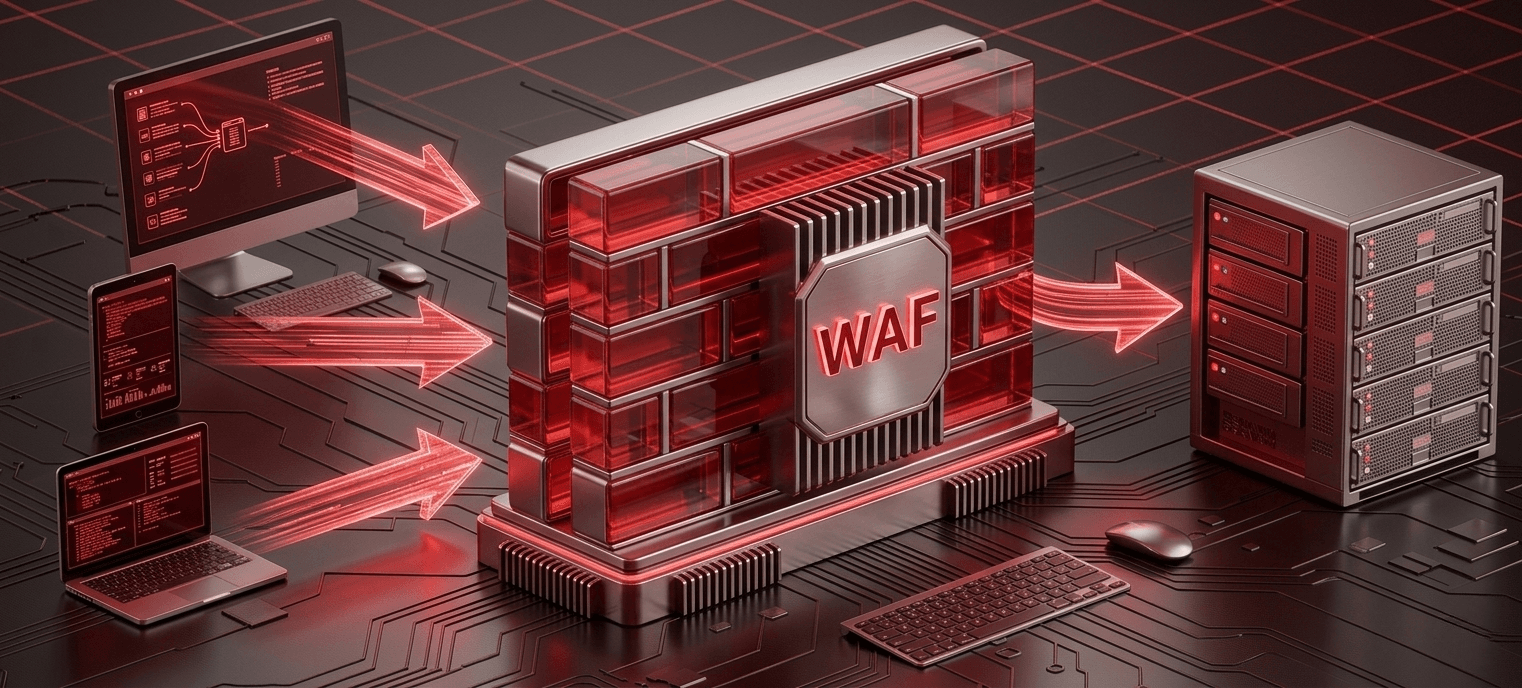
To protect the digital financial ecosystem, Fintech businesses typically deploy a WAF (web application firewall) that operates at Layer 7 (Application Layer) of the OSI model. Unlike a traditional firewall that only filters based on IP addresses and network ports, a WAF is capable of deeply analyzing the content of every HTTP/HTTPS request.
Before data flows reach a payment application, a central server, or a sensitive database, the WAF filters, monitors, and detects anomalous behavior. This allows the system to precisely identify and block sophisticated application-layer attacks, ensuring that the data stream remains clean and secure.
Fintech is an industry under extremely high pressure from cyberattacks for three core reasons:
- Financial data and customer information carry high value on underground markets.
- Fintech's API infrastructure is continually expanding to integrate with e-wallets, banks, and payment gateways, creating a larger attack surface than virtually any other industry.
- Real-time transactions require systems to remain highly available at all times, making businesses especially vulnerable to service-disruption attacks.
In the digital finance sector, a web application firewall is a mandatory security foundation for every business, not an optional add-on. Given that new features are released continuously, vulnerabilities that emerge when code moves to production are an ever-present risk, regardless of how rigorously a system was tested. A WAF acts as an immediate defensive checkpoint at the application layer, blocking real-time threats without requiring changes to existing infrastructure, ensuring the absolute safety of financial flows and transaction data.
2. Common attack types targeting Fintech
In Fintech, a small vulnerability can immediately translate into financial loss. To protect payment flows and user data, a WAF for Fintech must be capable of comprehensively blocking the specific threats described below:
2.1 Payment API attacks (API abuse and Broken Authentication)
Payment APIs are the connection point between a Fintech application and banks, payment gateways, and e-wallets. Attackers exploit Broken Authentication flaws to impersonate legitimate users, or abuse APIs without rate limits to automatically execute thousands of fraudulent transactions in a short period of time. A WAF protects payment APIs by validating request structures against predefined schemas, blocking malformed requests, and enforcing rate limits on sensitive endpoints.
2.2 SQL Injection and attacks on customer databases
SQL Injection is an attack technique in which a threat actor injects malicious SQL statements into application input fields to retrieve, modify, or delete data stored in the database. For a Fintech application, a successful SQL Injection attack can expose entire account records, balances, transaction histories, and personal details of thousands of customers, resulting in a serious data breach. A WAF detects and blocks SQL Injection by analyzing request content against a continuously updated rule set based on the OWASP Top 10.
2.3 Credential Stuffing and Brute Force account attacks
Credential Stuffing uses sets of leaked usernames and passwords from previous breaches to attempt mass logins against a Fintech application. The Brute Force technique tries every possible password combination to take over an account. Both attack types use automated bots to send thousands to millions of requests in a very short time. A WAF detects and blocks these behaviors through bot management mechanisms, bot fingerprint recognition, and login-failure frequency limits.
2.4 Layer 7 DDoS attacks targeting payment gateways
Layer 7 DDoS attacks simulate the behavior of real users to overwhelm application servers. Unlike traditional volumetric DDoS attacks, Layer 7 DDoS sends syntactically valid requests at extremely high frequency, taking down a payment gateway right during peak transaction hours. Attackers sometimes combine this with ransom DDoS to extort businesses. A WAF analyzes the behavior of each session and distinguishes legitimate requests from attacking bots, blocking precisely without impacting valid transactions.
2.5 Malicious bots scraping price data and manipulating transactions
On Fintech platforms offering investment, lending, or foreign exchange services, malicious bots continuously scrape pricing data to supply competitors or execute arbitrage trades. These bots consume server resources and distort the data displayed to real users. A WAF with bot management capabilities distinguishes legitimate crawlers (such as search engine bots) from malicious bots based on behavioral patterns, access frequency, and device fingerprints.

3. How a WAF helps Fintech meet security compliance standards
For the Fintech industry, establishing purely technical security layers is not enough, because businesses must also meet increasingly stringent domestic legal frameworks and international standards. In this context, a web application firewall plays a pivotal role as key technical proof of compliance, built on three core pillars:
- PCI-DSS v4.0: This is the mandatory security standard for any organization that processes payment card data. Specifically, Requirement 6.4.2 mandates that all public-facing web applications be protected by a web application firewall or equivalent automated mechanism to proactively detect and prevent attack vectors. Detailed log data from the WAF also serves as the indispensable audit evidence required to demonstrate ongoing compliance.
- ISO 27001:2022: This international information security governance framework requires organizations to comprehensively control system risks. Deploying a WAF serves as a critical technical control, directly satisfying the stringent requirements for Network Security (Annex A.8.20) and Application Security. Audit reports generated by the system directly support periodic assessment activities.
- Vietnamese law (Law No. 91/2025/QH15 on Personal Data Protection and Decree 13/2023/ND-CP): Taking effect from January 1, 2026, this law together with Decree 13 imposes strict penalties on companies operating in Vietnam regarding their obligations to protect user information. A WAF is the technology solution that enables Fintech companies to demonstrate to regulators that they have implemented adequate preventive and data protection measures, thereby minimizing legal risks and civil or criminal liability in the event of a security incident.
- Supporting the 5-tier information security compliance framework: A WAF is a core solution that helps Fintech businesses complete their multi-layered security architecture, with a direct impact on the highest tiers, Levels 3, 4, and 5.
4. Core capabilities required of a WAF system for Fintech
Beyond blocking basic web attacks, a WAF for Fintech must possess more advanced intervention capabilities at the application layer. Below are the essential features that help Fintech businesses keep their systems secure:
4.1 Deep API protection with API schema validation and rate limiting
Unlike traditional web protection, a WAF for Fintech must understand API structures in order to validate each request against a schema defined by the organization. API schema validation ensures that only requests with the correct format, HTTP method, and parameters are permitted through. Rate limiting per endpoint prevents payment API abuse without slowing down the experience for legitimate users.
4.2 Intelligent bot detection and blocking
Next-generation bot management analyzes behavior throughout an entire session, not just inspecting individual requests in isolation. The system builds behavioral profiles of real users in order to distinguish them from automated bots, even when those bots are programmed to simulate human behavior. For Fintech, this capability is critical because false positives (blocking real users by mistake) directly translate to lost transaction revenue.
4.3 Customizable rule engine for financial business logic
The OWASP Core Rule Set covers common threats, but Fintech businesses need to supplement it with custom rules tailored to their specific business logic. For example, a lending platform might configure a rule to block requests that modify a loan amount beyond a certain threshold within a short window of time. The ability to customize rules without degrading performance is a critical requirement when selecting a WAF for Fintech.
4.4 Scalability for traffic spikes
Financial transaction volumes are far from consistent over time. Traffic surges at the start of the month, at year-end, on IPO days, and during major promotional events. A WAF for Fintech must scale automatically to absorb sudden spikes without adding latency or downtime. Cloud WAF architecture handles this requirement far more effectively than fixed hardware appliances.
4.5 Real-time monitoring and alerting
A WAF must provide a dashboard that displays traffic, security events, and attack patterns in real time. When an anomaly is detected, the system must immediately alert both technical and security teams. Detailed logs from the WAF not only enable fast incident response but also serve as the documentation required for compliance audit activities.

5. Key considerations when selecting a WAF solution for Fintech
Choosing the wrong WAF can produce two opposing problems: insufficient protection leading to attack risk, or over-protection causing false positives that disrupt transactions. Below are the technical and business criteria to evaluate carefully before making a decision:
- Network infrastructure and local optimization: Choose a provider that owns a widely distributed PoP network. This advantage eliminates processing latency below 1ms, ensuring real-time financial transactions are always smooth and free from downtime even when international links experience issues.
- Expert team and 24/7 SOC: Prioritize solutions with a Security Operations Center running continuously. The collaboration of experienced specialists enables complex application attacks to be identified, isolated, and fully remediated in under 5 minutes, protecting business payment flows with absolute security.
- Flexible deployment model: Cloud WAF is well suited to fast-growing Fintech companies as it requires no hardware investment and costs scale with actual usage. Assess hybrid environment support if the organization runs both on-premise and cloud infrastructure.
- OWASP Core Rule Set support and customizability: The WAF must include a continuously updated OWASP rule set and allow the addition of custom rules tailored to business logic without degrading processing performance.
- False positive reduction: A high false positive rate is a real and serious problem for Fintech, as every erroneously blocked transaction is lost revenue. Require vendors to demonstrate their solution in a real test environment using the organization's own traffic data.
- High performance and low latency: The latency added by the WAF must be minimal (ideally below 1ms under normal conditions) so as not to impact user experience during real-time payment transactions.
- Reports and logs for audit compliance: The WAF must generate structured reports aligned with PCI-DSS and ISO 27001 requirements, including detailed logs of security events, source IPs, attack types, and actions taken.
- Integration with existing infrastructure: Assess the ability to integrate with SIEM, centralized logging systems, and current DevSecOps workflows to ensure the WAF operates in sync across the entire security ecosystem.
6. VNIS Cloud WAF by VNETWORK — the right choice for Vietnamese Fintech businesses
Founded in 2013, VNETWORK is proud to be Vietnam's leading provider of cybersecurity and digital infrastructure services, with more than 13 years of hands-on operational experience. Holding internationally recognized certifications including ISO/IEC 27001 and ISO/IEC 9001, VNETWORK is a trusted strategic partner for a wide range of large corporations, financial institutions, and Fintech companies in the domestic market. VNETWORK's reputation has been established through its proven ability to secure and optimize infrastructure for leading financial systems including MoMo, VPS, FireAnt, Shinhan Bank, VNDirect Securities, Bao Viet Insurance, BVBank, and many other reputable financial organizations. With a deep understanding of the operational mindset and unique security pressures of the industry, VNETWORK delivers the VNIS solution to help Fintech businesses optimize their defense systems comprehensively.
6.1 How VNIS works
VNIS is an integrated Web/App/API security and acceleration platform, designed to comprehensively protect Fintech applications against the threats analyzed throughout this article, from multi-layer DDoS attacks at Layers 3, 4, and 7, to SQL Injection, Credential Stuffing, and payment API abuse. The entire architecture and operational workflows of VNIS are built in accordance with ISO 27001 standards, ensuring that Fintech businesses can integrate VNIS directly into their existing information security management systems without creating compliance gaps.
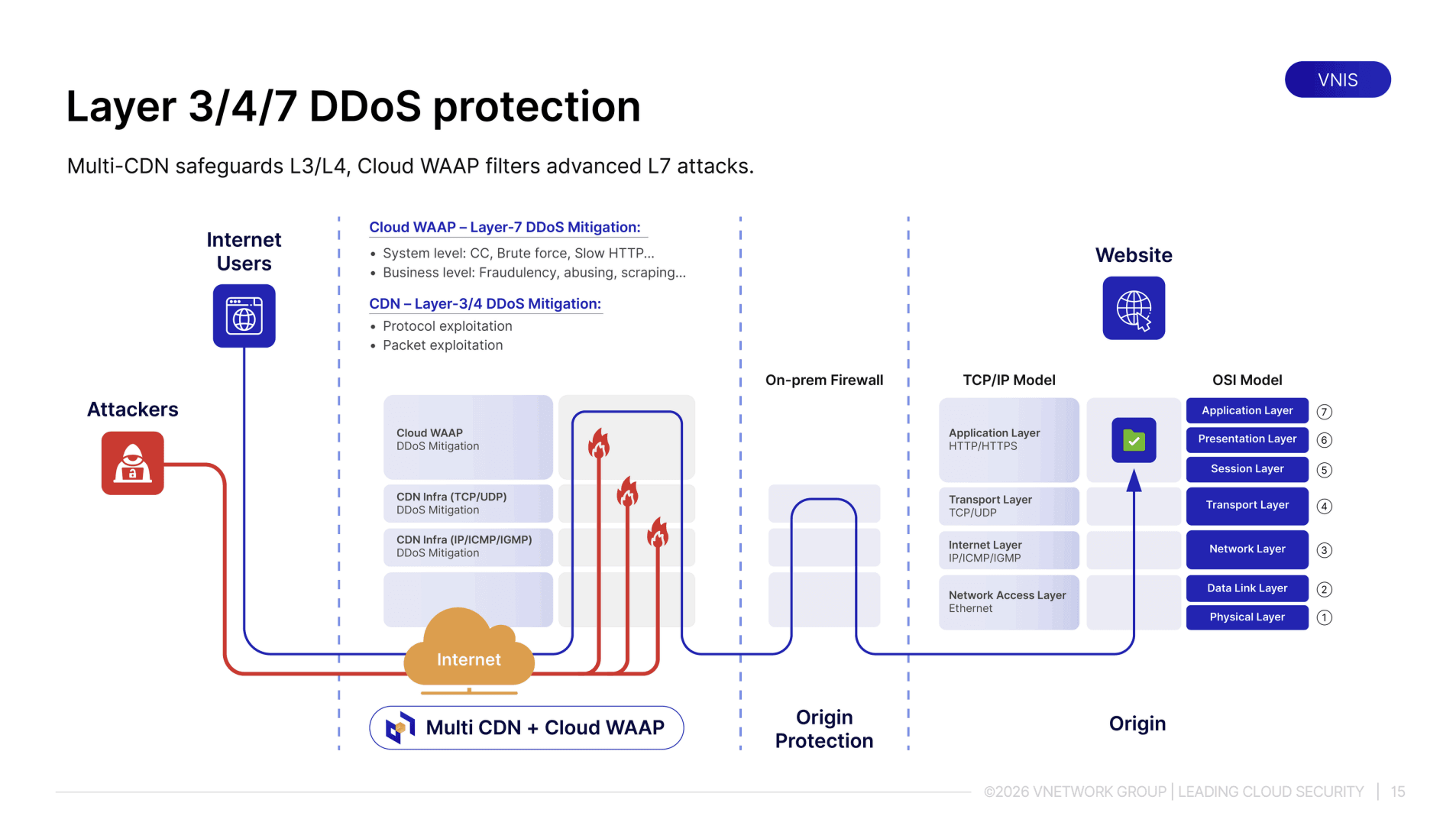
Fintech applications cannot be effectively protected by a single-layer solution. Today's attacks on Fintech typically combine multiple vectors simultaneously: while volumetric traffic assaults the network infrastructure, malicious HTTP requests quietly exploit payment API logic and automated bots execute Credential Stuffing against login portals. To address this holistically, VNIS deploys a two-layer protection model:
- Infrastructure-layer attack handling: An AI Smart Load Balancing mechanism combined with a global Multi-CDN system absorbs and distributes Layer 3/4 DDoS traffic before it reaches Fintech infrastructure. AI continuously analyzes traffic behavior, automatically distributes legitimate traffic, and eliminates anomalous sources without manual intervention. The system operates in real time, ensuring payment transactions continue without interruption even during an active attack.
- Application and API protection layer: VNIS deploys WAAP (Web Application and API Protection) powered by AI to analyze every request in real time, detect anomalous behavior, and block Layer 7 DDoS before it consumes application server resources. Intelligent rate limiting driven by behavioral analysis enables the system to distinguish real users from malicious bots even when they originate from the same IP address, satisfying the Zero Trust principles that financial organizations require. Security rules are continuously updated in line with the OWASP Top 10, while also protecting financial APIs against the sophisticated forms of abuse and exploitation described throughout this article.
When an incident occurs, VNETWORK's SOC works directly with the Fintech company's technical team to isolate the attack, analyze its root cause, and restore operations in the shortest possible time.
6.2 Case study: FireAnt
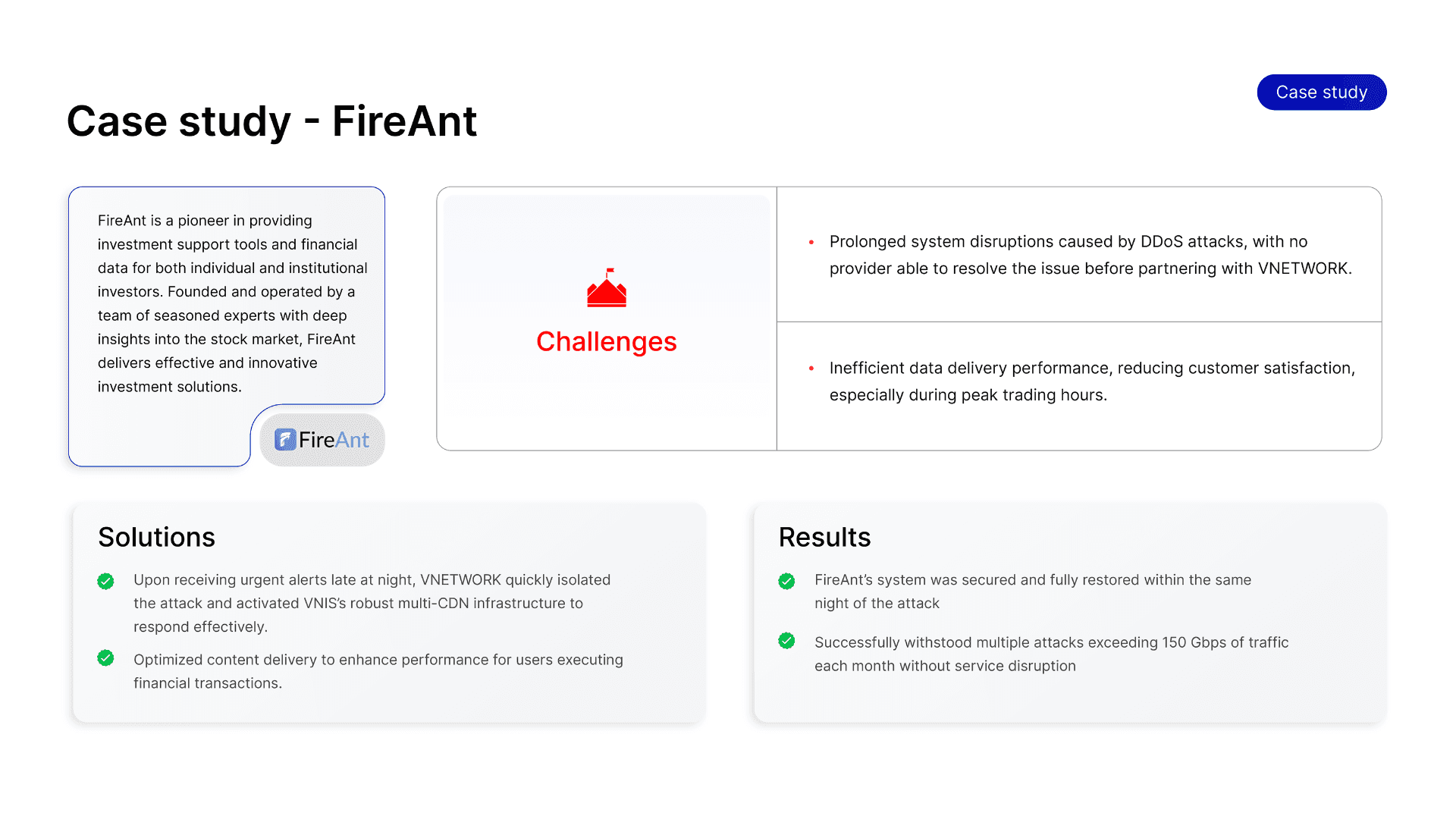
As a leading platform providing financial analysis tools and stock market data, FireAnt serves the continuous information needs of tens of thousands of individual and institutional investors. In the digital financial markets, even a single minute of downtime during trading hours can cause direct and serious harm to end users.
The biggest challenge FireAnt faced was repeated DDoS attacks that destabilized the system, combined with severe data transmission performance degradation during peak hours. When a large-scale nighttime attack occurred, VNETWORK's technical team and SOC immediately responded: fully activating the Multi-CDN infrastructure within the VNIS ecosystem to isolate and completely absorb the malicious traffic stream, while simultaneously optimizing routing to keep systems running safely through the night.
Key results achieved after deploying the VNIS solution:
- Rapid system recovery: The entire FireAnt platform was fully restored on the same night the incident occurred, ensuring no disruption affected the next morning's trading session.
- Outstanding capacity under attack: The system withstood continuous volumetric attack waves exceeding 150 Gbps per day, sustained for months on end, without the company needing to invest in any additional hardware upgrades.
- Eliminating peak-hour latency: Data transmission speeds were significantly improved during periods of high market volatility, where millisecond-level latency can determine the success or failure of an investment decision.
- Automated defense workflows: FireAnt's internal technical team was completely freed from the burden of manual incident response. The VNIS platform automatically handles all threats, backed by 24/7/365 monitoring from VNETWORK's SOC security specialists.
Conclusion
A WAF is no longer an optional choice — it is a mandatory protective layer for every Fintech business that takes security seriously. From blocking SQL Injection and preventing Credential Stuffing, to protecting payment APIs and supporting PCI-DSS compliance, a WAF provides comprehensive coverage of the specific risks the digital finance industry faces every day. Businesses that invest in a WAF are not only protecting their digital assets but also building customer trust and meeting the increasingly stringent demands of regulators.
If your Fintech business is evaluating a WAF solution or wants to assess its current level of protection, contact VNETWORK today for a consultation and to try VNIS Cloud WAF.
FAQ
1. How is a WAF for Fintech different from a standard WAF?
A WAF for Fintech is optimized to handle the specific requirements of the digital finance industry, including payment API protection with strict schema validation, integration with PCI-DSS compliance workflows, and the ability to scale instantly for transaction traffic spikes. A standard WAF primarily focuses on protecting websites and web applications using generic OWASP rule sets, without the deep customization layers required for financial business logic.
2. Is a WAF sufficient to protect a Fintech application, or are additional solutions needed?
A WAF is a critical protective layer at the Application Layer but needs to be combined with other solutions as part of a multi-layered security strategy. A comprehensive security model for Fintech should include network-layer DDoS protection, strong access controls (authentication and authorization), data encryption both at rest and in transit, and regular security review processes. A WAF works most effectively as part of a comprehensive security system following the Defense in Depth principle.
3. What does PCI-DSS require of Fintech businesses regarding WAF?
PCI-DSS v4.0 under Requirement 6.4.2 mandates that all web applications exposed to public networks must be protected by a WAF or equivalent web application security solution capable of detecting and preventing web-based attacks. The WAF must operate in active mode (blocking immediately, not just detecting), be capable of updating rules when new threats emerge, and generate comprehensive logs to meet audit requirements.
4. How can you tell if a WAF is working effectively in a Fintech environment?
A business can evaluate WAF effectiveness through three key metrics. First, the false positive rate (legitimate transactions blocked in error) must be low and must not generate complaints from real users. Second, the WAF must detect and fully log real attacks, validated through periodic penetration tests. Third, the dashboard must display the number of requests blocked by attack type, enabling the security team to recognize attack patterns being directed at the system.
5. Is Cloud WAF suitable for fast-growing Fintech companies?
Cloud WAF is particularly well suited to fast-growing Fintech for two reasons. First, the Cloud WAF model scales automatically with traffic without manual intervention or hardware upgrade investments each time the business launches a new product or expands into new markets. Second, the pay-as-you-go pricing model helps early-stage businesses manage their budgets effectively while still having enterprise-grade protection when needed.